Tang Fei, Zheng Pan
Division of Immunotherapy, Institute of Human Virology and Department of Surgery, University of Maryland School of Medicine, 725 W Lombard Street, Baltimore, MD 21201 USA.
Cell Biosci. 2018 May 2;8:34. doi: 10.1186/s13578-018-0232-4. eCollection 2018.
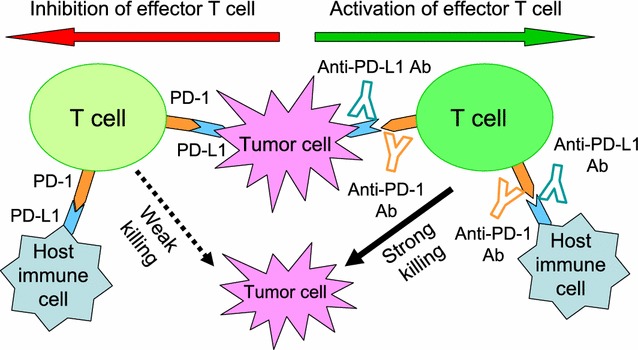
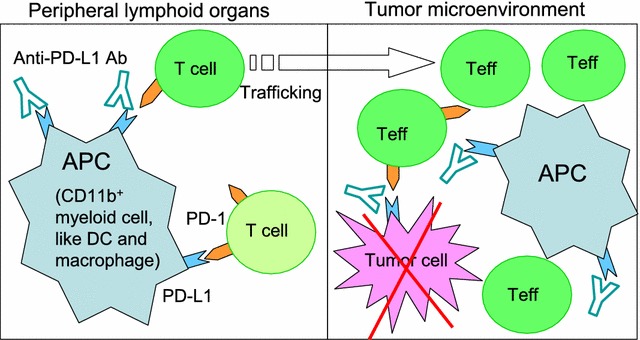
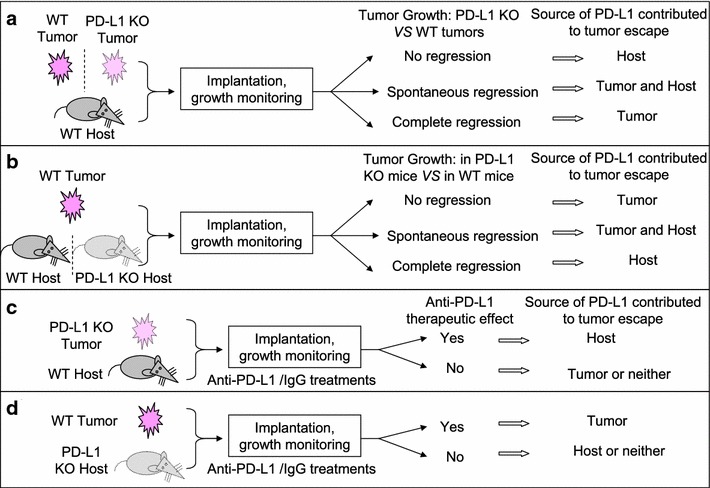
Antibody blockade of the PD-1/PD-L1 pathway has elicited durable antitumor responses in the therapy of a broad spectrum of cancers. PD-L1 is constitutively expressed in certain tumors and host immune cells, and its expression can be induced or maintained by many factors. The expression of PD-L1 on tumor tissues has been reported to be positively correlated with the efficacy of anti-PD-1/PD-L1 therapy in patients. However, multiple clinical trials indicate that patients with PD-L1-negative tumors also respond to this blockade therapy, which suggests the potential contribution of PD-L1 from host immune cells. Recently, six articles independently evaluated and verified the contributions of PD-L1 from tumor versus non-tumor cells in various mouse tumor models. These studies confirmed that PD-L1 on either tumor cells or host immune cells contributes to tumor escape, and the relative contributions of PD-L1 on these cells seem to be context-dependent. While both tumor- and host-derived PD-L1 can play critical roles in immune suppression, differences in tumor immunogenicity appear to underlie their relative importance. Notably, these reports highlight the essential roles of PD-L1 from host myeloid cells in negatively regulating T cell activation and limiting T cell trafficking. Therefore, comprehensive evaluating the global PD-L1 expression, rather than monitoring PD-L1 expression on tumor cells alone, should be a more accurate way for predicting responses in PD-1/PD-L1 blockade therapy in cancer patients.
对PD-1/PD-L1通路进行抗体阻断已在多种癌症治疗中引发了持久的抗肿瘤反应。PD-L1在某些肿瘤和宿主免疫细胞中组成性表达,其表达可由多种因素诱导或维持。据报道,肿瘤组织上PD-L1的表达与患者抗PD-1/PD-L1治疗的疗效呈正相关。然而,多项临床试验表明,PD-L1阴性肿瘤患者也对这种阻断疗法有反应,这提示宿主免疫细胞来源的PD-L1可能发挥了作用。最近,六篇文章在各种小鼠肿瘤模型中独立评估并验证了肿瘤细胞与非肿瘤细胞来源的PD-L1的作用。这些研究证实,肿瘤细胞或宿主免疫细胞上的PD-L1均有助于肿瘤逃逸,且这些细胞上PD-L1的相对作用似乎取决于具体情况。虽然肿瘤来源和宿主来源的PD-L1在免疫抑制中均可发挥关键作用,但肿瘤免疫原性的差异似乎是它们相对重要性的基础。值得注意的是,这些报告强调了宿主髓样细胞来源的PD-L1在负向调节T细胞活化和限制T细胞迁移方面的重要作用。因此,全面评估整体PD-L1表达,而非仅监测肿瘤细胞上的PD-L1表达,应该是预测癌症患者PD-1/PD-L1阻断治疗反应的更准确方法。