
尿肌酐排泄率测定的移植后肌肉量可预测肝移植后的长期结局。
Posttransplant muscle mass measured by urinary creatinine excretion rate predicts long-term outcomes after liver transplantation.
机构信息
Division of Nephrology, Department of Internal Medicine, University of Groningen, University Medical Center Groningen, Groningen, The Netherlands.
Department of Gastroenterology and Hepatology, University Medical Center Groningen, Groningen, The Netherlands.
出版信息
Am J Transplant. 2019 Feb;19(2):540-550. doi: 10.1111/ajt.14926. Epub 2018 Jun 3.
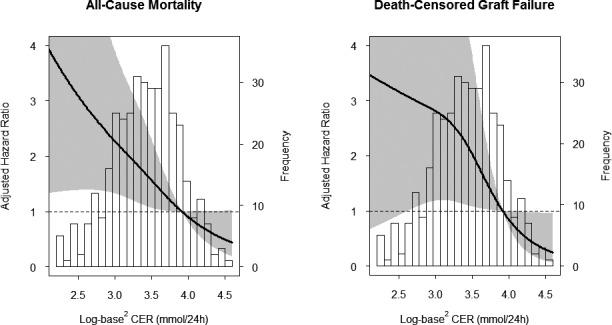
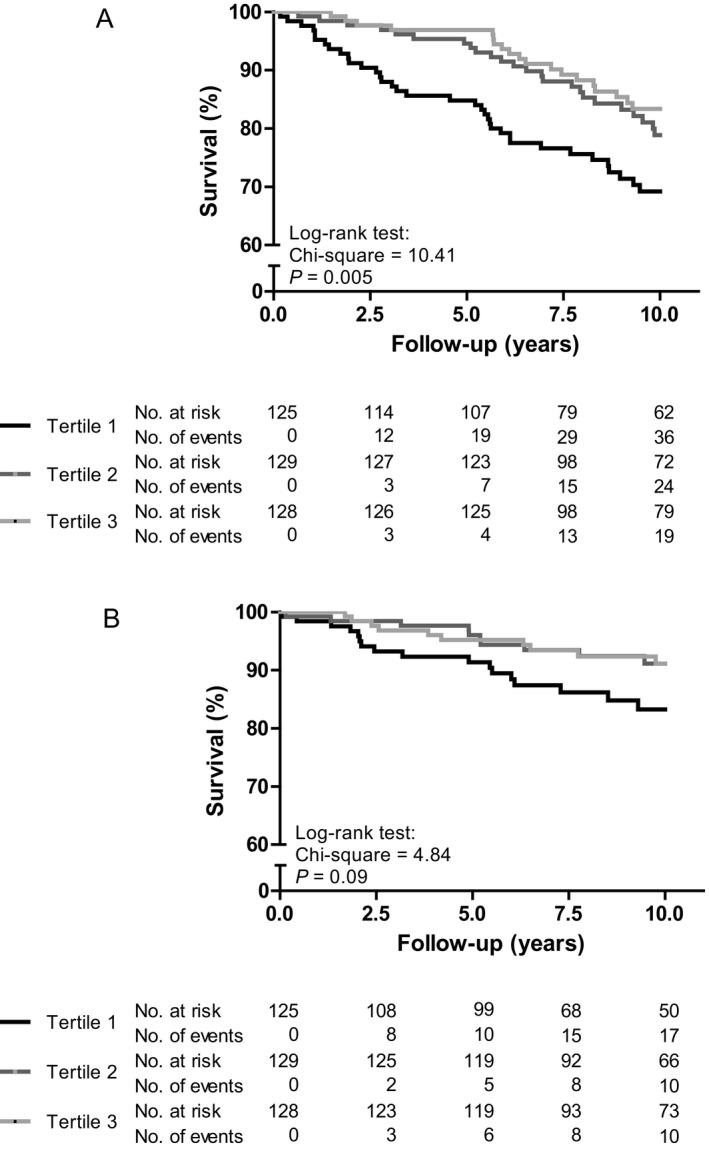
Long-term survival in orthotopic liver transplant (OLT) recipients remains impaired because of many contributing factors, including a low pretransplant muscle mass (or sarcopenia). However, influence of posttransplant muscle mass on survival is currently unknown. We hypothesized that posttransplant urinary creatinine excretion rate (CER), an established noninvasive marker of total body muscle mass, is associated with long-term survival after OLT. In a single-center cohort study of 382 adult OLT recipients, mean ± standard deviation CER at 1 year posttransplantation was 13.3 ± 3.7 mmol/24 h in men and 9.4 ± 2.6 mmol/24 h in women. During median follow-up for 9.8 y (interquartile range 6.4-15.0 y), 104 (27.2%) OLT recipients died and 44 (11.5%) developed graft failure. In Cox regression analyses, as continuous variable, low CER was associated with increased risk for mortality (HR = 0.43, 95% CI: 0.26-0.71, P = .001) and graft failure (HR = 0.42, 95% CI: 0.20-0.90, P = .03), independent of age, sex, and body surface area. Similarly, OLT recipients in the lowest tertile had an increased risk for mortality (HR = 2.69; 95% CI: 1.47-4.91, P = .001) and graft failure (HR = 2.77, 95% CI: 1.04-7.39, P = .04), compared to OLT recipients in the highest tertile. We conclude that 1 year posttransplant low total body muscle mass is associated with long-term risk of mortality and graft failure in OLT recipients.
原位肝移植(OLT)受者的长期存活率仍然受到多种因素的影响,包括移植前肌肉量低(或肌少症)。然而,目前尚不清楚移植后肌肉量对存活率的影响。我们假设移植后尿肌酐排泄率(CER)是一种已建立的全身肌肉量的非侵入性标志物,与 OLT 后的长期存活率有关。在一项对 382 例成人 OLT 受者的单中心队列研究中,男性和女性在移植后 1 年的平均±标准差 CER 分别为 13.3±3.7mmol/24h 和 9.4±2.6mmol/24h。在中位数为 9.8 年(四分位距 6.4-15.0 年)的随访期间,104 例(27.2%)OLT 受者死亡,44 例(11.5%)发生移植物衰竭。在 Cox 回归分析中,作为连续变量,低 CER 与死亡率增加相关(HR=0.43,95%CI:0.26-0.71,P=0.001)和移植物衰竭(HR=0.42,95%CI:0.20-0.90,P=0.03),独立于年龄、性别和体表面积。同样,与最高三分位组的 OLT 受者相比,最低三分位组的 OLT 受者死亡率(HR=2.69;95%CI:1.47-4.91,P=0.001)和移植物衰竭(HR=2.77,95%CI:1.04-7.39,P=0.04)的风险增加。我们的结论是,OLT 受者移植后 1 年全身肌肉量低与长期死亡率和移植物衰竭风险相关。
 Zotero 插件