INSERM, UMR_S 1197, Hôpital Paul Brousse, Villejuif, France.
Université Paris-Saclay, Paris, France.
Front Immunol. 2018 Apr 26;9:853. doi: 10.3389/fimmu.2018.00853. eCollection 2018.
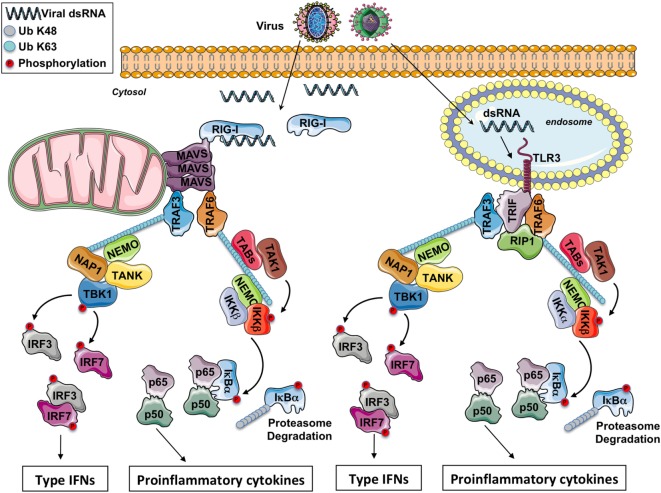
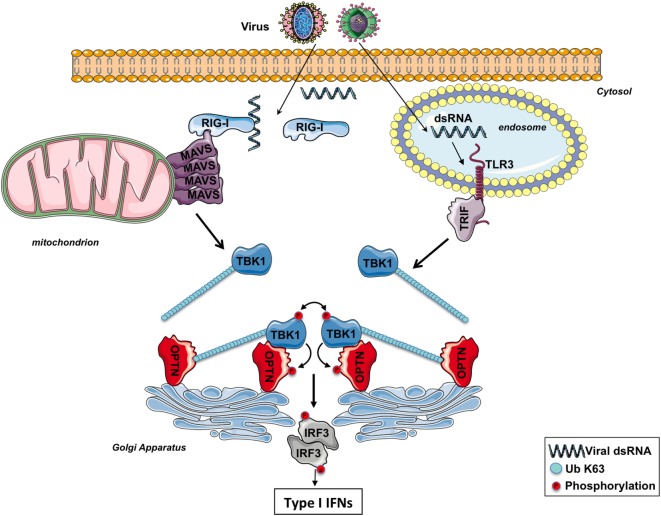
After a viral infection and the stimulation of some pattern-recognition receptors as the toll-like receptor 3 in the endosomes or the RIG-I-like receptors in the cytosol, activation of the IKK-related kinase TBK1 leads to the production of type I interferons (IFNs) after phosphorylation of the transcription factors IRF3 and IRF7. Recent findings indicate an involvement of K63-linked polyubiquitination and of the Golgi-localized protein optineurin (OPTN) in the activation of this crucial kinase involved in innate antiviral immunity. This review summarizes the sensing of viruses and the signaling leading to type I IFN production following TBK1 activation through its ubiquitination and the sensing of ubiquitin chains by OPTN at the Golgi apparatus.
在病毒感染后,内体中的 Toll 样受体 3 或细胞质中的 RIG-I 样受体等模式识别受体被激活,IKK 相关激酶 TBK1 被激活,导致转录因子 IRF3 和 IRF7 磷酸化后产生 I 型干扰素(IFN)。最近的研究结果表明,K63 连接的多聚泛素化和高尔基定位蛋白 optineurin(OPTN)参与了这种在先天抗病毒免疫中起关键作用的激酶的激活。本综述总结了通过 TBK1 的泛素化及其在高尔基体内通过 OPTN 对泛素链的感应来感知病毒以及导致 I 型 IFN 产生的信号转导。