Unit of Nutrition and Cancer, Cancer Epidemiology Research Program, Catalan Institute of Oncology (ICO), Bellvitge Biomedical Research Institute (IDIBELL), Av Gran Via 199-203, 08908, L'Hospitalet De Llobregat, Barcelona, Spain.
Nutrition and Metabolism Section, International Agency for Research on Cancer (IARC), Lyon, France.
Eur J Epidemiol. 2018 Nov;33(11):1063-1075. doi: 10.1007/s10654-018-0408-6. Epub 2018 May 15.
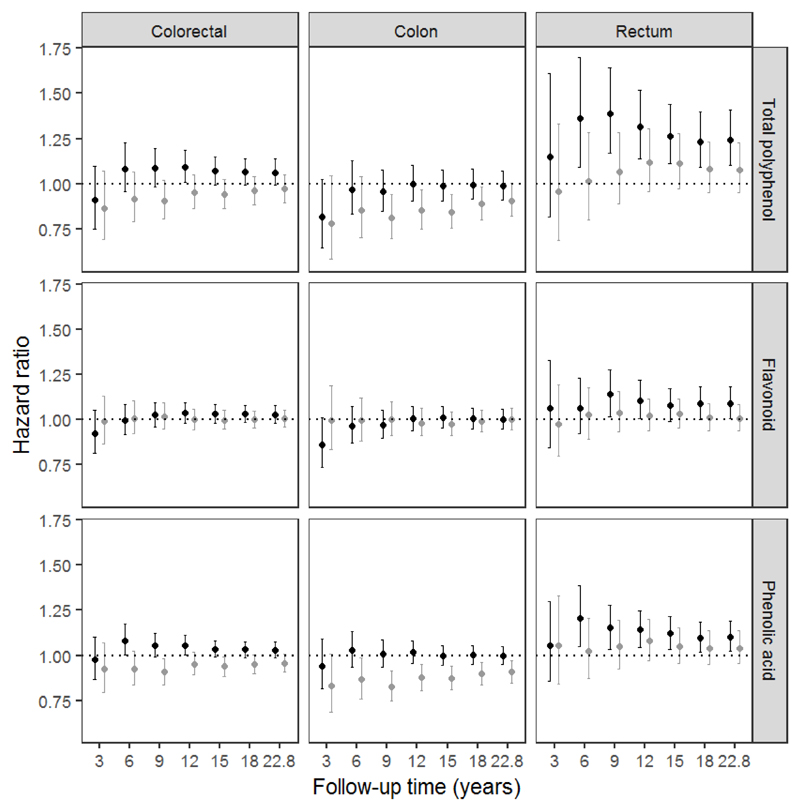
Polyphenols may play a chemopreventive role in colorectal cancer (CRC); however, epidemiological evidence supporting a role for intake of individual polyphenol classes, other than flavonoids is insufficient. We evaluated the association between dietary intakes of total and individual classes and subclasses of polyphenols and CRC risk and its main subsites, colon and rectum, within the European Prospective Investigation into Cancer and Nutrition (EPIC) study. The cohort included 476,160 men and women from 10 European countries. During a mean follow-up of 14 years, there were 5991 incident CRC cases, of which 3897 were in the colon and 2094 were in the rectum. Polyphenol intake was estimated using validated centre/country specific dietary questionnaires and the Phenol-Explorer database. In multivariable-adjusted Cox regression models, a doubling in total dietary polyphenol intake was not associated with CRC risk in women (HR = 1.06, 95% CI 0.99-1.14) or in men (HR = 0.97, 95% CI 0.90-1.05), respectively. Phenolic acid intake, highly correlated with coffee consumption, was inversely associated with colon cancer in men (HR = 0.91, 95% CI 0.85-0.97) and positively associated with rectal cancer in women (HR = 1.10, 95% CI 1.02-1.19); although associations did not exceed the Bonferroni threshold for significance. Intake of other polyphenol classes was not related to colorectal, colon or rectal cancer risks. Our study suggests a possible inverse association between phenolic acid intake and colon cancer risk in men and positive with rectal cancer risk in women.
多酚可能在结直肠癌(CRC)中发挥化学预防作用;然而,支持除类黄酮以外的单个多酚类别的摄入量与 CRC 之间存在关联的流行病学证据不足。我们评估了欧洲癌症与营养前瞻性调查(EPIC)研究中总摄入量和个体类别和亚类的多酚与 CRC 风险及其主要亚部位(结肠和直肠)之间的关联。该队列包括来自 10 个欧洲国家的 476160 名男性和女性。在平均 14 年的随访期间,有 5991 例 CRC 病例,其中 3897 例发生在结肠,2094 例发生在直肠。多酚的摄入量是使用经过验证的中心/国家特定的饮食问卷和 Phenol-Explorer 数据库来估计的。在多变量调整的 Cox 回归模型中,女性(HR=1.06,95%CI 0.99-1.14)或男性(HR=0.97,95%CI 0.90-1.05)中总膳食多酚摄入量增加一倍与 CRC 风险无关。与咖啡消费高度相关的酚酸摄入量与男性结肠癌呈负相关(HR=0.91,95%CI 0.85-0.97),与女性直肠癌呈正相关(HR=1.10,95%CI 1.02-1.19);尽管这些关联没有超过 Bonferroni 显著性阈值。其他多酚类别的摄入量与结直肠癌、结肠癌或直肠癌风险无关。我们的研究表明,男性酚酸摄入量与结肠癌风险之间可能存在反比关系,而女性直肠癌风险呈正相关。