Qutob Sami S, Chauhan Vinita, Kuo Byron, Williams Andrew, Yauk Carole L, McNamee James P, Gollapudi B
Consumer and Clinical Radiation Protection Bureau, Health Canada, Ottawa, Ontario, K1A 1C1, Canada.
Environmental Health Science and Research Bureau, Health Canada, Ottawa, Ontario, Canada.
Environ Mol Mutagen. 2018 Jul;59(6):502-515. doi: 10.1002/em.22196. Epub 2018 May 15.
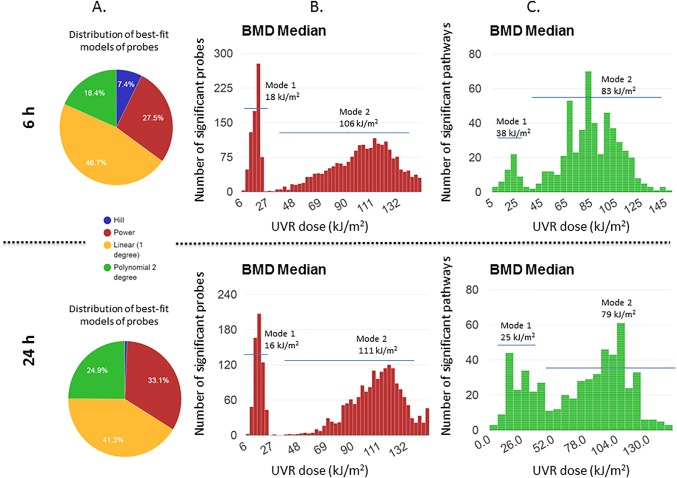
Considerable data has been generated to elucidate the transcriptional response of cells to ultraviolet radiation (UVR) exposure providing a mechanistic understanding of UVR-induced cellular responses. However, using these data to support standards development has been challenging. In this study, we apply benchmark dose (BMD) modeling of transcriptional data to derive thresholds of gene responsiveness following exposure to solar-simulated UVR. Human epidermal keratinocytes were exposed to three doses (10, 20, 150 kJ/m ) of solar simulated UVR and assessed for gene expression changes 6 and 24 hr postexposure. The dose-response curves for genes with p-fit values (≥ 0.1) were used to derive BMD values for genes and pathways. Gene BMDs were bi-modally distributed, with a peak at ∼16 kJ/m and ∼108 kJ/m UVR exposure. Genes/pathways within Mode 1 were involved in cell signaling and DNA damage response, while genes/pathways in the higher Mode 2 were associated with immune response and cancer development. The median value of each Mode coincides with the current human exposure limits for UVR and for the minimal erythemal dose, respectively. Such concordance implies that the use of transcriptional BMD data may represent a promising new approach for deriving thresholds of actinic effects. Environ. Mol. Mutagen. 59:502-515, 2018. © 2018 The Authors Environmental and Molecular Mutagenesis published by Wiley Periodicals, Inc. on behalf of Environmental Mutagen Society.
为了阐明细胞对紫外线辐射(UVR)暴露的转录反应,已经产生了大量数据,从而对UVR诱导的细胞反应有了机制上的理解。然而,利用这些数据来支持标准制定一直具有挑战性。在本研究中,我们应用转录数据的基准剂量(BMD)建模来推导暴露于太阳模拟UVR后基因反应性的阈值。将人类表皮角质形成细胞暴露于三种剂量(10、20、150 kJ/m²)的太阳模拟UVR下,并在暴露后6小时和24小时评估基因表达变化。使用p拟合值(≥0.1)的基因剂量反应曲线来推导基因和通路的BMD值。基因BMD呈双峰分布,在UVR暴露约16 kJ/m²和约108 kJ/m²处出现峰值。模式1中的基因/通路参与细胞信号传导和DNA损伤反应,而较高的模式2中的基因/通路与免疫反应和癌症发展相关。每个模式的中值分别与当前UVR的人类暴露限值和最小红斑剂量一致。这种一致性意味着使用转录BMD数据可能代表一种推导光化效应阈值的有前途的新方法。《环境与分子诱变》59:502 - 515,2018年。© 2018作者。《环境与分子诱变》由威利期刊公司代表环境诱变协会出版。