Queen's University School of Medicine, Kingston, ON, Canada.
The Institute for Clinical Evaluative Sciences, Toronto, ON, Canada.
Pain. 2018 Aug;159(8):1562-1568. doi: 10.1097/j.pain.0000000000001242.
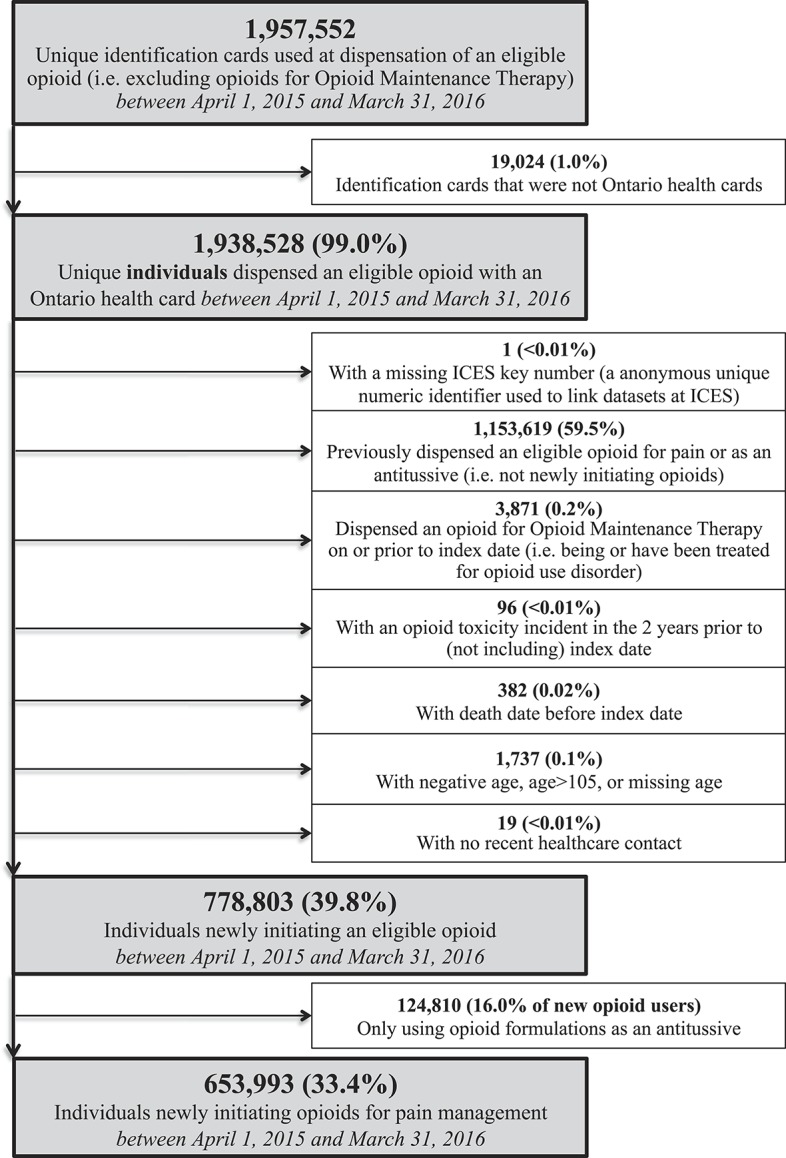
Concerns over prescription opioids contributing to high levels of opioid use disorder and overdose have led policymakers and clinicians to seek means to reduce inappropriate and high-dose initial prescriptions. To inform such efforts, we sought to describe the clinical indications associated with opioid initiation and the characteristics of the initial prescriptions and patients through a retrospective population-based cohort study. Our cohort included Ontarians initiating prescription opioids for pain management between April 1, 2015, and March 31, 2016. We identified the apparent clinical indication for opioid initiation by linking prescription drug claims to procedural and diagnostic information on health service records on the day of, and 5 days preceding prescription. Outcomes included initial opioid type, prescription duration, and daily dose (in milligram morphine equivalents), stratified either by indication or indication cluster. Among 653,993 individuals, we successfully classified 575,512 (88.0%) people initiating opioids into 23 clinical indications in 6 clusters: dental (23.2%); postsurgical (17.4%); musculoskeletal (12.0%); trauma (11.2%); cancer/palliative care (6.5%); and other less frequent indications (17.7%). Individuals with postsurgical pain received the highest daily doses (40.5% with greater than 50 milligram morphine equivalent), and those with musculoskeletal pain received more initial prescriptions with a duration exceeding 7 days (34.2%). Opioids are initiated for a wide range of indications with varying doses and durations; yet, those who initiated opioids for postsurgical and musculoskeletal pain received the greatest doses and durations of therapy, respectively. These findings may help tailor and prioritize efforts to promote more appropriate opioid prescribing.
对处方类阿片导致阿片类药物使用障碍和过量的担忧,促使政策制定者和临床医生寻求减少不合理和高剂量初始处方的方法。为了提供信息支持,我们试图通过回顾性基于人群的队列研究,描述与阿片类药物起始相关的临床指征,以及初始处方和患者的特征。我们的队列包括 2015 年 4 月 1 日至 2016 年 3 月 31 日期间因疼痛管理而开始使用处方类阿片的安大略省居民。我们通过将处方药与健康服务记录上的程序和诊断信息进行链接,在处方日和之前的 5 天内确定阿片类药物起始的明显临床指征。结果包括初始阿片类药物类型、处方持续时间和每日剂量(以毫克吗啡当量计),按照指征或指征聚类进行分层。在 653993 人中,我们成功地将 575512 人(88.0%)归类为 6 个聚类中的 23 种临床指征:牙科(23.2%);手术后(17.4%);肌肉骨骼(12.0%);创伤(11.2%);癌症/姑息治疗(6.5%);以及其他不太常见的指征(17.7%)。接受手术后疼痛治疗的人接受的每日剂量最高(40.5%的人接受超过 50 毫克吗啡当量),而肌肉骨骼疼痛患者接受的初始处方持续时间超过 7 天的比例最高(34.2%)。阿片类药物的起始指征广泛,剂量和持续时间各不相同;然而,接受手术后和肌肉骨骼疼痛治疗的人分别接受了最大剂量和最长时间的治疗。这些发现可能有助于调整和优先考虑促进更合理的阿片类药物处方的努力。