Department of Internal Medicine, Sahlgrenska University Hospital, Göteborg, Sweden.
Department of Cardiology, Sahlgrenska University Hospital, Göteborg, Sweden.
Brain Behav. 2018 Jun;8(6):e00992. doi: 10.1002/brb3.992. Epub 2018 May 18.
Elevated blood pressure (BP) is common in acute ischemic stroke, but its effect on outcome is not fully understood. We aimed to investigate the association of baseline BP and BP change within the first day after stroke with stroke severity, functional outcome, and mortality.
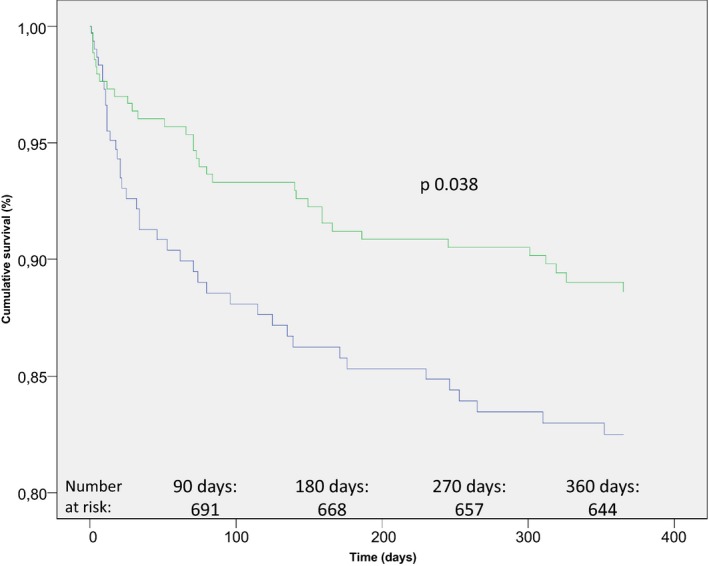
Patients admitted to hospital with acute ischemic stroke (IS) from 15 February 2005 through 31 May 2009 were consecutively included. Acute stroke severity and functional outcome at three and twelve months were investigated using multivariate regression analysis; the association between BP and all-cause mortality at one, three, and twelve was investigated by Cox proportional hazard regression and Kaplan-Meier survival curves.
A total of 799 patients (mean age 78.4 ± 8.0, 48% men) were included. Higher decreases in systolic and mean arterial blood pressure (ΔSBP and ΔMAP) were associated with decreased 1-month mortality (ΔSBP: hazard ratio, HR: 0.981; 95% CI: 0.968 - 0.994; p = .005), 3-month mortality (ΔSBP: HR 0.989; 95% CI 0.981 - 0.998; p-value .014), and twelve-month mortality (ΔSBP: HR 0.989; 95% CI 0.982 - 0.996; p-value .003). Stroke severity was associated with ΔMAP (B coefficient -.46, p-value .011). Higher SBP and MAP on admission were associated with better functional outcome at three (SBP: OR 0.987; 95% CI 0.978 - 0.997; p-value .008 - MAP: OR 0.985; 95% CI 0.971 - 1; p-value .046) and twelve (SBP: OR 0.988; 95% CI 0.979 - 0.998; p-value .015 - MAP: OR 0.983; 95% CI 0.968 - 0.997; p-value .02) months.
In this elderly population, higher BP on arrival to the emergency room (ER) and decrease in BP after the patients' arrival to the ward were associated with improved functional outcome and reduced mortality, respectively. These results may reflect a regulatory situation in which elevated initial blood pressure indicates adequate response to cerebral tissue ischemia while subsequent blood pressure decrease instead may be a consequence of partial, successful reperfusion.
急性缺血性脑卒中患者常伴有血压升高,但血压升高对预后的影响尚不完全清楚。本研究旨在探讨入院时血压和卒中后第 1 天内血压变化与卒中严重程度、功能结局和死亡率之间的关系。
连续纳入 2005 年 2 月 15 日至 2009 年 5 月 31 日期间因急性缺血性卒中入院的患者。采用多变量回归分析评估卒中发病后 3 个月和 12 个月的卒中严重程度和功能结局;采用 Cox 比例风险回归和 Kaplan-Meier 生存曲线评估入院时血压和第 1、3、12 个月全因死亡率之间的关系。
共纳入 799 例患者(平均年龄 78.4±8.0 岁,48%为男性)。入院时收缩压和平均动脉压(ΔSBP 和 ΔMAP)的下降幅度越大,1 个月死亡率(ΔSBP:风险比,HR:0.981;95%可信区间:0.968 - 0.994;p=0.005)、3 个月死亡率(ΔSBP:HR 0.989;95%可信区间:0.981 - 0.998;p 值.014)和 12 个月死亡率(ΔSBP:HR 0.989;95%可信区间:0.982 - 0.996;p 值.003)越低。卒中严重程度与ΔMAP 相关(B 系数-0.46,p 值.011)。入院时 SBP 和 MAP 越高,3 个月(SBP:比值比,OR 0.987;95%可信区间:0.978 - 0.997;p 值.008)和 12 个月(SBP:OR 0.988;95%可信区间:0.979 - 0.998;p 值.015)的功能结局越好;MAP 越高,12 个月(MAP:比值比,OR 0.983;95%可信区间:0.968 - 0.997;p 值.026)的功能结局越好。
在本老年人群中,入院时的血压和卒中后第 1 天的血压下降与功能结局的改善和死亡率的降低相关。这些结果可能反映了一种调节情况,即初始血压升高表明对脑组织缺血有足够的反应,而随后的血压下降可能是部分成功再灌注的结果。