
草乌甲素 A 减轻 spared nerve injury 诱导的背根神经节神经元过度兴奋:优选阻断 Nav1.7 和 Nav1.3 通道的作用。
Bulleyaconitine A attenuates hyperexcitability of dorsal root ganglion neurons induced by spared nerve injury: The role of preferably blocking Nav1.7 and Nav1.3 channels.
机构信息
1 Department of Anesthesiology, Sun Yat-sen University Cancer Center, State Key Laboratory of Oncology in South China, Collaborative Innovation Center for Cancer Medicine, Guangzhou, China.
2 Department of Physiology, Pain Research Center, Zhongshan School of Medicine of Sun Yat-Sen University, Guangzhou, China.
出版信息
Mol Pain. 2018 Jan-Dec;14:1744806918778491. doi: 10.1177/1744806918778491.
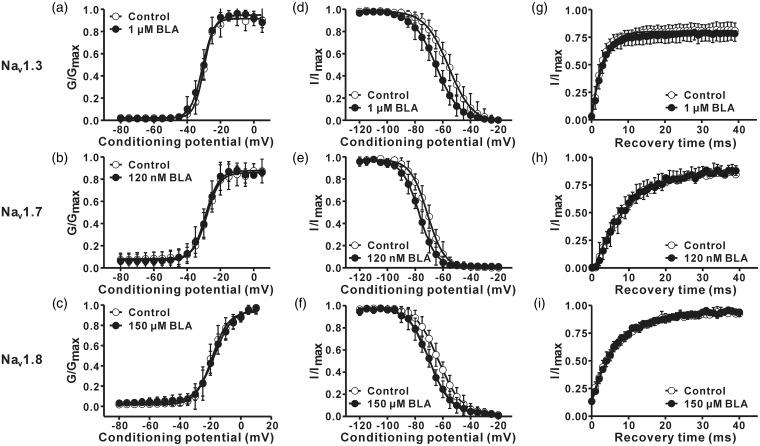
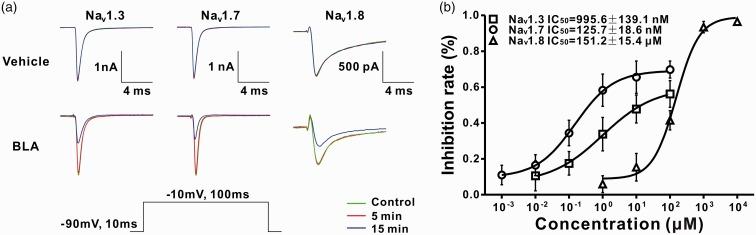
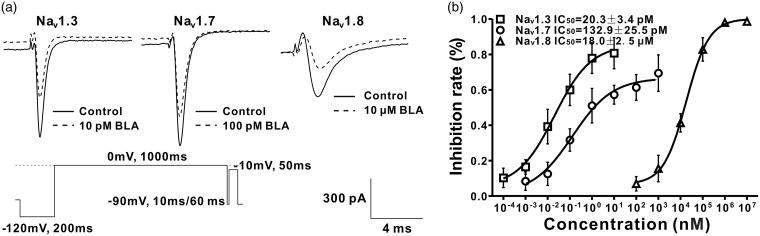
Background Oral administration of Bulleyaconitine A, an extracted diterpenoid alkaloid from Aconitum bulleyanum plants, is effective for treating chronic pain in rats and in human patients, but the underlying mechanisms are poorly understood. Results As the hyperexcitability of dorsal root ganglion neurons resulting from the upregulation of voltage-gated sodium (Nav) channels has been proved critical for development of chronic pain, we tested the effects of Bulleyaconitine A on Nav channels in rat spared nerve injury model of neuropathic pain. We found that Bulleyaconitine A at 5 nM increased the threshold of action potentials and reduced the firing rate of dorsal root ganglion neurons in spared nerve injury rats but not in sham rats. Bulleyaconitine A preferably blocked tetrodotoxin-sensitive Nav channels over tetrodotoxin-resistant ones in dorsal root ganglion neurons of spared nerve injury rats. Bulleyaconitine A was more potent for blocking Nav1.3 and Nav1.7 than Nav1.8 in cell lines. The half maximal inhibitory concentration (IC) values for resting Nav1.3, Nav1.7, and Nav1.8 were 995.6 ± 139.1 nM, 125.7 ± 18.6 nM, and 151.2 ± 15.4 μM, respectively, which were much higher than those for inactivated Nav1.3 (20.3 ± 3.4 pM), Nav1.7 (132.9 ± 25.5 pM), and Nav1.8 (18.0 ± 2.5 μM). The most profound use-dependent blocking effect of Bulleyaconitine A was observed on Nav1.7, less on Nav1.3, and least on Nav1.8 at IC concentrations. Bulleyaconitine A facilitated the inactivation of Nav channels in each subtype. Conclusions Preferably blocking tetrodotoxin-sensitive Nav1.7 and Nav1.3 in dorsal root ganglion neurons may contribute to Bulleyaconitine A's antineuropathic pain effect.
背景
从乌头属植物中提取的二萜生物碱类物质乌头碱 A 经口服给药,可有效治疗大鼠和人类患者的慢性疼痛,但作用机制尚不清楚。
结果
由于背根神经节神经元的过度兴奋是电压门控钠(Nav)通道上调导致慢性疼痛发展的关键因素,我们测试了 Bulleyaconitine A 对神经病理性疼痛大鼠 spared 神经损伤模型中 Nav 通道的影响。我们发现,在 spared 神经损伤大鼠中,5 nM 的乌头碱 A 增加了动作电位的阈值,并降低了背根神经节神经元的放电率,但在假手术大鼠中没有。乌头碱 A 更倾向于阻断 spared 神经损伤大鼠背根神经节神经元中的河豚毒素敏感型 Nav 通道,而非河豚毒素抗性 Nav 通道。乌头碱 A 在细胞系中对 Nav1.3 和 Nav1.7 的阻断作用强于 Nav1.8。静息 Nav1.3、Nav1.7 和 Nav1.8 的半数最大抑制浓度(IC)值分别为 995.6±139.1 nM、125.7±18.6 nM 和 151.2±15.4 μM,远高于失活 Nav1.3(20.3±3.4 pM)、Nav1.7(132.9±25.5 pM)和 Nav1.8(18.0±2.5 μM)。在 IC 浓度下,乌头碱 A 对 Nav1.7 的使用依赖性阻断作用最为明显,对 Nav1.3 的阻断作用次之,对 Nav1.8 的阻断作用最小。乌头碱 A 促进了每种亚型 Nav 通道的失活。
结论
在背根神经节神经元中,优选阻断河豚毒素敏感的 Nav1.7 和 Nav1.3 可能是乌头碱 A 抗神经病理性疼痛作用的基础。





 Zotero 插件