Department of Epidemiology, Janssen Research and Development, Titusville, Florida.
Depress Anxiety. 2018 Jul;35(7):668-673. doi: 10.1002/da.22774. Epub 2018 May 22.
Treatment for depressive disorders often requires subsequent interventions. Patients who do not respond to antidepressants have treatment-resistant depression (TRD). Predicting who will develop TRD may help healthcare providers make more effective treatment decisions. We sought to identify factors that predict TRD in a real-world setting using claims databases.
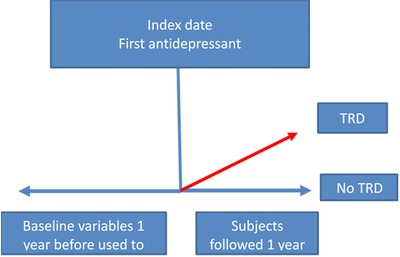
A retrospective cohort study was conducted in a US claims database of adult subjects with newly diagnosed and treated depression with no mania, dementia, and psychosis. The index date was the date of antidepressant dispensing. The outcome was TRD, defined as having at least three distinct antidepressants or one antidepressant and one antipsychotic within 1 year after the index date. Predictors were age, gender, medical conditions, medications, and procedures 1 year before the index date.
Of 230,801 included patients, 10.4% developed TRD within 1 year. TRD patients at baseline were younger; 10.87% were between 18 and 19 years old versus 7.64% in the no-TRD group, risk ratio (RR) = 1.42 (95% confidence interval [CI] 1.37-1.48). TRD patients were more likely to have an anxiety disorder at baseline than non-TRD patients, RR = 1.38 (95% CI 1.35-1.14). At 3.68, fatigue had the highest RR (95% CI 3.18-4.25). TRD patients had substance use disorders, psychiatric conditions, insomnia, and pain more often at baseline than non-TRD patients.
Ten percent of subjects newly diagnosed and treated for depression developed TRD within a year. They were younger and suffered more frequently from fatigue, substance use disorders, anxiety, psychiatric conditions, insomnia, and pain than non-TRD patients.
治疗抑郁症通常需要后续干预。对抗抑郁药无反应的患者患有治疗抵抗性抑郁症(TRD)。预测谁会发展为 TRD 可能有助于医疗保健提供者做出更有效的治疗决策。我们试图使用索赔数据库在真实环境中确定预测 TRD 的因素。
在一项美国索赔数据库中进行了一项回顾性队列研究,该数据库包含新诊断和治疗的抑郁症且无躁狂、痴呆和精神病的成年患者。索引日期为抗抑郁药配药日期。结果是 TRD,定义为在索引日期后 1 年内至少使用三种不同的抗抑郁药或一种抗抑郁药和一种抗精神病药。预测因子为索引日期前 1 年的年龄、性别、医疗状况、药物和程序。
在 230801 名纳入患者中,10.4%在 1 年内发展为 TRD。基线时 TRD 患者较年轻;10.87%为 18 至 19 岁,而非 TRD 组为 7.64%,风险比(RR)= 1.42(95%置信区间[CI] 1.37-1.48)。TRD 患者基线时更有可能患有焦虑症,RR = 1.38(95% CI 1.35-1.14)。RR 最高的是疲劳,为 3.68(95% CI 3.18-4.25)。TRD 患者基线时比非 TRD 患者更频繁地患有物质使用障碍、精神疾病、失眠和疼痛。
新诊断和治疗抑郁症的患者中有 10%在一年内发展为 TRD。他们比非 TRD 患者更年轻,更频繁地出现疲劳、物质使用障碍、焦虑、精神疾病、失眠和疼痛。