Vija Racaru Lavinia, Sinigaglia Mathieu, Kanoun Salim, Ben Bouallègue Fayçal, Tal Ilan, Brillouet Sévérine, Bauriaud-Mallet Mathilde, Zerdoud Slimane, Dierickx Lawrence, Vallot Delphine, Caselles Olivier, Gabiache Erwan, Pascal Pierre, Courbon Frederic
Department of Nuclear Medicine, Claudius Regaud Institute, Toulouse Oncology University Institute-IUCT-Oncopole.
Department of Biophysics and Nuclear Medicine, Faculty of Medicine, Paul Sabatier University.
Nucl Med Commun. 2018 Jul;39(7):672-679. doi: 10.1097/MNM.0000000000000850.
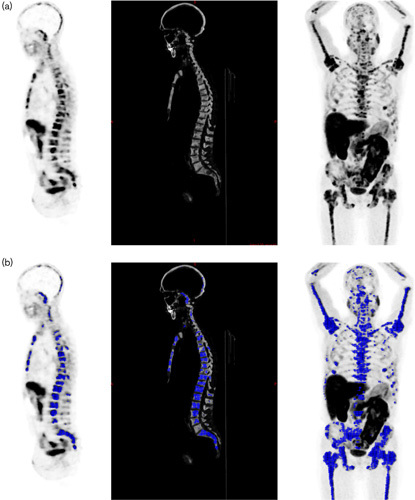
This study aims to predict hematological toxicity induced by Ra therapy. We investigated the value of metabolically active bone tumor volume (MBTV) and total bone lesion activity (TLA) calculated on pretreatment fluorine-18-fluorocholine (F-FCH) PET/CT in castrate-resistant prostate cancer (CRPC) patients with bone metastases treated with Ra radionuclide therapy.
F-FCH PET/CT imaging was performed in 15 patients with CRPC before treatment with Ra. Bone metastatic disease was quantified on the basis of the maximum standardized uptake value (SUV), total lesion activity (TLA=MBTV×SUVmean), or MBTV/height (MBTV/H) and TLA/H. F-FCH PET/CT bone tumor burden and activity were analyzed to identify which parameters could predict hematological toxicity [on hemoglobin (Hb), platelets (PLTs), and lymphocytes] while on Ra therapy. Pearson's correlation was used to identify the correlations between age, prostate-specific antigen, and F-FCH PET parameters.
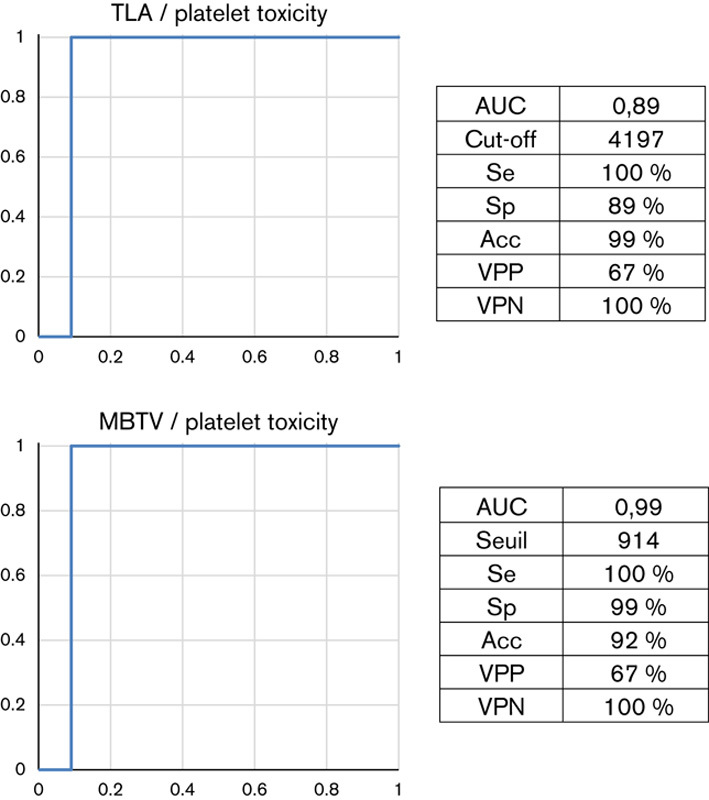
MBTV ranged from 75 to 1259 cm (median: 392 cm). TLA ranged from 342 to 7198 cm (median: 1853 cm). Patients benefited from two to six cycles of Ra (n=56 cycles in total). At the end of Ra therapy, five of the 15 (33%) patients presented grade 2/3 toxicity on Hb and lymphocytes, whereas three of the 15 (20%) patients presented grade 2/3 PLT toxicity.Age was correlated negatively with both MBTV (r=-0.612, P=0.015) and TLA (r=-0.596, P=0.018). TLA, TLA/H, and MBTV/H predicted hematological toxicity on Hb, whereas TLA/H and MBTV/H predicted toxicity on PLTs at the end of Ra cycles. Receiver operating characteristic curve analysis allowed to define the cutoffs for MBTV (915 cm) and TLA (4198 cm) predictive for PLT toxicity, with an accuracy of 0.92 and 0.99.
Tumor bone burden calculation is feasible with F-FCH PET/CT with freely available open-source software. In this pilot study, baseline F-FCH PET/CT markers (TLA, MBTV) have shown abilities to predict Hb and PLT toxicity after Ra therapy and could be explored for patient selection and treatment optimization.
本研究旨在预测镭疗法所致血液学毒性。我们调查了在接受镭核素治疗的去势抵抗性前列腺癌(CRPC)骨转移患者中,治疗前氟-18-氟胆碱(F-FCH)PET/CT计算的代谢活性骨肿瘤体积(MBTV)和总骨病变活性(TLA)的价值。
15例CRPC患者在接受镭治疗前进行了F-FCH PET/CT成像。根据最大标准化摄取值(SUV)、总病变活性(TLA = MBTV×SUV均值)或MBTV/身高(MBTV/H)和TLA/H对骨转移疾病进行量化。分析F-FCH PET/CT骨肿瘤负荷和活性,以确定哪些参数可预测镭治疗期间的血液学毒性[血红蛋白(Hb)、血小板(PLT)和淋巴细胞方面]。采用Pearson相关性分析确定年龄、前列腺特异性抗原与F-FCH PET参数之间的相关性。
MBTV范围为75至1259 cm³(中位数:392 cm³)。TLA范围为342至7198 cm³(中位数:1853 cm³)。患者接受了2至6个周期的镭治疗(共56个周期)。在镭治疗结束时,15例患者中有5例(33%)在Hb和淋巴细胞方面出现2/3级毒性,而15例患者中有3例(20%)出现2/3级PLT毒性。年龄与MBTV(r = -0.612,P = 0.015)和TLA(r = -0.596,P = 0.018)均呈负相关。TLA、TLA/H和MBTV/H可预测镭治疗周期结束时Hb方面的血液学毒性,而TLA/H和MBTV/H可预测PLT方面的毒性。通过受试者操作特征曲线分析确定了预测PLT毒性的MBTV(915 cm³)和TLA(4198 cm³)的截断值,准确率分别为0.92和0.99。
使用免费的开源软件,通过F-FCH PET/CT计算肿瘤骨负荷是可行 的。在这项初步研究中,基线F-FCH PET/CT标志物(TLA、MBTV)已显示出预测镭治疗后Hb和PLT毒性的能力,可用于患者选择和治疗优化的探索。