Laboratory of Molecular Evolution and Bioinformatics, Department of Microbiology, Biomedical Sciences Institute, University of São Paulo, São Paulo, Brazil.
Laboratory of Molecular Evolution and Bioinformatics, Department of Microbiology, Biomedical Sciences Institute, University of São Paulo, São Paulo, Brazil; Instituto de Investigación de Recursos Biológicos Alexander von Humboldt, Bogotá, Colombia.
Infect Genet Evol. 2018 Oct;64:207-211. doi: 10.1016/j.meegid.2018.05.017. Epub 2018 May 21.
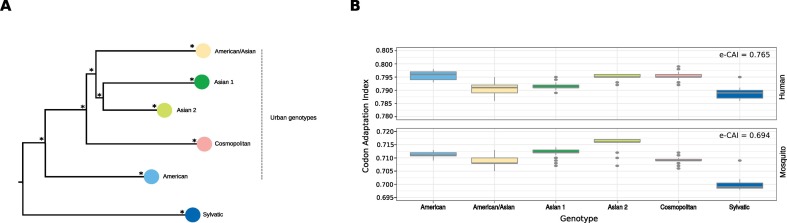
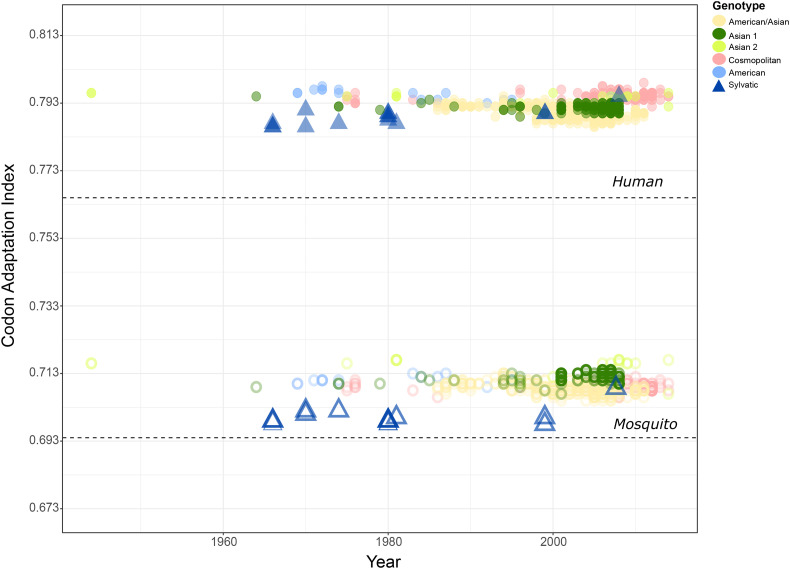
Dengue virus (DENV) emerged from the sylvatic environment and colonized urban settings, being sustained in a human-Aedes-human transmission chain, mainly by the bites of females of the anthropophilic species Aedes aegypti. Herein, we sought evidence for fine-tuning in viral codon usage, possibly due to viral adaptation to human transmission. We compared the codon adaptation of DENV serotype 2 (DENV-2) genotypes from urban and sylvatic habitats and tried to correlate the findings with key evolutionary determinants. We found that DENV-2 codons of urban and sylvatic genotypes had a higher CAI to humans than to Ae. aegypti. Remarkably, we found no significant differences in codon adaptation to human between urban American/Asian and sylvatic DENV-2 genotypes. Moreover, CAI values were significantly different, when comparing all genotypes to Ae. aegypti codon preferences, with lower values for sylvatic than urban genotypes. In summary, our findings suggest the presence of a molecular signature among the genotypes that circulate in sylvatic and urban environments, and may help explain the trafficking of DENV-2 strains to an urban cycle.
登革热病毒(DENV)从森林环境中出现并殖民到城市环境中,通过人类-埃及伊蚊-人类传播链得以维持,主要由嗜人血的埃及伊蚊雌性叮咬传播。在此,我们寻找病毒密码子使用精细调整的证据,可能是由于病毒适应人类传播。我们比较了来自城市和森林生境的登革热病毒血清型 2(DENV-2)基因型的密码子适应性,并试图将这些发现与关键的进化决定因素联系起来。我们发现,城市和森林生境的 DENV-2 基因型的病毒密码子对人类的 CAI 高于对埃及伊蚊的 CAI。值得注意的是,我们发现城市的美国/亚洲型和森林型 DENV-2 基因型之间,在对人类的密码子适应性方面没有显著差异。此外,当将所有基因型与埃及伊蚊的密码子偏好进行比较时,CAI 值差异显著,森林型的 CAI 值低于城市型。总之,我们的研究结果表明,在循环于森林和城市环境中的基因型中存在分子特征,这可能有助于解释 DENV-2 株向城市循环的传播。