Fan Yanjie, Wu Yanming, Wang Lili, Wang Yu, Gong Zhuwen, Qiu Wenjuan, Wang Jingmin, Zhang Huiwen, Ji Xing, Ye Jun, Han Lianshu, Jin Xingming, Shen Yongnian, Li Fei, Xiao Bing, Liang Lili, Zhang Xia, Liu Xiaomin, Gu Xuefan, Yu Yongguo
Department of Pediatric Endocrinology/Genetics, Xinhua Hospital affiliated to Shanghai Jiao Tong University School of Medicine, Shanghai Institute for Pediatric Research, 1665 Kongjiang Road, Shanghai, 200092, China.
Department of Pediatrics, People's Hospital of Shanghai Pudong New District, 490 South Chuanhuan Road, Shanghai, 201200, China.
BMC Med Genomics. 2018 May 24;11(1):49. doi: 10.1186/s12920-018-0368-4.
Developmental delay (DD) and intellectual disability (ID) are frequently associated with a broad spectrum of additional phenotypes. Chromosomal microarray analysis (CMA) has been recommended as a first-tier test for DD/ID in general, whereas the diagnostic yield differs significantly among DD/ID patients with different comorbid conditions.
To investigate the genotype-phenotype correlation, we examined the characteristics of identified pathogenic copy number variations (pCNVs) and compared the diagnostic yields among patient subgroups with different co-occurring conditions.
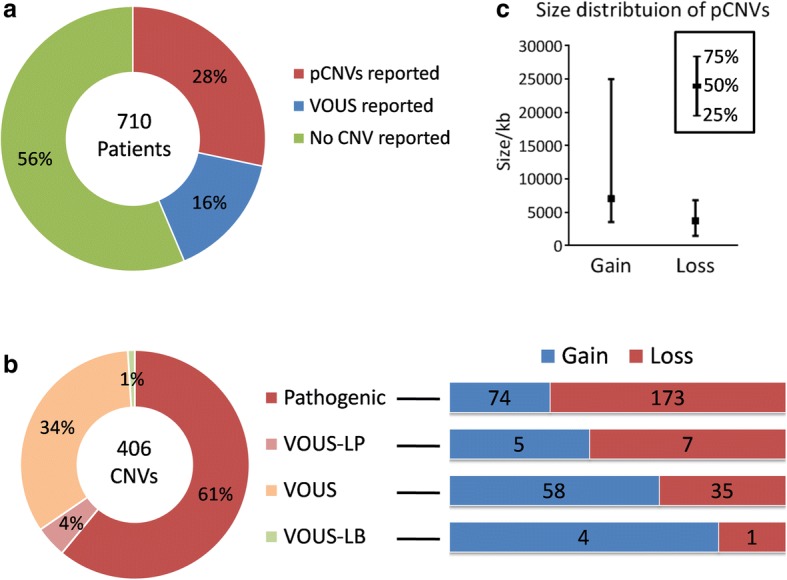
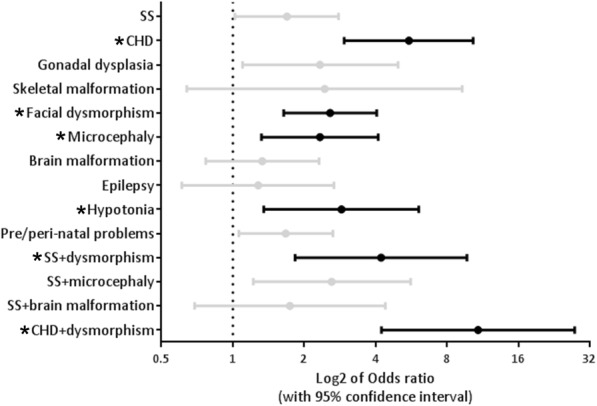
This study is a retrospective review of CMA results generated from a mixed cohort of 710 Chinese patients with DD/ID. A total of 247 pCNVs were identified in 201 patients (28%). A large portion of these pCNVs were copy number losses, and the size of copy number losses was generally smaller than gains. The diagnostic yields were significantly higher in subgroups with co-occurring congenital heart defects (55%), facial dysmorphism (39%), microcephaly (34%) or hypotonia (35%), whereas co-occurring conditions of skeletal malformation (26%), brain malformation (24%) or epilepsy (24%) did not alter the yield. In addition, the diagnostic yield nominally correlated with ID severity.
Varied yields exist in DD/ID patients with different phenotypic presentation. The presence of comorbid conditions can be among factors to consider when planning CMA.
发育迟缓(DD)和智力障碍(ID)常与一系列广泛的其他表型相关。一般而言,染色体微阵列分析(CMA)已被推荐作为DD/ID的一线检测方法,然而在患有不同合并症的DD/ID患者中,诊断率差异显著。
为了研究基因型-表型相关性,我们检查了已识别的致病性拷贝数变异(pCNV)的特征,并比较了不同合并症患者亚组的诊断率。
本研究是对710例中国DD/ID患者混合队列的CMA结果进行的回顾性分析。在201例患者(28%)中总共识别出247个pCNV。这些pCNV大部分是拷贝数缺失,且拷贝数缺失的大小通常小于增加的大小。在合并先天性心脏病(55%)、面部畸形(39%)、小头畸形(34%)或肌张力减退(35%)的亚组中,诊断率显著更高,而合并骨骼畸形(26%)、脑畸形(24%)或癫痫(24%)的情况并未改变诊断率。此外,诊断率与ID严重程度存在名义上的相关性。
不同表型的DD/ID患者存在不同的诊断率。在计划进行CMA时,合并症的存在可能是需要考虑的因素之一。