Subramaniam Dhananjay Radhakrishnan, Arens Raanan, Wagshul Mark E, Sin Sanghun, Wootton David M, Gutmark Ephraim J
Department of Aerospace Engineering and Engineering Mechanics, CEAS, University of Cincinnati, Cincinnati, OH, USA.
Division of Respiratory and Sleep Medicine, The Children's Hospital at Montefiore, Albert Einstein College of Medicine, Bronx, NY, USA.
J Biomech. 2018 Jul 25;76:8-15. doi: 10.1016/j.jbiomech.2018.05.013. Epub 2018 May 17.
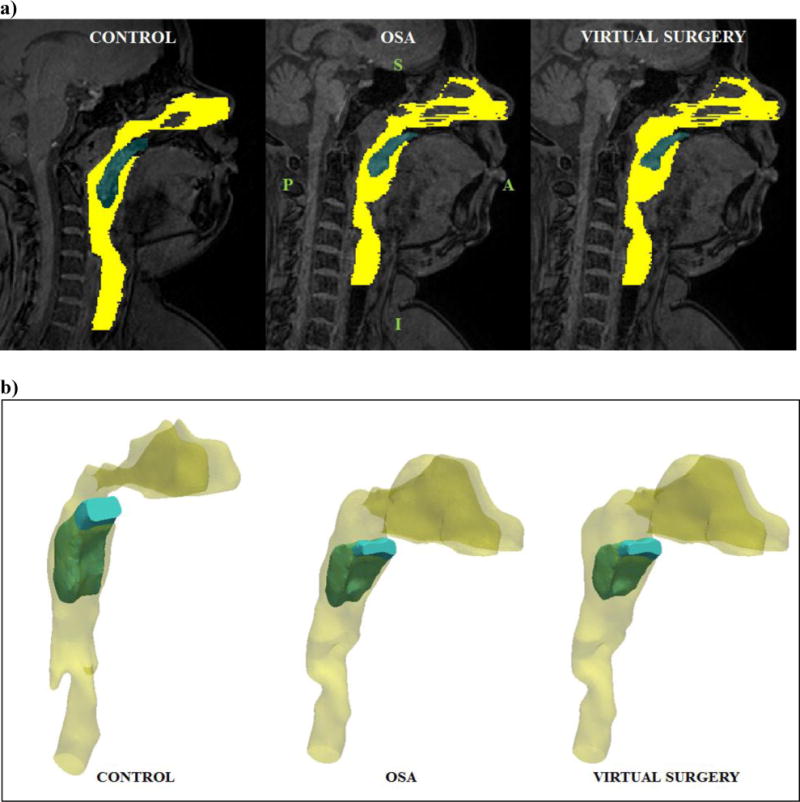
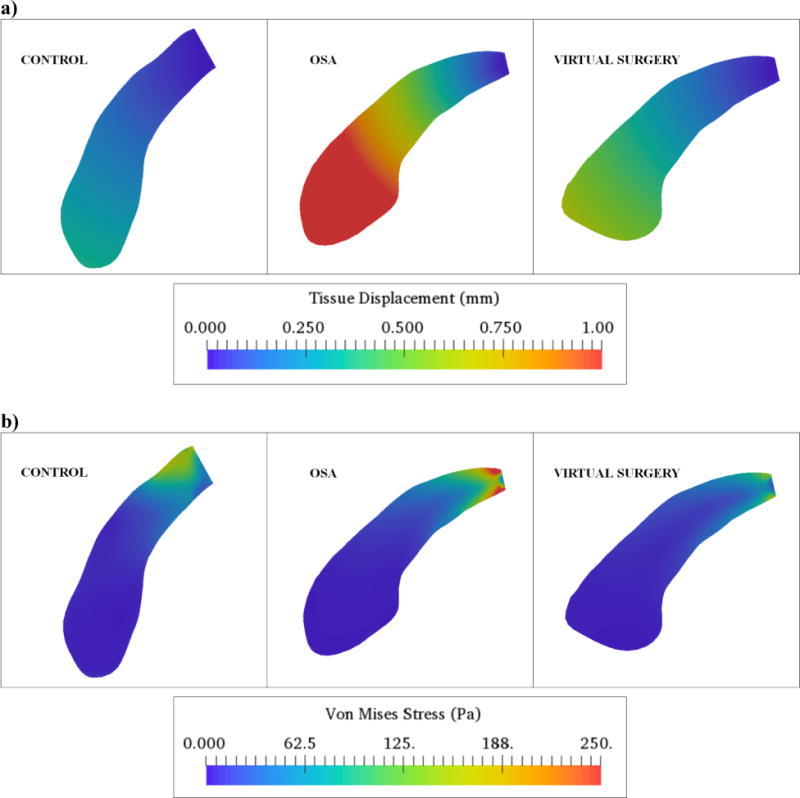
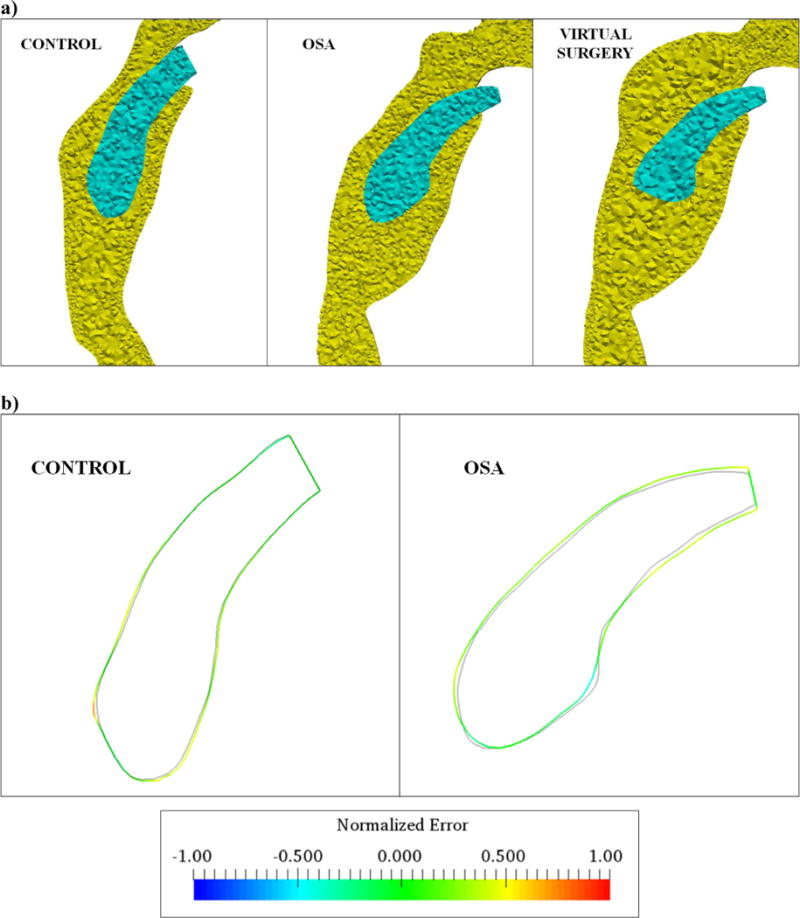
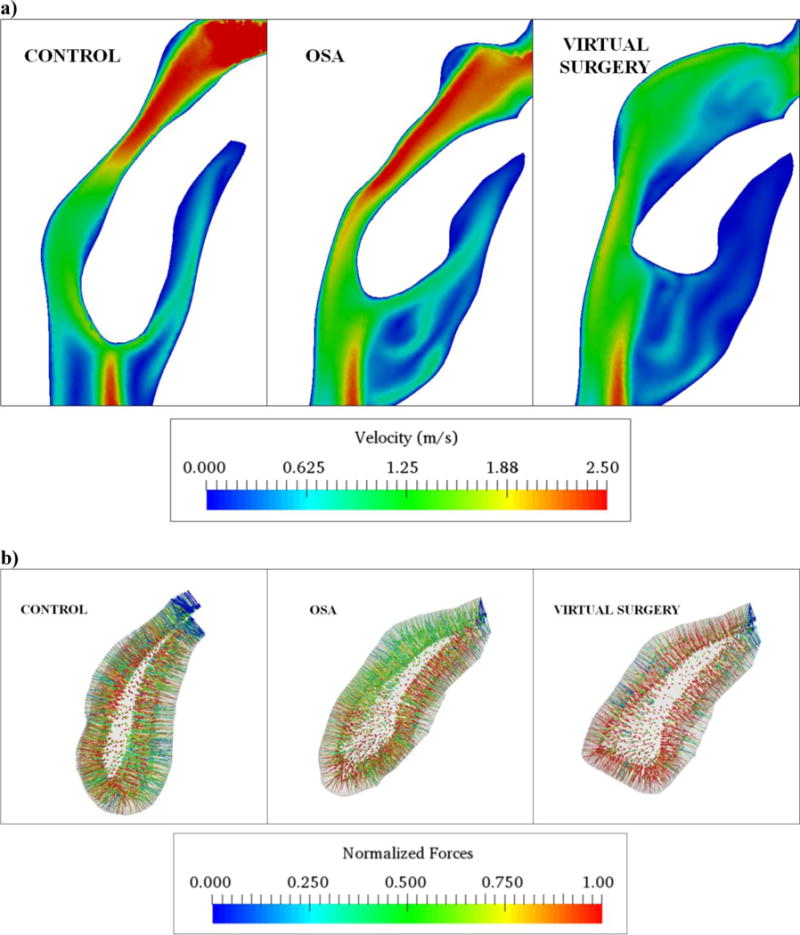
Highly compliant tissue supporting the pharynx and low muscle tone enhance the possibility of upper airway occlusion in children with obstructive sleep apnea (OSA). The present study describes subject-specific computational modeling of flow-induced velopharyngeal narrowing in a female child with polycystic ovarian syndrome (PCOS) with OSA and a non-OSA control. Anatomically accurate three-dimensional geometries of the upper airway and soft-palate were reconstructed for both subjects using magnetic resonance (MR) images. A fluid-structure interaction (FSI) shape registration analysis was performed using subject-specific values of flow rate to iteratively compute the biomechanical properties of the soft-palate. The optimized shear modulus for the control was 38 percent higher than the corresponding value for the OSA patient. The proposed computational FSI model was then employed for planning surgical treatment for the apneic subject. A virtual surgery comprising of a combined adenoidectomy, palatoplasty and genioglossus advancement was performed to estimate the resulting post-operative patterns of airflow and tissue displacement. Maximum flow velocity and velopharyngeal resistance decreased by 80 percent and 66 percent respectively following surgery. Post-operative flow-induced forces on the anterior and posterior faces of the soft-palate were equilibrated and the resulting magnitude of tissue displacement was 63 percent lower compared to the pre-operative case. Results from this pilot study indicate that FSI computational modeling can be employed to characterize the mechanical properties of pharyngeal tissue and evaluate the effectiveness of various upper airway surgeries prior to their application.
支撑咽部的高顺应性组织和低肌张力增加了阻塞性睡眠呼吸暂停(OSA)儿童上气道阻塞的可能性。本研究描述了一名患有多囊卵巢综合征(PCOS)且伴有OSA的女童和一名非OSA对照受试者中气流诱导的腭咽狭窄的个体特异性计算模型。使用磁共振(MR)图像为两名受试者重建了上气道和软腭的解剖学精确三维几何模型。使用特定受试者的流速值进行流固耦合(FSI)形状配准分析,以迭代计算软腭的生物力学特性。对照受试者的优化剪切模量比OSA患者的相应值高38%。然后将所提出的计算FSI模型用于为呼吸暂停受试者规划手术治疗。进行了包括腺样体切除术、腭成形术和颏舌肌前移术的虚拟手术,以估计术后气流和组织位移的模式。术后最大流速和腭咽阻力分别降低了80%和66%。术后软腭前后表面上由气流引起的力达到平衡,与术前相比,组织位移的幅度降低了63%。这项初步研究的结果表明,FSI计算模型可用于表征咽部组织的力学特性,并在各种上气道手术应用之前评估其有效性。