Xcenda GmbH, Hannover, Germany.
INAV GmbH, Berlin, Germany.
PLoS One. 2018 May 24;13(5):e0197905. doi: 10.1371/journal.pone.0197905. eCollection 2018.
In Germany, a 23-valent polysaccharide pneumococcal vaccine (PPSV23) is recommended for elderly (60+) and patients 16+ with chronic diseases not associated with immune suppression. For all other patients at risk, sequential immunization with a 13-valent pneumococcal conjugate vaccine (PCV13) first, followed by PPSV23 is recommended. Repeated vaccination with PPSV23 is recommended every 6 years after individual assessment by the physician. This was adopted into the vaccination directive with binding reimbursement and funding. However, additional voluntary services allow statutory health insurances to differentiate from each other. Aim of this study is to estimate the cost-effectiveness of voluntary service scenarios compared to the strategy in place to support informed decision making.
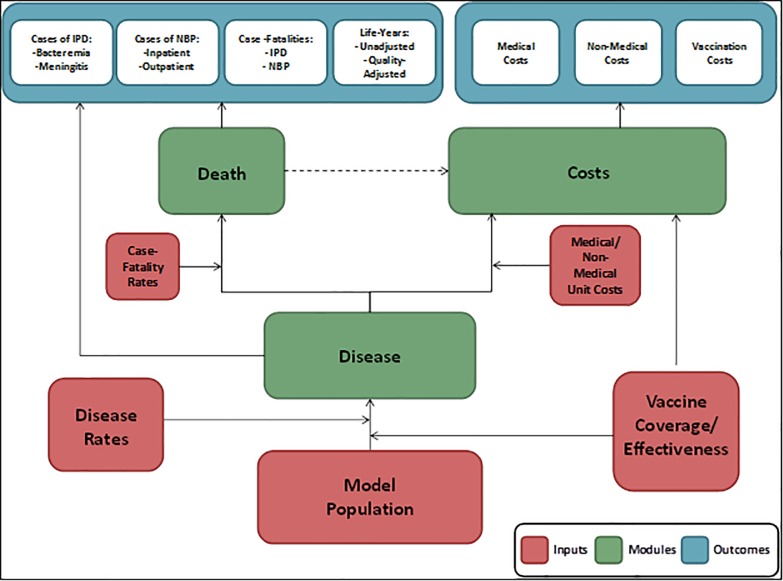
A microsimulation framework with Markov-type process of a population susceptible to pneumococcal disease over a lifetime horizon was developed to compare effectiveness and cost-effectiveness of different vaccination strategies. We simulated 1,000 iterations for seven scenarios. Assumptions were derived from published literature and probabilistic sensitivity analysis was run to show the robustness of the model.
Our study indicates that all voluntary service strategies could prevent further clinical cases compared to the existing policy. Depending on the scenario, 48-142 invasive pneumococcal disease (IPD), 24,000-45,000 hospitalized all-cause nonbacteremic pneumonia (NBP), 15,000-45,000 outpatient NBP cases, and 4,000-8,000 deaths could be avoided on average. This refers to potential savings of €115 Mio. - €187 Mio. for medical and non-medical costs. Additional costs per patient for the payer are €2.48 to €7.13 and for the society €2.20 to €6.85. The ICER per LYG ranged from €3,662 to €23,061 (payer) and €3,258 to €29,617 (societal). All but one scenario was cost-effective in ≥60% of the generated 1,000 simulations.
Compared to the vaccination strategy in place, the different hypothetical scenarios can be considered cost-effective and suitable as additional voluntary services.
在德国,建议为 60 岁以上老年人和无免疫抑制相关慢性疾病的 16 岁以上患者接种 23 价多糖肺炎球菌疫苗(PPSV23)。对于所有其他有风险的患者,建议首先序贯接种 13 价肺炎球菌结合疫苗(PCV13),然后接种 PPSV23。接种 PPSV23 后,医生需根据个体情况进行评估,每 6 年重复接种一次。这一建议已被纳入具有强制性报销和资金支持的疫苗接种指南。然而,额外的自愿服务允许法定健康保险相互区分。本研究旨在评估与现行策略相比,自愿服务方案在支持知情决策方面的成本效益。
本研究开发了一个基于马尔可夫过程的人群易感肺炎球菌疾病的微观模拟框架,以比较不同疫苗接种策略的有效性和成本效益。我们模拟了 7 种方案下的 1000 次迭代。假设源自已发表文献,进行概率敏感性分析以展示模型的稳健性。
我们的研究表明,与现行政策相比,所有自愿服务方案都能预防更多的侵袭性肺炎球菌病(IPD)病例。根据不同方案,平均可预防 48-142 例侵袭性肺炎球菌病(IPD)、24000-45000 例住院非细菌性肺炎(NBP)、15000-45000 例门诊 NBP 病例和 4000-8000 例死亡。这意味着医疗和非医疗费用可节省 1.15 亿至 1.87 亿欧元。对于支付方,每位患者的额外成本为 2.48 欧元至 7.13 欧元,对于社会,每位患者的额外成本为 2.20 欧元至 6.85 欧元。每个生命年质量调整生命年(LYG)的增量成本效益比(ICER)范围为支付方 3662 欧元至 23061 欧元,社会 3258 欧元至 29617 欧元。在生成的 1000 次模拟中,除一种方案外,所有方案在≥60%的情况下都具有成本效益。
与现行的疫苗接种策略相比,这些不同的假设方案可以被认为是具有成本效益的,并可作为额外的自愿服务。