Ann Phoebe, Seagle Brandon-Luke L, Shilpi Arunima, Kandpal Manoj, Shahabi Shohreh
Division of Gynecologic Oncology, Department of Obstetrics and Gynecology, Northwestern University Feinberg School of Medicine, 60611 Chicago, IL, USA.
Oncotarget. 2018 May 1;9(33):23114-23125. doi: 10.18632/oncotarget.25225.
Tumor expression of Anterior Gradient 2 (), an endoplasmic reticulum protein disulfide isomerase, was associated with decreased breast cancer survival. We aimed to validate the association of tumor mRNA expression with disease-specific survival (DSS) and identify differentially expressed signaling pathways between high and low expression tumor groups.
Primary tumor mRNA expression data from the METABRIC study was used to evaluate expression as a prognostic factor for DSS while adjusting for survival-determining confounders using Cox proportional-hazards regression. Differentially expressed genes and signaling pathway differences between high and low groups were determined by modular enrichment analyses using DAVID and Ingenuity Pathway Analysis.
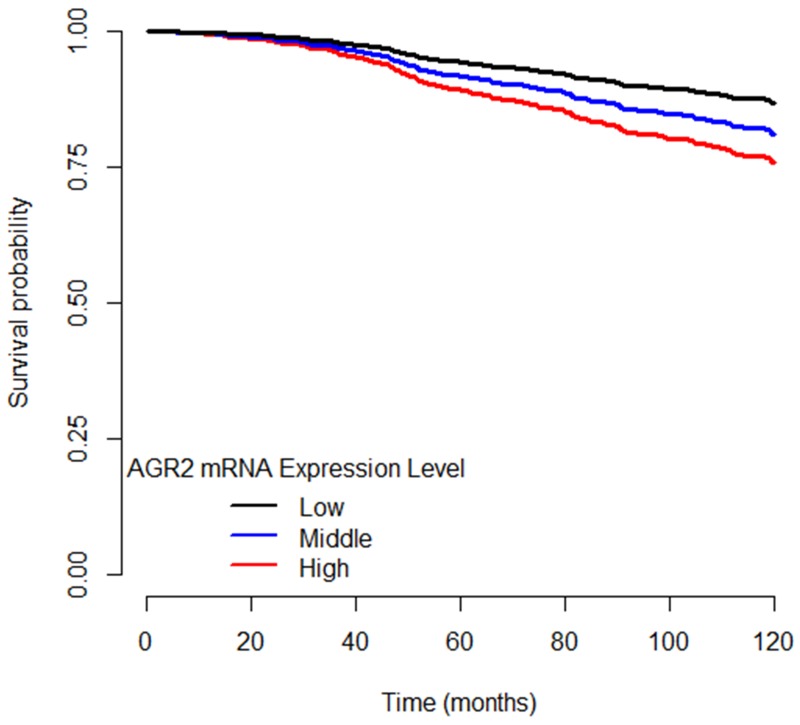
Increased tumor mRNA expression was associated with decreased DSS among 1,341 women (per each standard deviation increase of expression: HR 1.14, 95% CI: 1.01-1.29, P = 0.03). Pathway analyses supported prior experimental studies showing that estrogen receptor 1 () regulated expression. Canonical signaling pathways significantly differentially represented between high and low groups included those involved in inflammation and immunity.
Increased primary tumor expression was associated with decreased DSS. Pathway analyses suggested that increased was associated with endoplasmic reticular homeostasis, possibly allowing tumor cells to overcome hypoxic stress and meet the increased protein demand of tumorigenesis, thereby preventing unfolded protein response-mediated apoptosis.
内质网蛋白二硫键异构酶前梯度2(AGR2)的肿瘤表达与乳腺癌生存率降低相关。我们旨在验证肿瘤AGR2 mRNA表达与疾病特异性生存率(DSS)之间的关联,并确定高表达和低表达AGR2肿瘤组之间差异表达的信号通路。
来自METABRIC研究的原发性肿瘤mRNA表达数据用于评估AGR2表达作为DSS的预后因素,同时使用Cox比例风险回归对决定生存的混杂因素进行校正。通过使用DAVID和 Ingenuity Pathway Analysis的模块富集分析确定高AGR2组和低AGR2组之间差异表达的基因和信号通路差异。
在1341名女性中,肿瘤AGR2 mRNA表达增加与DSS降低相关(AGR2表达每增加一个标准差:HR 1.14,95% CI:1.01-1.29,P = 0.03)。通路分析支持先前的实验研究,表明雌激素受体1(ESR1)调节AGR2表达。高AGR2组和低AGR2组之间显著差异表达的经典信号通路包括那些参与炎症和免疫的通路。
原发性肿瘤AGR2表达增加与DSS降低相关。通路分析表明,AGR2增加与内质网稳态相关,可能使肿瘤细胞克服缺氧应激并满足肿瘤发生增加的蛋白质需求,从而防止未折叠蛋白反应介导的细胞凋亡。