Fergusson Dean, Monfaredi Zarah, Pussegoda Kusala, Garritty Chantelle, Lyddiatt Anne, Shea Beverley, Duffett Lisa, Ghannad Mona, Montroy Joshua, Murad M. Hassan, Pratt Misty, Rader Tamara, Shorr Risa, Yazdi Fatemeh
Ottawa Hospital Research Institute, Ottawa, ON Canada.
Centre for Practice-Changing Research, Office L1298a, 501 Smyth Road, Box 201B, Ottawa, ON K1H 8L6 Canada.
Res Involv Engagem. 2018 May 22;4:17. doi: 10.1186/s40900-018-0099-x. eCollection 2018.
With the growing movement to engage patients in research, questions are being asked about who is engaging patients and how they are being engaged. Internationally, research groups are supporting and funding patient-oriented research studies that engage patients in the identification of research priorities and the design, conduct and uptake of research. As we move forward, we need to know what meaningful patient engagement looks like, how it benefits research and clinical practice, and what are the barriers to patient engagement?We conducted a review of the published literature looking for trials that report engaging patients in the research. We included both randomized controlled trials and non-randomized comparative trials. We looked at these trials for important study characteristics, including how patients were engaged, to better understand the practices used in trials. Importantly, we also discuss the number of trials reporting patient engagement practices relative to all published trials. We found that very few trials report any patient engagement activities even though it is widely supported by many major funding organizations. The findings of our work will advance patient-oriented research by showing how patients can be engaged and by stressing that patient engagement practices need to be better reported.
Patient-Oriented Research (POR) is research informed by patients and is centred on what is of importance to them. A fundamental component of POR is that patients are included as an integral part of the research process from conception to dissemination and implementation, and by extension, across the research continuum from basic research to pragmatic trials [J Comp Eff Res 2012, 1:181-94, JAMA 2012, 307:1587-8]. Since POR's inception, questions have been raised as to how best to achieve this goal.We conducted a systematic review of randomized controlled trials and non-randomized comparative trials that report engaging patients in their research. Our main goal was to describe the characteristics of published trials engaging patients in research, and to identify the extent of patient engagement activities reported in these trials.
The MEDLINE®, EMBASE®, Cinahl, PsycINFO, Cochrane Methodology Registry, and Pubmed were searched from May 2011 to June 16th, 2016. Title, abstract and full text screening of all reports were conducted independently by two reviewers. Data were extracted from included trials by one reviewer and verified by a second. All trials that report patient engagement for the purposes of research were included.
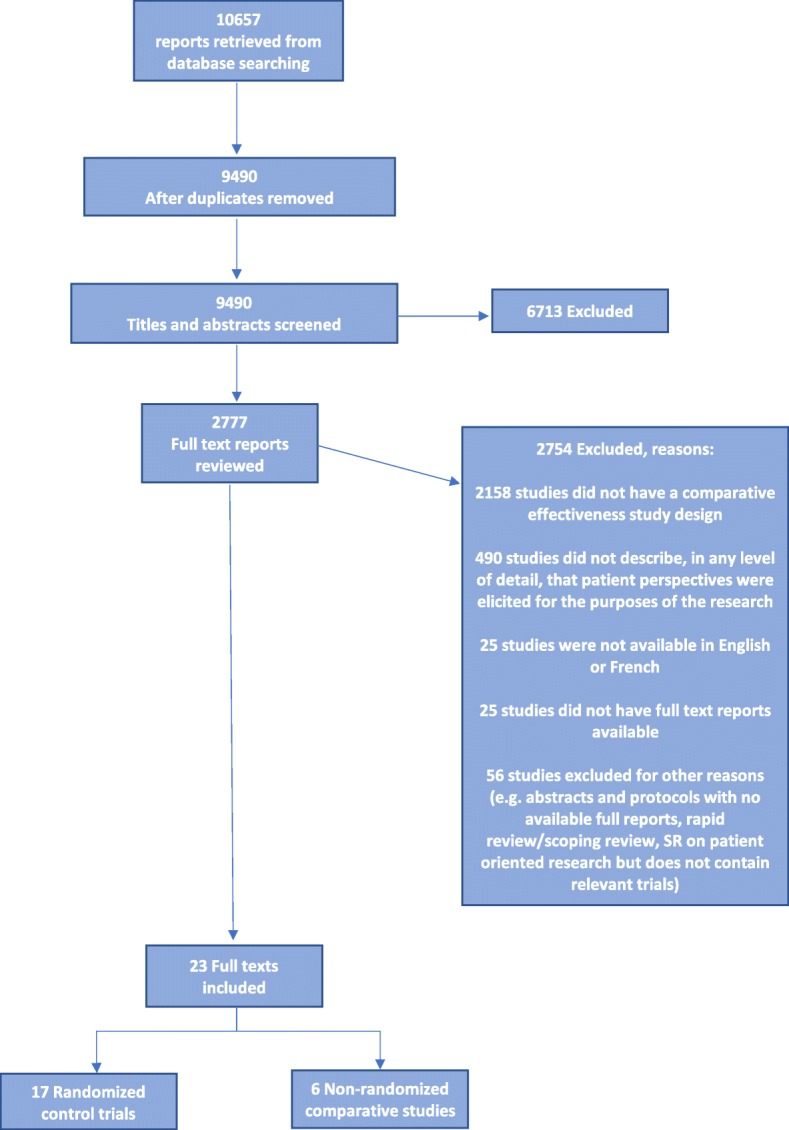
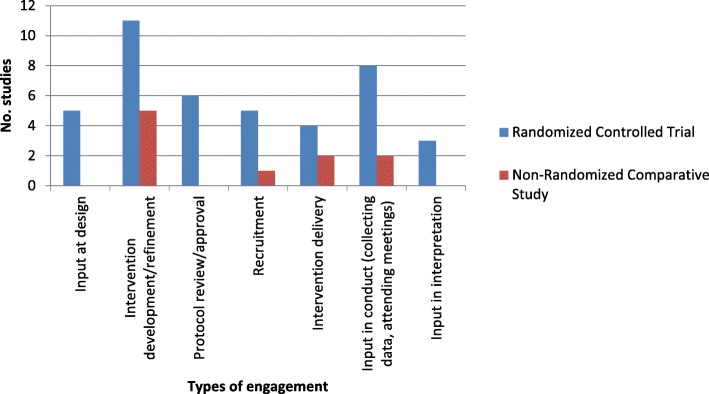
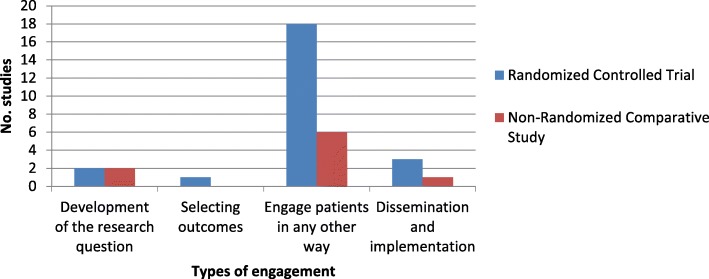
Of the 9490 citations retrieved, 2777 were reviewed at full text, of which 23 trials were included. Out of the 23 trials, 17 were randomized control trials, and six were non-randomized comparative trials. The majority of these trials (83%, 19/23) originated in the United States and United Kingdom. The trials engaged a range of 2-24 patients/ community representatives per study. Engagement of children and minorities occurred in 13% (3/23) and 26% (6/23) of trials; respectively. Engagement was identified in the development of the research question, the selection of study outcomes, and the dissemination and implementation of results.
The prevalence of patient engagement in patient-oriented interventional research is very poor with 23 trials reporting activities engaging patients. Research dedicated to determining the best practice for meaningful engagement is still needed, but adequate reporting measures also need to be defined.
随着让患者参与研究的行动日益兴起,人们开始质疑谁在让患者参与以及如何让他们参与。在国际上,研究团队正在支持并资助以患者为导向的研究项目,这些项目让患者参与确定研究重点以及研究的设计、实施和推广。在我们向前推进的过程中,我们需要了解有意义的患者参与是什么样的,它如何使研究和临床实践受益,以及患者参与的障碍是什么?我们对已发表的文献进行了综述,寻找报告让患者参与研究的试验。我们纳入了随机对照试验和非随机对照试验。我们研究这些试验的重要研究特征,包括患者如何参与,以便更好地理解试验中所采用的做法。重要的是,我们还讨论了报告患者参与做法的试验数量与所有已发表试验的相对比例。我们发现,尽管许多主要资助机构广泛支持,但很少有试验报告任何患者参与活动。我们的研究结果将通过展示如何让患者参与并强调需要更好地报告患者参与做法,来推动以患者为导向的研究。
以患者为导向的研究(POR)是基于患者的研究,以对他们重要的内容为核心。POR的一个基本要素是,从构思到传播和实施,患者被纳入研究过程的一个组成部分,进而在从基础研究到实用试验的整个研究连续体中也是如此[《比较疗效研究杂志》2012年,第1卷:第181 - 94页,《美国医学会杂志》2012年,第307卷:第1587 - 1588页]。自POR诞生以来,人们就一直在问如何最好地实现这一目标。我们对报告让患者参与其研究的随机对照试验和非随机对照试验进行了系统综述。我们的主要目标是描述已发表的让患者参与研究的试验的特征,并确定这些试验中报告的患者参与活动的程度。
2011年5月至2016年6月16日在MEDLINE®、EMBASE®、护理学与健康领域数据库(Cinahl)、心理学文摘数据库(PsycINFO)、Cochrane方法学注册库和PubMed中进行检索。由两名评审员独立对所有报告进行标题、摘要和全文筛选。由一名评审员从纳入的试验中提取数据,并由另一名评审员进行核实。所有报告为了研究目的让患者参与的试验都被纳入。
在检索到的9490条引文中,2777条进行了全文审阅,其中23项试验被纳入。在这23项试验中,17项是随机对照试验,6项是非随机对照试验。这些试验中的大多数(83%,19/23)起源于美国和英国。每项研究涉及的患者/社区代表人数在2至24人之间。儿童和少数族裔参与分别出现在13%(3/23)和26%(6/23)的试验中。在研究问题的制定、研究结果的选择以及结果的传播和实施中都发现了患者参与。
在以患者为导向的干预性研究中,患者参与的比例非常低,只有23项试验报告了让患者参与的活动。仍然需要致力于确定有意义参与的最佳实践的研究,但也需要定义充分的报告措施。