Polonis Katarzyna, Blackburn Patrick R, Urrutia Raul A, Lomberk Gwen A, Kruisselbrink Teresa, Cousin Margot A, Boczek Nicole J, Hoppman Nicole L, Babovic-Vuksanovic Dusica, Klee Eric W, Pichurin Pavel N
Department of Cardiovascular Medicine, Mayo Clinic, Rochester, Minnesota 55905, USA.
Department of Laboratory Medicine and Pathology, Mayo Clinic, Rochester, Minnesota 55905, USA.
Cold Spring Harb Mol Case Stud. 2018 Aug 1;4(4). doi: 10.1101/mcs.a002899. Print 2018 Aug.
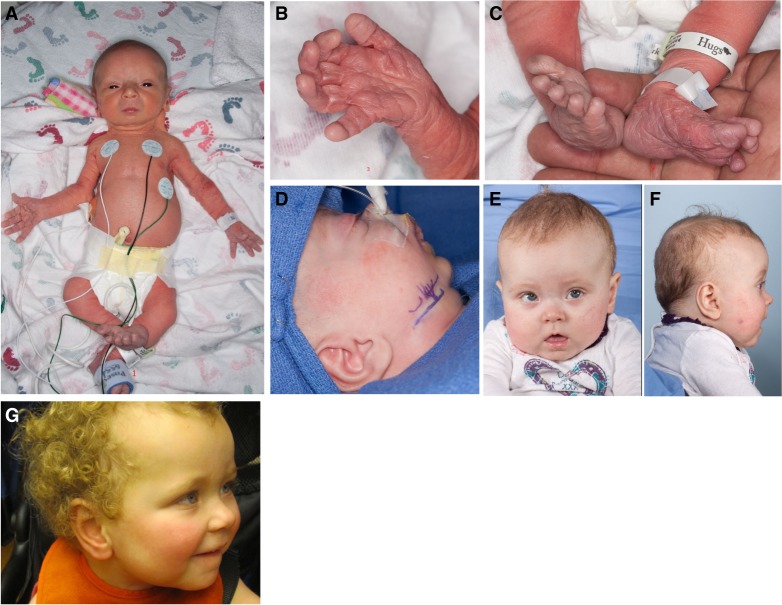
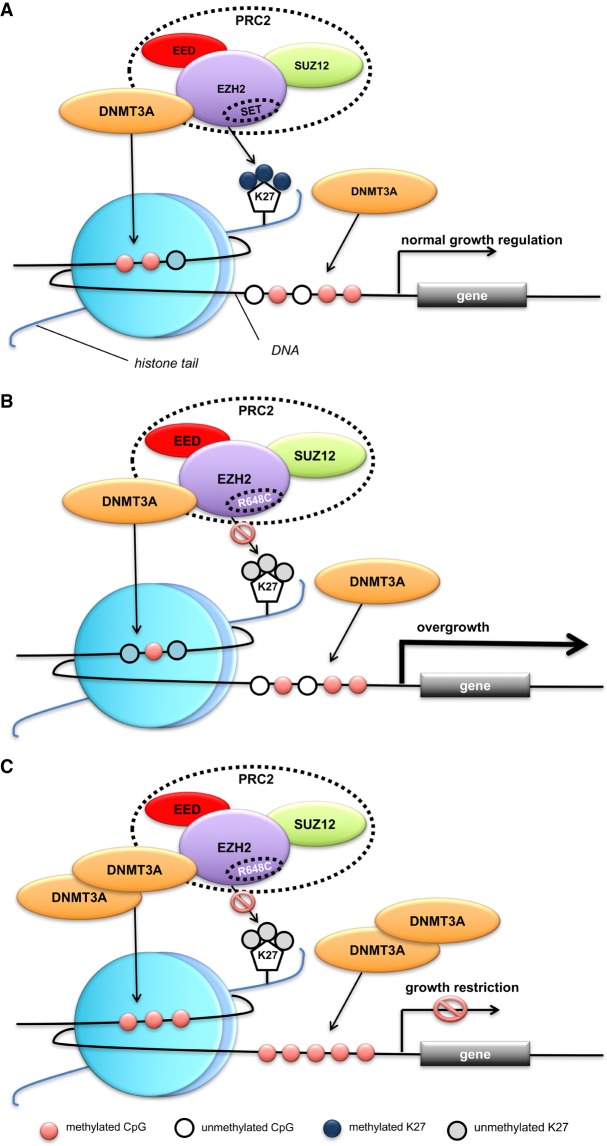
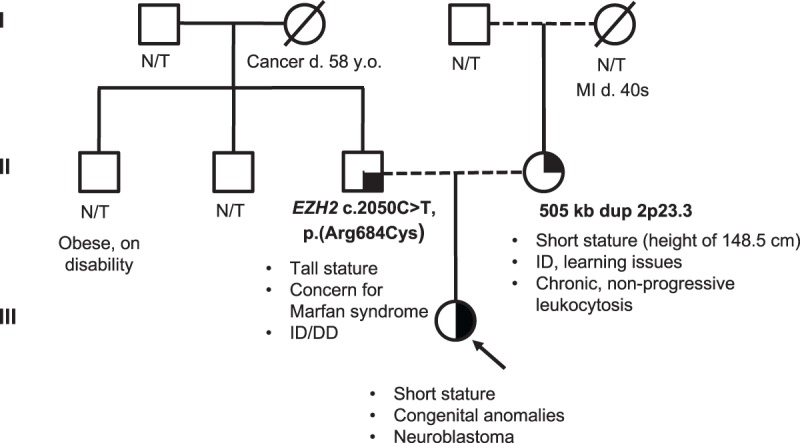
Overgrowth syndromes are a clinically heterogeneous group of disorders characterized by localized or generalized tissue overgrowth and varying degrees of developmental and intellectual disability. An expanding list of genes associated with overgrowth syndromes include the histone methyltransferase genes and , which cause Weaver and Sotos syndrome, respectively, and the DNA methyltransferase () gene that results in Tatton-Brown-Rahman syndrome (TBRS). Here, we describe a 5-year-old female with a paternally inherited pathogenic mutation in (c.2050C>T, p.Arg684Cys) and a maternally inherited 505-kb duplication of uncertain significance at 2p23.3 (encompassing five genes, including ) who presented with intrauterine growth restriction, slow postnatal growth, short stature, hypotonia, developmental delay, and neuroblastoma diagnosed at the age of 8 mo. Her father had tall stature, dysmorphic facial features, and intellectual disability consistent with Weaver syndrome, whereas her mother had short stature, cognitive delays, and chronic nonprogressive leukocytosis. It has been previously shown that EZH2 directly controls DNA methylation through physical association with DNMTs, including DNMT3A, with concomitant H3K27 methylation and CpG promoter methylation leading to repression of EZH2 target genes. Interestingly, NSD1 is involved in H3K36 methylation, a mark associated with transcriptional activation, and exhibits exquisite dosage sensitivity leading to overgrowth when deleted and severe undergrowth when duplicated in vivo. Although there is currently no evidence of dosage effects for , the co-occurrence of a duplication involving this gene and a pathogenic alteration in in a patient with severe undergrowth is suggestive of a similar paradigm and further study is warranted.
过度生长综合征是一组临床异质性疾病,其特征为局部或全身性组织过度生长以及不同程度的发育和智力残疾。与过度生长综合征相关的基因越来越多,包括分别导致韦弗综合征和索托斯综合征的组蛋白甲基转移酶基因 和 ,以及导致塔顿 - 布朗 - 拉赫曼综合征(TBRS)的DNA甲基转移酶()基因。在此,我们描述了一名5岁女性,她携带父系遗传的 基因致病性突变(c.2050C>T,p.Arg684Cys)以及母系遗传的2p23.3处505 kb意义不明的重复(包含五个基因,包括 ),该患者出现宫内生长受限、出生后生长缓慢、身材矮小、肌张力低下、发育迟缓,并在8个月大时被诊断出患有神经母细胞瘤。她的父亲身材高大,面部特征异常,且有与韦弗综合征相符的智力残疾,而她的母亲身材矮小,有认知延迟和慢性非进行性白细胞增多症。先前的研究表明,EZH2通过与包括DNMT3A在内的DNMTs直接物理结合来直接控制DNA甲基化,同时伴随H3K27甲基化和CpG启动子甲基化,导致EZH2靶基因的抑制。有趣的是,NSD1参与H3K36甲基化,这是一种与转录激活相关的标记,并且表现出精确的剂量敏感性,在体内缺失时导致过度生长,而重复时导致严重生长不足。尽管目前没有证据表明 存在剂量效应,但在一名严重生长不足的患者中,涉及该基因的重复与 基因的致病性改变同时出现,提示了类似的模式,值得进一步研究。