Key Laboratory of Tropical Marine Bio-resources and EcologyGuangdong Key Laboratory of Marine Materia Medica, RNAM Center for Marine Microbiology, South China Sea Institute of Oceanology, Chinese Academy of Sciences, 164 West Xingang Road, Guangzhou, 510301, China.
University of Chinese Academy of Sciences, 19 Yuquan Road, Beijing, 100049, China.
Nat Commun. 2018 May 25;9(1):2088. doi: 10.1038/s41467-018-04487-z.
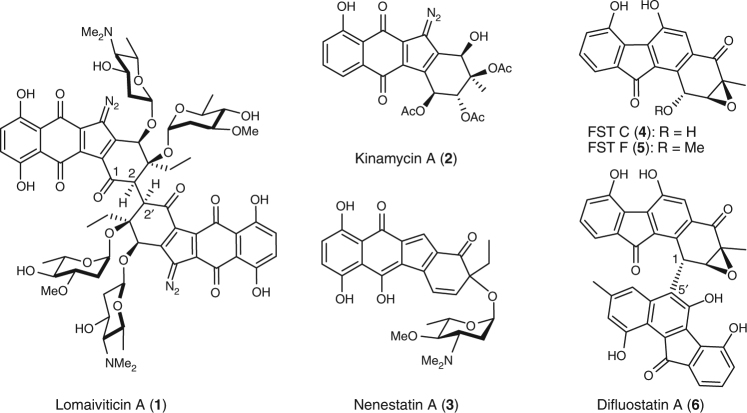
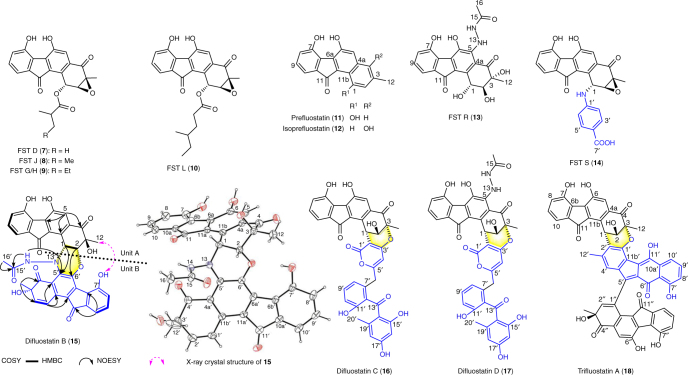
Lomaiviticin A and difluostatin A are benzofluorene-containing aromatic polyketides in the atypical angucycline family. Although these dimeric compounds are potent antitumor agents, how nature constructs their complex structures remains poorly understood. Herein, we report the discovery of a number of fluostatin type dimeric aromatic polyketides with varied C-C and C-N coupling patterns. We also demonstrate that these dimers are not true secondary metabolites, but are instead derived from non-enzymatic deacylation of biosynthetic acyl fluostatins. The non-enzymatic deacylation proceeds via a transient quinone methide like intermediate which facilitates the subsequent C-C/C-N coupled dimerization. Characterization of this unusual property of acyl fluostatins explains how dimerization takes place, and suggests a strategy for the assembly of C-C and C-N coupled aromatic polyketide dimers. Additionally, a deacylase FlsH was identified which may help to prevent accumulation of toxic quinone methides by catalyzing hydrolysis of the acyl group.
洛马维替丁 A 和双氟司他汀 A 是含苯并荧蒽的非典型蒽环类芳香聚酮类化合物。尽管这些二聚体化合物是有效的抗肿瘤剂,但自然界如何构建它们的复杂结构仍知之甚少。本文报道了一系列具有不同 C-C 和 C-N 偶联模式的氟司他汀型二聚芳香聚酮的发现。我们还证明这些二聚体不是真正的次级代谢产物,而是生物合成酰基氟司他汀的非酶脱酰基化产物。非酶脱酰基化通过瞬态醌甲亚胺中间体进行,该中间体有利于随后的 C-C/C-N 偶联二聚化。酰基氟司他汀这一不寻常性质的表征解释了二聚化是如何发生的,并为 C-C 和 C-N 偶联的芳香聚酮二聚体的组装提供了一种策略。此外,还鉴定了一种脱酰酶 FlsH,它可以通过催化酰基的水解来帮助防止有毒醌甲亚胺的积累。