Ma Xiao-Lu, Zhu Jing, Wu Jiong, Tian Lu, Gao Yao-Yi, Zhang Chun-Yan, Zhou Yan, Dai Qian, Wang Bei-Li, Pan Bai-Shen, Zhou Jian, Fan Jia, Yang Xin-Rong, Guo Wei
Department of Laboratory Medicine, Zhongshan Hospital, Fudan University, Shanghai 200032, P.R. China.
Department of Liver Surgery, Liver Cancer Institute, Zhongshan Hospital, Fudan University, Key Laboratory of Carcinogenesis and Cancer Invasion, Ministry of Education, Shanghai 200032, P.R. China.
Oncol Lett. 2018 Jun;15(6):8396-8404. doi: 10.3892/ol.2018.8375. Epub 2018 Mar 29.
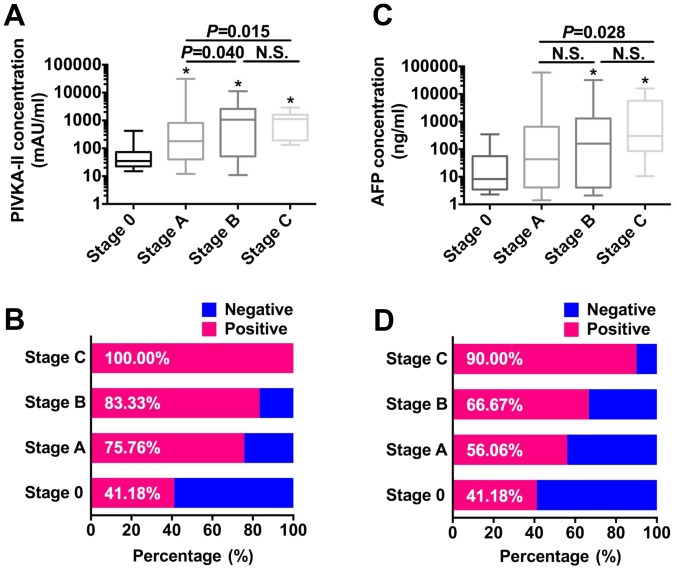
The present study aimed to determine the levels of prothrombin induced by vitamin K absence-II (PIVKA-II) according to the Barcelona Clinic Liver Cancer (BCLC) staging system, to develop an appropriate strategy for managing hepatocellular carcinoma (HCC), particularly early HCC, and to investigate the value of PIVKA-II for predicting prognosis-associated pathological parameters. Clinical information of 117 patients with hepatitis B-associated HCC was retrospectively collected. Preoperative serum PIVKA-II and α-fetoprotein (AFP) levels were measured using a chemiluminescence method. The efficiency of PIVKA-II levels for predicting pathological parameters was evaluated using step-wise logistic regression. The receiver operator characteristic curve was used to evaluate the predictive performance of PIVKA-II levels. It was demonstrated that except for the difference between stages B and C HCC (P=0.923), serum PIVKA-II levels significantly increased according to BCLC stage (P<0.050), however AFP levels did not. In early HCC (stage 0+A), the correlation between PIVKA-II and AFP levels (dual-positive, 64.70% in stage 0; 46.97% in stage A) was relatively weak (r=0.410). PIVKA-II >40 mAU/ml was an independent predictor of microvascular invasion [hazard ratio (HR), 3.77; 95% confidence interval (CI), 1.31-10.88; P=0.014; and high Ki67 expression (HR, 2.99; 95% CI, 1.19-7.52; P=0.020). Combined analysis of PIVKA and AFP levels may contribute to an effective strategy for the management of patients with early HCC, as high PIVKA-II levels indicated a more aggressive tumor phenotype. Further investigation of PIVKA-II levels may provide novel insights into the mechanism underlying the metastasis of HCC cells and facilitate the development of novel therapeutic strategies for HCC.
本研究旨在根据巴塞罗那临床肝癌(BCLC)分期系统确定维生素K缺乏诱导蛋白-II(PIVKA-II)水平,制定管理肝细胞癌(HCC)尤其是早期HCC的合适策略,并研究PIVKA-II对预测预后相关病理参数的价值。回顾性收集了117例乙型肝炎相关HCC患者的临床信息。采用化学发光法检测术前血清PIVKA-II和甲胎蛋白(AFP)水平。使用逐步逻辑回归评估PIVKA-II水平预测病理参数的效能。采用受试者工作特征曲线评估PIVKA-II水平的预测性能。结果表明,除了B期和C期HCC之间的差异外(P=0.923),血清PIVKA-II水平根据BCLC分期显著升高(P<0.050),而AFP水平则不然。在早期HCC(0+A期)中,PIVKA-II与AFP水平之间的相关性(双阳性,0期为64.70%;A期为46.97%)相对较弱(r=0.410)。PIVKA-II>40 mAU/ml是微血管侵犯的独立预测因素[风险比(HR),3.77;95%置信区间(CI),1.31-10.88;P=0.014]以及高Ki67表达(HR,2.99;95%CI,1.19-7.52;P=0.020)。PIVKA和AFP水平的联合分析可能有助于制定早期HCC患者的有效管理策略,因为高PIVKA-II水平表明肿瘤表型更具侵袭性。对PIVKA-II水平的进一步研究可能为HCC细胞转移的潜在机制提供新见解,并促进HCC新治疗策略的开发。