Department of Internal Medicine II, University Hospital Regensburg, Franz-Josef-Strauss-Allee 11, 93053 Regensburg, Germany.
Department of Nephrology, University Hospital Regensburg, Franz-Josef-Strauss-Allee 11, 93053 Regensburg, Germany.
J Diabetes Res. 2018 Apr 1;2018:7617524. doi: 10.1155/2018/7617524. eCollection 2018.
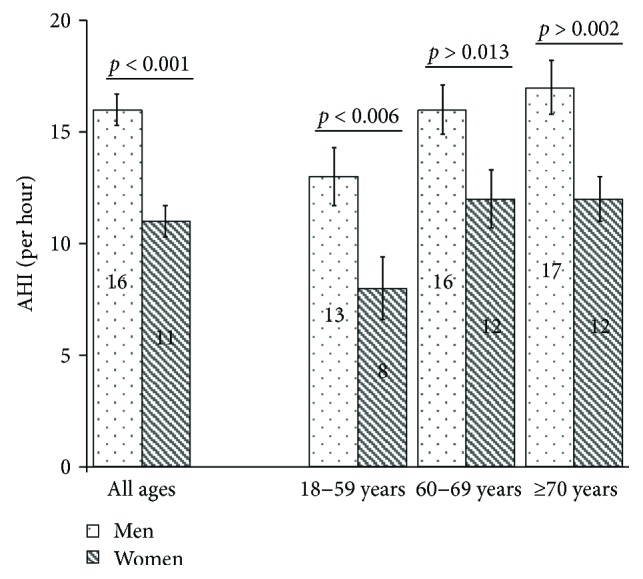
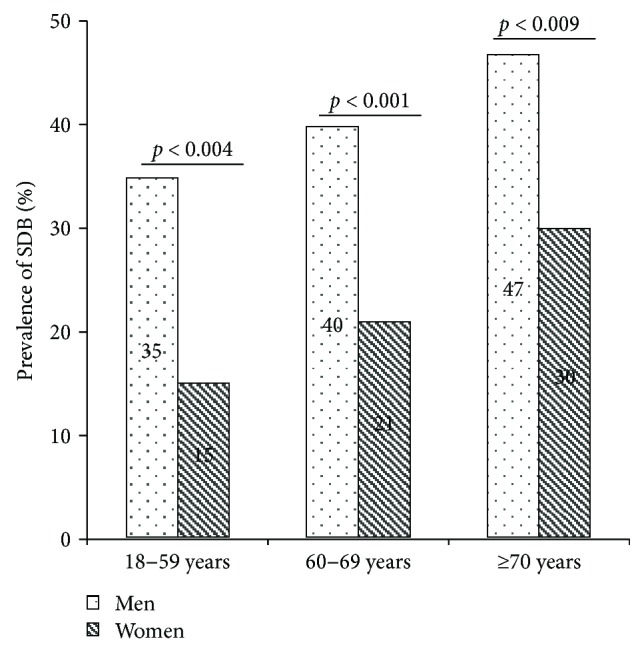
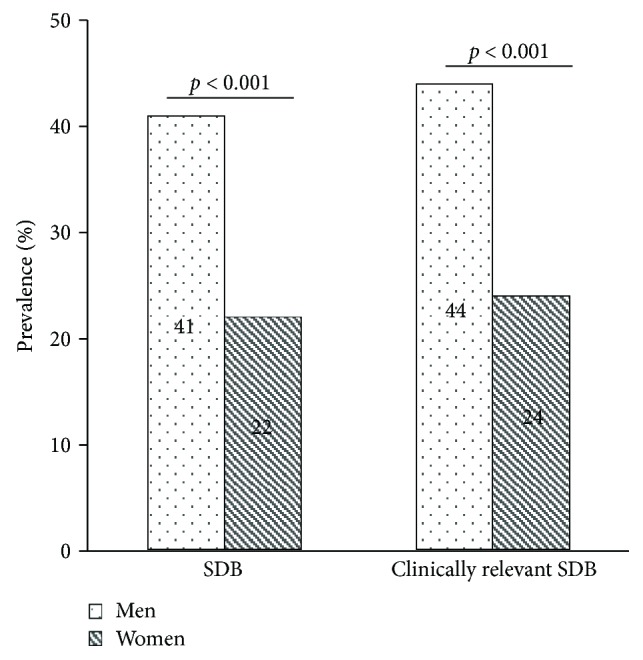
In patients with type 2 diabetes, sleep-disordered breathing is a widespread cause of deteriorated quality of life. However, robust prevalence estimates for sleep-disordered breathing in patients with type 2 diabetes are limited due to scarce data. We investigated sex differences in sleep-disordered breathing prevalence and its modulators in the DIACORE SDB substudy, a sample of outpatient type 2 diabetes. 721 participants were tested for sleep-disordered breathing using a two-channel sleep apnoea monitoring device. Patients were stratified according to the severity of sleep-disordered breathing, defined as an apnoea-hypopnoea index < 15, ≥15 to 29, and ≥30 events per hour as no/mild, moderate, and severe sleep-disordered breathing, respectively. In the 679 analysed patients (39% women, age 66 ± 9 years, body mass index 31.0 ± 5.4 kg/m), the prevalence of sleep-disordered breathing was 34%. The prevalence of sleep-disordered breathing was higher in men than in women (41% versus 22%, < 0.001) and increased with age (15%, 21%, and 30% in women and 35%, 40%, and 47% in men in those aged 18-59, 60-69, or ≥70, respectively; age trend = 0.064 in women and = 0.15 in men). In linear regression analysis, age, BMI, and waist-hip ratio were associated with apnoea-hypopnoea index. Modulators for higher apnoea-hypopnoea index seem to be similar in men and women.
在 2 型糖尿病患者中,睡眠呼吸紊乱是导致生活质量恶化的一个普遍原因。然而,由于数据稀缺,睡眠呼吸紊乱在 2 型糖尿病患者中的患病率估计值并不准确。我们在 DIACORE SDB 子研究中调查了睡眠呼吸紊乱在男性和女性中的患病率差异及其调节因素,该研究是一个 2 型糖尿病门诊患者的样本。721 名参与者使用双通道睡眠呼吸暂停监测设备进行睡眠呼吸紊乱测试。根据睡眠呼吸紊乱的严重程度对患者进行分层,定义为呼吸暂停低通气指数<15、15 至 29 和≥30 次/小时分别为无/轻度、中度和重度睡眠呼吸紊乱。在 679 名分析患者(39%为女性,年龄 66±9 岁,体重指数 31.0±5.4kg/m2)中,睡眠呼吸紊乱的患病率为 34%。男性睡眠呼吸紊乱的患病率高于女性(41%比 22%,<0.001),且随年龄增长而增加(女性分别为 15%、21%和 30%,年龄为 18-59、60-69 或≥70 岁;男性分别为 35%、40%和 47%;年龄趋势在女性中为 0.064,在男性中为 0.15)。在线性回归分析中,年龄、BMI 和腰臀比与呼吸暂停低通气指数相关。导致呼吸暂停低通气指数较高的调节因素在男性和女性中似乎相似。