Brenninger Christoph, Jolliffe John D, Bach Thorsten
Lehrstuhl für Organische Chemie I and Catalysis Research Center (CRC), Technische Universität München, Lichtenbergstr. 4, 85747, Garching, Germany.
Angew Chem Int Ed Engl. 2018 Oct 26;57(44):14338-14349. doi: 10.1002/anie.201804006. Epub 2018 Jul 5.
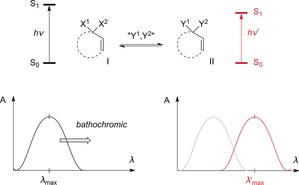
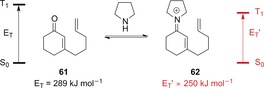
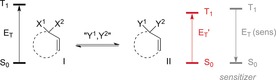
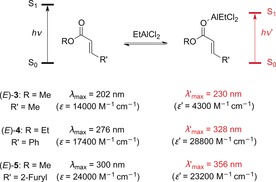
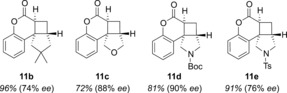
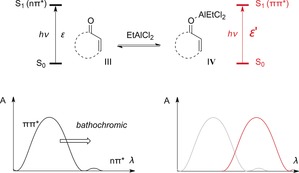
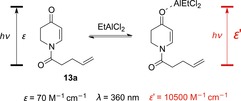
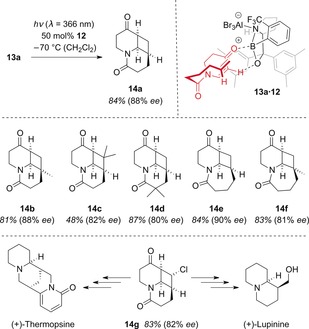
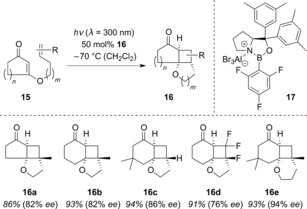
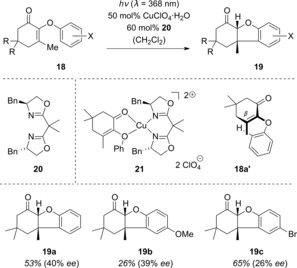
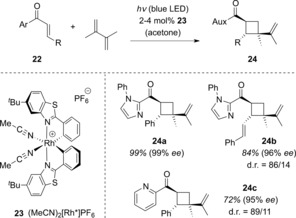
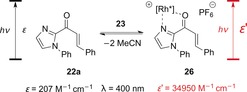
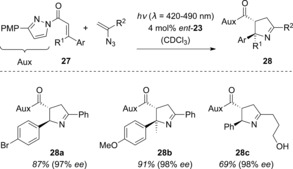
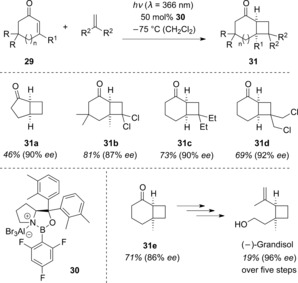
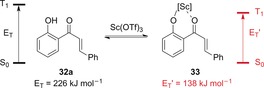
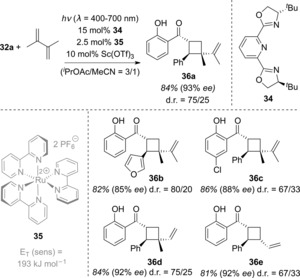
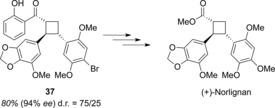
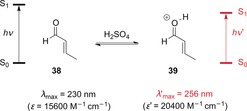
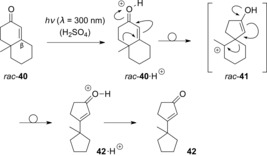
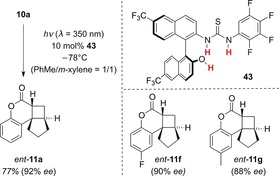
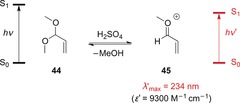
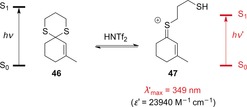
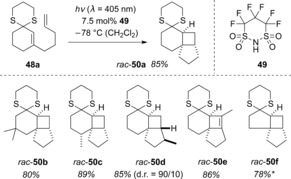
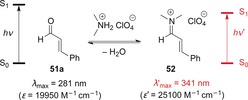
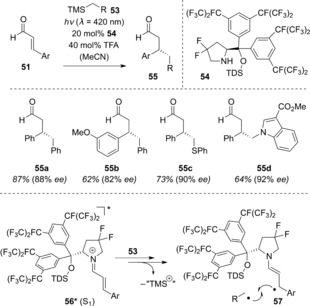
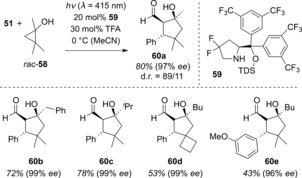
The first law of photochemistry, as described by Theodor von Grotthuß and John W. Draper, states that only the light absorbed by the irradiated matter can effect photochemical change. Consequently, the photochemical behavior of a molecule can be controlled by bringing its absorbance properties in line with the emission of the light source. A compound with a chromophore that only absorbs light at short wavelengths will not be excited by light of longer wavelengths. If one can reversibly modify the photophysical properties of a compound with a chemical activator, then it is possible to photoexcite only the activated species. For α,β-unsaturated carbonyl compounds, the use of Lewis acids, Brønsted acids, or the formation of the respective iminium ions can bring about the desired chromophore activation to catalyze a photochemical reaction at a given wavelength. In this Minireview, the concept of chromophore activation will be illustrated, and examples of its implementation in enantioselective catalysis will be discussed.
正如西奥多·冯·格罗特斯和约翰·W·德雷珀所描述的,光化学第一定律指出,只有被辐照物质吸收的光才能引起光化学变化。因此,通过使分子的吸收特性与光源的发射相匹配,可以控制分子的光化学行为。一个仅在短波长吸收光的发色团化合物不会被长波长的光激发。如果能用化学活化剂可逆地改变化合物的光物理性质,那么就有可能仅光激发活化的物种。对于α,β - 不饱和羰基化合物,使用路易斯酸、布朗斯特酸或形成相应的亚胺离子可以实现所需的发色团活化,从而在给定波长下催化光化学反应。在这篇微型综述中,将阐述发色团活化的概念,并讨论其在对映选择性催化中的应用实例。