Department of Epidemiology, School of Public Health, Shahid Beheshti University of Medical Sciences, Tehran, Iran.
Safety Promotion and Injury Prevention Research Center, Shahid Beheshti University of Medical Sciences, Tehran, Iran.
Epidemiol Health. 2018 May 21;40:e2018021. doi: 10.4178/epih.e2018021. eCollection 2018.
We analyzed dietary patterns using reduced rank regression (RRR), and assessed how well the scores extracted by RRR predicted stroke in comparison to the scores produced by partial least squares and principal component regression models.
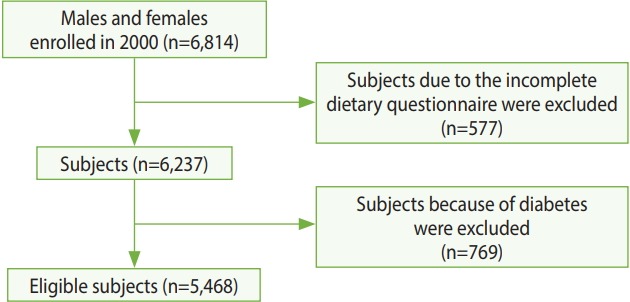
Dietary data at baseline were used to extract dietary patterns using the 3 methods, along with 4 response variables: body mass index, fibrinogen, interleukin-6, and low-density lipoprotein cholesterol. The analyses were based on 5,468 males and females aged 45-84 years who had no clinical cardiovascular disease, using data from the Multi-Ethnic Study of Atherosclerosis.
The primary factor derived by RRR was positively associated with stroke incidence in both models. The first model was adjusted for sex and race and the second model was adjusted for the variables in model 1 as well as smoking, physical activity, family and sibling history of stroke, the use of any lipid-lowering medication, the use of any anti-hypertensive medication, hypertension, and history of myocardial infarction (model 1: hazard ratio [HR], 7.49; 95% confidence interval [CI], 1.66 to 33.69; p for trend=0.01; model 2: HR, 6.83; 95% CI, 1.51 to 30.87 for quintile 5 compared with the reference category; p for trend=0.02).
Based primarily on RRR, we identified that a dietary pattern high in fats and oils, poultry, non-diet soda, processed meat, tomatoes, legumes, chicken, tuna and egg salad, and fried potatoes and low in dark-yellow and cruciferous vegetables may increase the incidence of ischemic stroke.
我们使用降秩回归(RRR)分析饮食模式,并评估通过 RRR 提取的评分与偏最小二乘法和主成分回归模型产生的评分相比,预测中风的效果如何。
使用 3 种方法以及 4 个响应变量(体重指数、纤维蛋白原、白细胞介素-6 和低密度脂蛋白胆固醇)在基线时的饮食数据提取饮食模式。该分析基于 5468 名年龄在 45-84 岁之间、无临床心血管疾病的男性和女性,使用来自动脉粥样硬化多民族研究的数据。
RRR 得出的主要因素与两种模型中的中风发生率呈正相关。第一个模型调整了性别和种族,第二个模型除了模型 1 中的变量外,还调整了吸烟、身体活动、中风家族史和兄弟姐妹史、使用任何降脂药物、使用任何抗高血压药物、高血压和心肌梗死史(模型 1:风险比 [HR],7.49;95%置信区间 [CI],1.66 至 33.69;趋势检验 p 值=0.01;模型 2:与参考类别相比,五分位数 5 的 HR,6.83;95%CI,1.51 至 30.87;趋势检验 p 值=0.02)。
主要基于 RRR,我们确定了一种高脂肪和油、家禽、无糖汽水、加工肉类、西红柿、豆类、鸡肉、金枪鱼和鸡蛋沙拉、炸土豆和深色蔬菜和十字花科蔬菜含量低的饮食模式可能会增加缺血性中风的发生率。