Veltsos Paris, Cossard Guillaume, Beaudoing Emmanuel, Beydon Genséric, Savova Bianchi Dessislava, Roux Camille, C González-Martínez Santiago, R Pannell John
Department of Ecology and Evolution, University of Lausanne, 1015 Lausanne, Switzerland.
Department of Biology, Jordan Hall, 1001 East Third Street, Indiana University, Bloomington, IN 47405, USA.
Genes (Basel). 2018 May 29;9(6):277. doi: 10.3390/genes9060277.
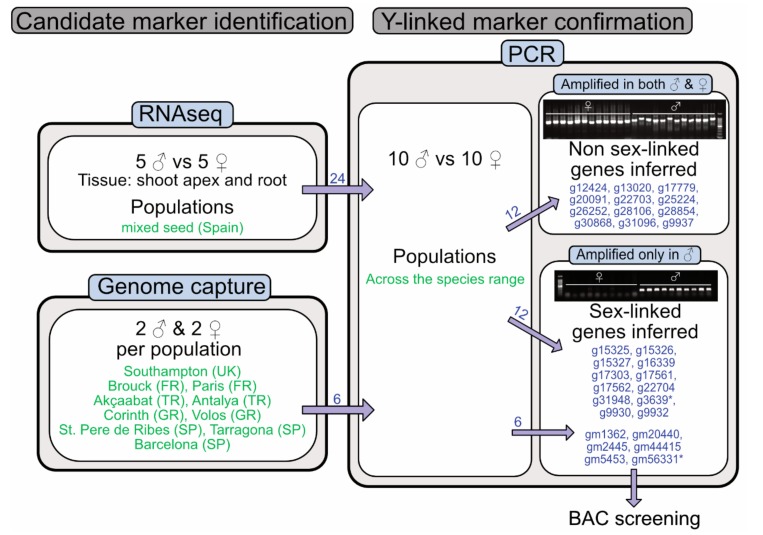
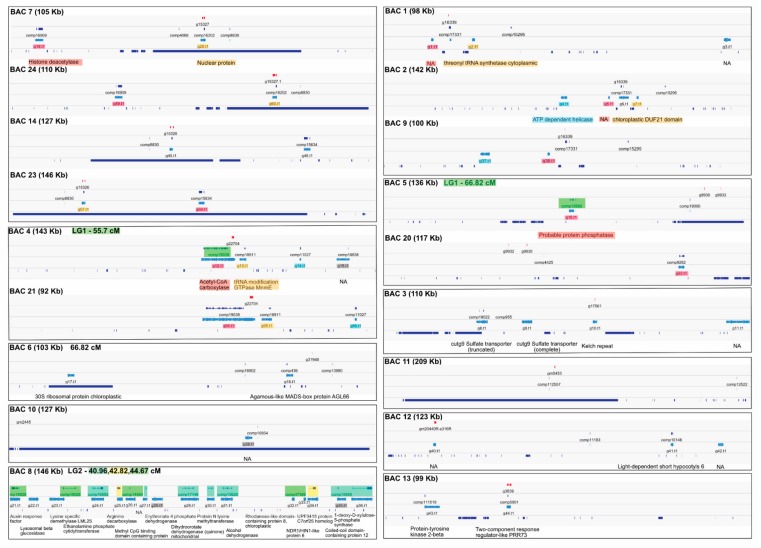
Dioecious plants vary in whether their sex chromosomes are heteromorphic or homomorphic, but even homomorphic sex chromosomes may show divergence between homologues in the non-recombining, sex-determining region (SDR). Very little is known about the SDR of these species, which might represent particularly early stages of sex-chromosome evolution. Here, we assess the size and content of the SDR of the diploid dioecious herb , a species with homomorphic sex chromosomes and mild Y-chromosome degeneration. We used RNA sequencing (RNAseq) to identify new Y-linked markers for Twelve of 24 transcripts showing male-specific expression in a previous experiment could be amplified by polymerase chain reaction (PCR) only from males, and are thus likely to be Y-linked. Analysis of genome-capture data from multiple populations of pointed to an additional six male-limited (and thus Y-linked) sequences. We used these markers to identify and sequence 17 sex-linked bacterial artificial chromosomes (BACs), which form 11 groups of non-overlapping sequences, covering a total sequence length of about 1.5 Mb. Content analysis of this region suggests that it is enriched for repeats, has low gene density, and contains few candidate sex-determining genes. The BACs map to a subset of the sex-linked region of the genetic map, which we estimate to be at least 14.5 Mb. This is substantially larger than estimates for other dioecious plants with homomorphic sex chromosomes, both in absolute terms and relative to their genome sizes. Our data provide a rare, high-resolution view of the homomorphic Y chromosome of a dioecious plant.
雌雄异株植物的性染色体在是否异形方面存在差异,但即使是同形性染色体,在非重组的性别决定区域(SDR)的同源染色体之间也可能表现出差异。对于这些物种的SDR知之甚少,它们可能代表了性染色体进化的特别早期阶段。在这里,我们评估了二倍体雌雄异株草本植物的SDR的大小和内容,该物种具有同形性染色体和轻度的Y染色体退化。我们使用RNA测序(RNAseq)来鉴定新的Y连锁标记。在先前的实验中显示雄性特异性表达的24个转录本中的12个可以通过聚合酶链反应(PCR)仅从雄性中扩增出来,因此可能是Y连锁的。对来自多个种群的基因组捕获数据的分析指出了另外六个雄性受限(因此是Y连锁)序列。我们使用这些标记来鉴定和测序17个性连锁细菌人工染色体(BAC),它们形成11组不重叠的序列,总序列长度约为1.5 Mb。该区域的内容分析表明,它富含重复序列,基因密度低,并且包含很少的候选性别决定基因。BAC定位到遗传图谱性连锁区域的一个子集,我们估计该区域至少为14.5 Mb。这在绝对数量上以及相对于它们的基因组大小而言,都比其他具有同形性染色体的雌雄异株植物的估计值大得多。我们的数据提供了一种罕见的、高分辨率的雌雄异株植物同形Y染色体视图。