1 Institute of Social Medicine and Prevention, University Medicine Greifswald , Greifswald, Germany.
2 Department of Psychiatry and Psychotherapy, Research Group S:TEP, University of Lübeck , Lübeck, Germany.
J Behav Addict. 2018 Jun 1;7(2):384-391. doi: 10.1556/2006.7.2018.38. Epub 2018 May 30.
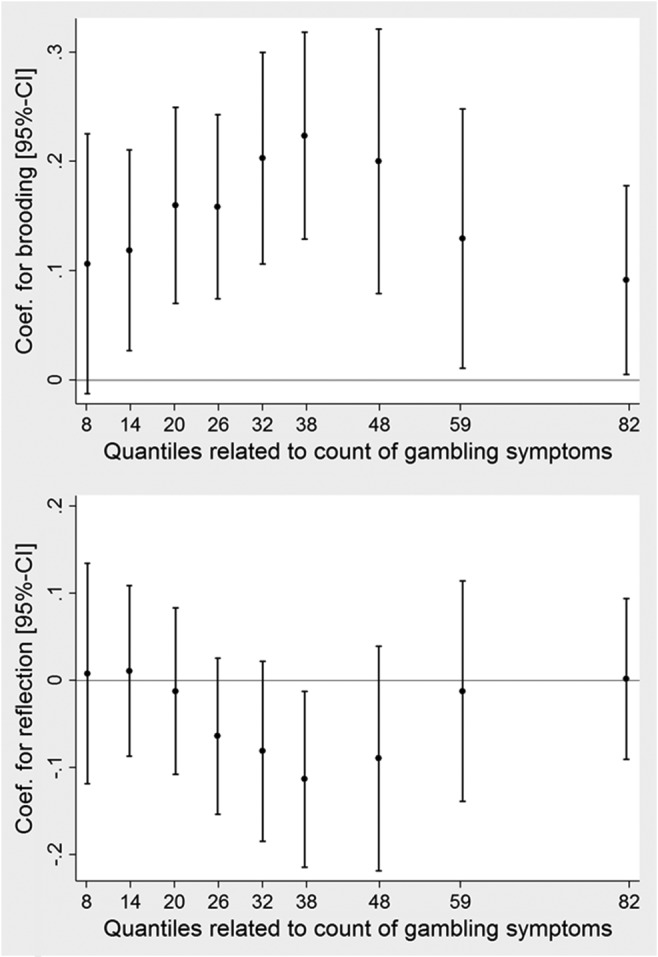
Background and aims Symptoms of pathological gambling (SPG) and depression often co-occur. The nature of this relationship remains unclear. Rumination, which is well known to be associated with depression, might act as a common underlying factor explaining the frequent co-occurrence of both conditions. The aim of this study is to analyze associations between the rumination subfactors brooding and reflection and SPG. Methods Participants aged 14-64 years were recruited within an epidemiological study on pathological gambling in Germany. Cross-sectional data of 506 (80.4% male) individuals with a history of gambling problems were analyzed. The assessment included a standardized clinical interview. To examine the effects of rumination across different levels of problem gambling severity, sequential quantile regression was used to analyze the association between the rumination subfactors and SPG. Results Brooding (p = .005) was positively associated with the severity of problem gambling after adjusting for reflection, depressive symptoms, and sociodemographic variables. Along the distribution of problem gambling severity, findings hold for all but the lowest severity level. Reflection (p = .347) was not associated with the severity of problem gambling at the median. Along the distribution of problem gambling severity, there was an inverse association at only one quantile. Discussion and conclusions Brooding might be important in the development and maintenance of problem gambling. With its relations to depression and problem gambling, it might be crucial when it comes to explaining the high comorbidity rates between SPG and depression. The role of reflection in SPG remains inconclusive.
病理性赌博(SPG)和抑郁的症状经常同时出现。这种关系的性质尚不清楚。反刍,这是众所周知的与抑郁有关,可能作为一个共同的潜在因素,解释这两种情况的频繁共病。本研究的目的是分析沉思的反刍和反思亚因素与 SPG 之间的关系。
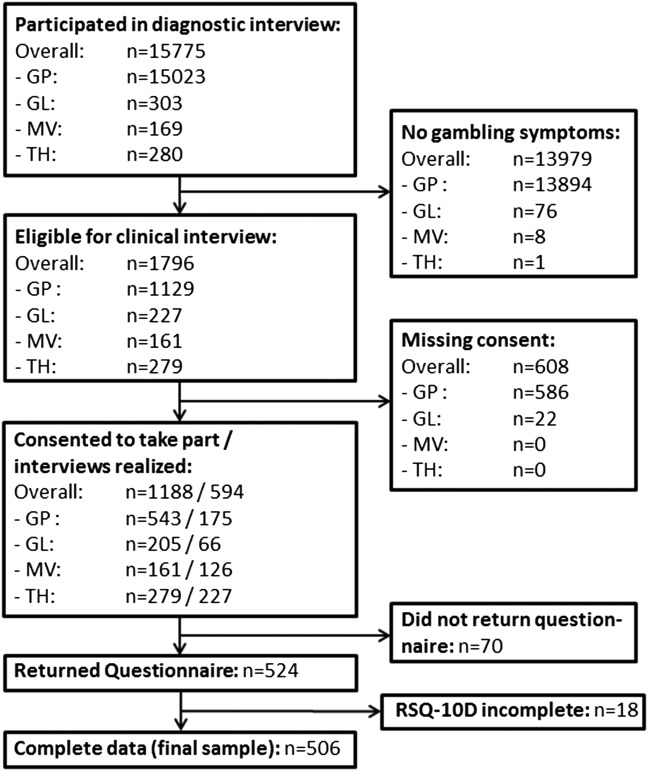
在德国一项病理性赌博的流行病学研究中,招募了年龄在 14-64 岁之间的参与者。对 506 名(80.4%为男性)有赌博问题史的个体的横断面数据进行了分析。评估包括标准化临床访谈。为了研究反刍在不同程度的赌博问题严重程度下的影响,我们使用顺序分位数回归来分析反刍亚因素与 SPG 之间的关系。
调整了反思、抑郁症状和社会人口学变量后,反刍(p=0.005)与赌博问题严重程度呈正相关。沿着赌博问题严重程度的分布,除了最低严重程度水平外,这一发现均成立。反思(p=0.347)与中值的赌博问题严重程度无关。沿着赌博问题严重程度的分布,只有一个分位数存在反向关联。
反刍可能在赌博问题的发展和维持中很重要。由于其与抑郁和赌博问题的关系,当涉及到解释 SPG 和抑郁之间的高共病率时,它可能是至关重要的。反思在 SPG 中的作用仍不确定。