School of Science and Engineering, University of the Sunshine Coast, Hervey Bay, Queensland, Australia.
Centre of Excellence in Biological Interactions, Department of Biological and Environmental Science, University of Jyväskylä, Jyväskylä, Finland.
PLoS One. 2018 May 30;13(5):e0197280. doi: 10.1371/journal.pone.0197280. eCollection 2018.
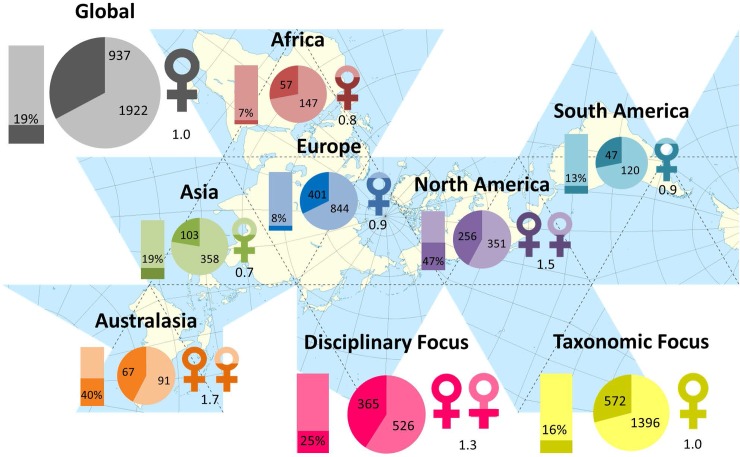
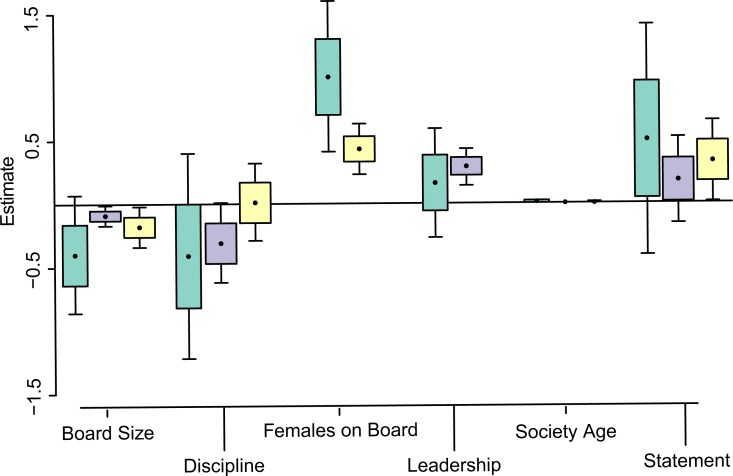
Research shows that gender inequality is still a major issue in academic science, yet academic societies may serve as underappreciated and effective avenues for promoting female leadership. That is, society membership is often self-selective, and board positions are elected (with a high turnover compared to institutions)-these characteristics, among others, may thus create an environment conducive to gender equality. We therefore investigate this potential using an information-theoretic approach to quantify gender equality (male:female ratios) in zoology society boards around the world. We compare alternative models to analyze how society characteristics might predict or correlate with the proportion of female leaders, and find that a cultural model, including society age, size of board and whether or not a society had an outward commitment or statement of equality, was the most informative predictor for the gender ratio of society boards and leadership positions. This model was more informative than alternatives that considered, for instance, geographic location, discipline of study or taxonomic focus. While women were more highly represented in society leadership than in institutional academic leadership, this representation was still far short of equal (~30%): we thus also provide a checklist and recommendations for societies to contribute to global gender equality in science.
研究表明,性别不平等仍然是学术科学界的一个主要问题,但学术协会可能是被低估了的、促进女性领导力的有效途径。也就是说,学会成员通常是自我选择的,而理事会职位是通过选举产生的(与机构相比,更替率很高)——除其他特点外,这些特点可能创造了一个有利于性别平等的环境。因此,我们使用信息论方法来量化全球动物学学会理事会中的性别平等(男女比例),从而研究这种潜在情况。我们比较了替代模型,以分析学会的特点如何预测或与女性领导人的比例相关,并发现一个文化模型(包括学会的年龄、理事会规模以及学会是否对外承诺或声明平等)是预测学会理事会和领导职位性别比例最具信息量的指标。该模型比考虑地理位置、研究学科或分类重点等替代模型更具信息量。尽管女性在学会领导中的代表性高于机构学术领导中的代表性,但仍远远没有达到平等(约 30%):因此,我们还为学会提供了一份清单和建议,以促进科学界的全球性别平等。