Hematology Oncology Center, Beijing Children's Hospital, Capital Medical University, Beijing Key Laboratory of Pediatric Hematology Oncology, National Key Discipline of Pediatrics, Ministry of Education, Beijing 100045, China.
Department of Pediatrics and Laboratory Medicine, and Hemophilia Clinic, Children's Hospital of Eastern Ontario and University of Ottawa, Ottawa, Ontario, K1H 8L1, Canada.
Chin Med J (Engl). 2018 Aug 5;131(15):1780-1785. doi: 10.4103/0366-6999.233604.
Although much attention has been paid to the pharmacokinetics (PKs) of different factor VIII (FVIII) concentrates in persons with hemophilia A (HA), limited information is available in young boys with severe HA. In this study, we aimed to assess the PK parameters of FVIII products in boys with severe HA in China.
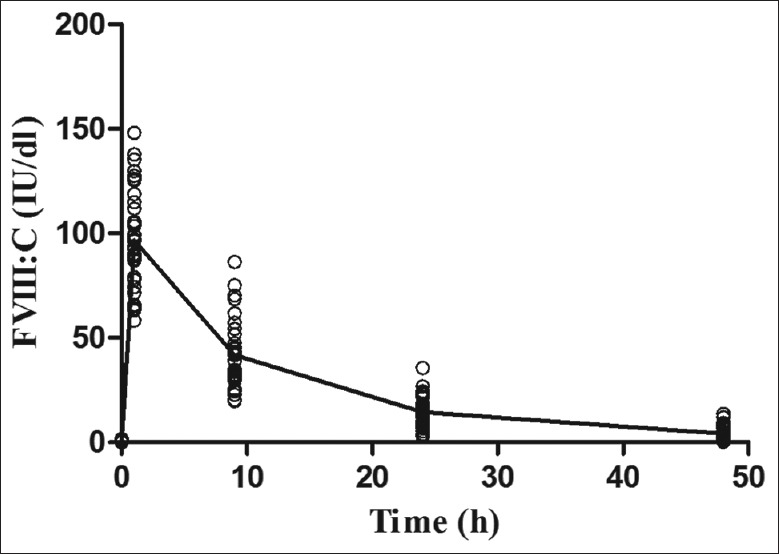
A total of 36 boys (plasma-derived [pd]-FVIII, n = 15; recombinant [r] FVIII, n = 21) were enrolled between January 2015 and May 2016 in Beijing Children's Hospital. PK characteristics of FVIII products were studied according to a reduced 4-sampling time point design (1 h, 9 h, 24 h, and 48 h postinfusion).
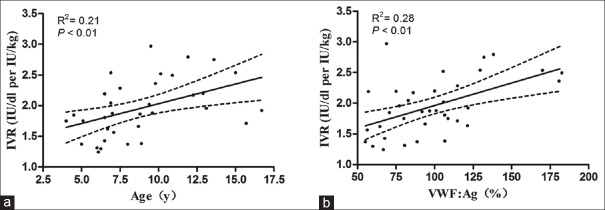
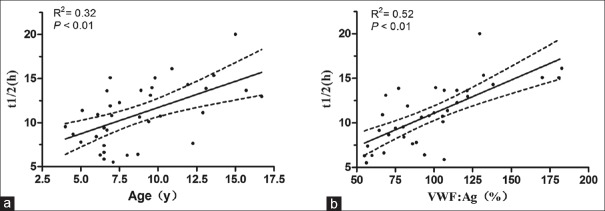
The mean FVIII half-life (t) was 10.99 ± 3.45 h (range 5.52-20.02 h), the mean in vivo recovery (IVR) was 2.01 ± 0.42 IU/dl per IU/kg (range 1.24-3.02 IU/dl per IU/kg) and mean clearance (CL) of FVIII is 4.34 ± 1.58 ml·kg·h (range 2.29-7.90 ml·kg·h). We also analyzed the influence of several parameters that potentially modulate FVIII PK. The age was closely associated with FVIII half-life (R = 0.32, P < 0.01). The tof FVIII increased by 0.59 h per year. Besides age, von Willebrand factor antigen (VWF:Ag) also was associated with FVIII half-life (R = 0.52, P < 0.01). Patients with blood Group O had a shorter FVIII half-life than patients with non-O blood group (9.40 ± 0.68 h vs. 12.3 ± 0.79 h, t = 2.70, P = 0.01). The FVIII IVR correlated with age (R = 0.21, P < 0.01) and VWF:Ag level (R = 0.28, P < 0.01). CL rates were faster in young patients and in those with low-VWF:Ag levels. CL rates of FVIII are higher in blood Group O versus non-blood Group O persons (5.02 ± 0.38 vs. 4.00 ± 0.32 ml·kg·h, t = 2.53, P = 0.02).
Chinese boys with severe HA have similar PK values to other ethnic groups and large differences in FVIII PK between individual patients. Age, blood group, and VWF:Ag levels are important determining factors for FVIII CL.
虽然人们对不同凝血因子 VIII (FVIII) 浓缩物在甲型血友病 (HA) 患者中的药代动力学 (PK) 进行了大量研究,但在严重 HA 的年轻男孩中,相关信息有限。在这项研究中,我们旨在评估中国严重 HA 男孩 FVIII 产品的 PK 参数。
2015 年 1 月至 2016 年 5 月期间,共招募了 36 名男孩(血浆衍生 [pd]-FVIII,n=15;重组 [r] FVIII,n=21)。根据简化的 4 个时间点采样设计(输注后 1 h、9 h、24 h 和 48 h)研究 FVIII 产品的 PK 特征。
FVIII 半衰期 (t) 的平均值为 10.99±3.45 h(范围 5.52-20.02 h),体内回收率 (IVR) 的平均值为 2.01±0.42 IU/dl per IU/kg(范围 1.24-3.02 IU/dl per IU/kg),FVIII 的平均清除率 (CL) 为 4.34±1.58 ml·kg·h(范围 2.29-7.90 ml·kg·h)。我们还分析了可能调节 FVIII PK 的几个参数的影响。年龄与 FVIII 半衰期密切相关(R=0.32,P<0.01)。FVIII 半衰期每年增加 0.59 h。除了年龄外,血管性血友病因子抗原 (VWF:Ag) 也与 FVIII 半衰期相关(R=0.52,P<0.01)。与非 O 血型的患者相比,O 血型的患者 FVIII 半衰期更短(9.40±0.68 h 比 12.3±0.79 h,t=2.70,P=0.01)。FVIII 的 IVR 与年龄(R=0.21,P<0.01)和 VWF:Ag 水平(R=0.28,P<0.01)相关。年轻患者和 VWF:Ag 水平较低的患者 CL 率更快。与非 O 血型的患者相比,O 血型的患者 FVIII 的 CL 率更高(5.02±0.38 比 4.00±0.32 ml·kg·h,t=2.53,P=0.02)。
中国严重 HA 男孩的 PK 值与其他种族相似,个体患者之间的 FVIII PK 差异很大。年龄、血型和 VWF:Ag 水平是 FVIII CL 的重要决定因素。