Sydney School of Public Health and.
Centre for Kidney Research, The Children's Hospital at Westmead, Sydney, New South Wales, Australia.
Clin J Am Soc Nephrol. 2018 Jun 7;13(6):916-926. doi: 10.2215/CJN.13441217. Epub 2018 May 31.
Living kidney donor candidates accept a range of risks and benefits when they decide to proceed with nephrectomy. Informed consent around this decision assumes they receive reliable data about outcomes they regard as critical to their decision making. We identified the outcomes most important to living kidney donors and described the reasons for their choices.
DESIGN, SETTING, PARTICIPANTS, & MEASUREMENTS: Previous donors were purposively sampled from three transplant units in Australia (Sydney and Melbourne) and Canada (Vancouver). In focus groups using the nominal group technique, participants identified outcomes of donation, ranked them in order of importance, and discussed the reasons for their preferences. An importance score was calculated for each outcome. Qualitative data were analyzed thematically.
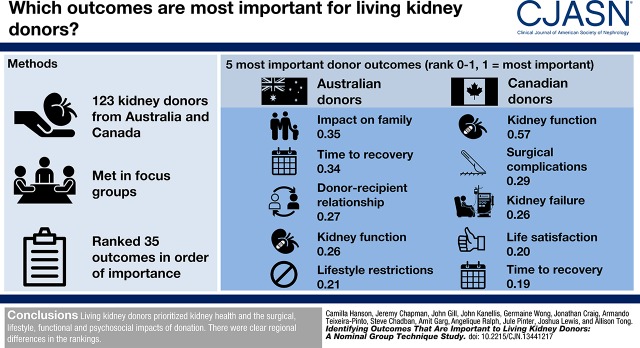
Across 14 groups, 123 donors aged 27-78 years identified 35 outcomes. Across all participants, the ten highest ranked outcomes were kidney function (importance=0.40, scale 0-1), time to recovery (0.27), surgical complications (0.24), effect on family (0.22), donor-recipient relationship (0.21), life satisfaction (0.18), lifestyle restrictions (0.18), kidney failure (0.14), mortality (0.13), and acute pain/discomfort (0.12). Kidney function and kidney failure were more important to Canadian participants, compared with Australian donors. The themes identified included worthwhile sacrifice, insignificance of risks and harms, confidence and empowerment, unfulfilled expectations, and heightened susceptibility.
Living kidney donors prioritized a range of outcomes, with the most important being kidney health and the surgical, lifestyle, functional, and psychosocial effects of donation. Donors also valued improvements to their family life and donor-recipient relationship. There were clear regional differences in the rankings.
活体肾脏捐献者在决定进行肾切除术时,会承担一系列的风险和获益。在知情同意的过程中,假设他们会收到有关结果的可靠数据,这些数据对他们的决策至关重要。我们确定了对活体肾脏捐献者最重要的结果,并描述了他们选择的原因。
设计、地点、参与者和测量:先前的捐献者是从澳大利亚(悉尼和墨尔本)和加拿大(温哥华)的三个移植单位有针对性地抽取的。在使用名义群体技术的焦点小组中,参与者确定了捐献的结果,按重要性对其进行排序,并讨论了他们偏好的原因。为每个结果计算了一个重要性得分。对定性数据进行了主题分析。
在 14 个小组中,123 名年龄在 27-78 岁的捐献者确定了 35 个结果。在所有参与者中,排名前十的结果是肾脏功能(重要性=0.40,范围 0-1)、恢复时间(0.27)、手术并发症(0.24)、对家庭的影响(0.22)、供受者关系(0.21)、生活满意度(0.18)、生活方式限制(0.18)、肾衰竭(0.14)、死亡率(0.13)和急性疼痛/不适(0.12)。与澳大利亚的捐献者相比,加拿大的参与者更看重肾脏功能和肾衰竭。确定的主题包括有价值的牺牲、风险和危害的微不足道、信心和赋权、未满足的期望以及更高的敏感性。
活体肾脏捐献者优先考虑一系列结果,最重要的是肾脏健康以及手术、生活方式、功能和心理社会方面的捐献影响。捐献者还重视改善他们的家庭生活和供受者关系。在排名上存在明显的地区差异。