Department of Pediatric Surgery, Xinhua Hospital, School of Medicine, Shanghai Jiaotong University, Shanghai, China.
Shanghai Institute for Pediatric Research, School of Medicine, Shanghai Jiaotong University, Shanghai, China.
J Immunol Res. 2018 May 9;2018:2481418. doi: 10.1155/2018/2481418. eCollection 2018.
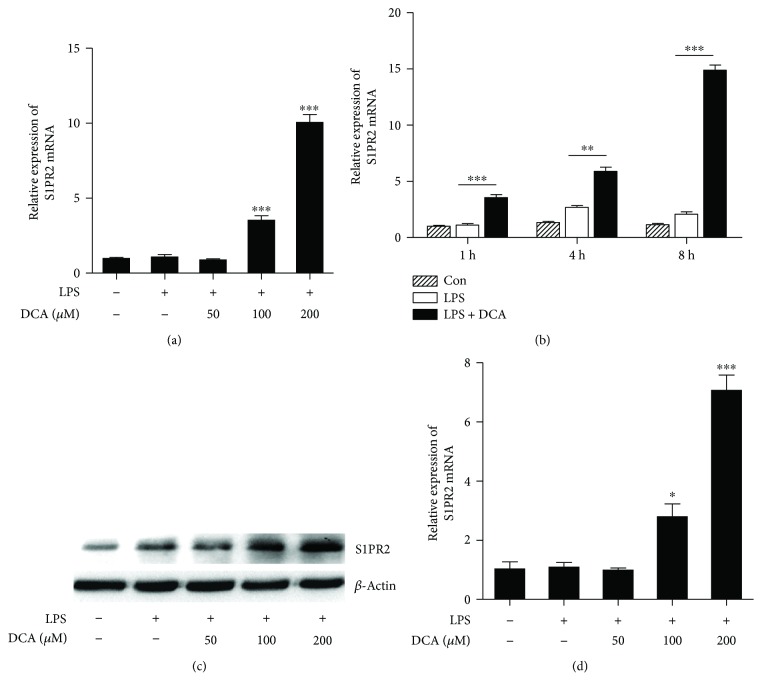
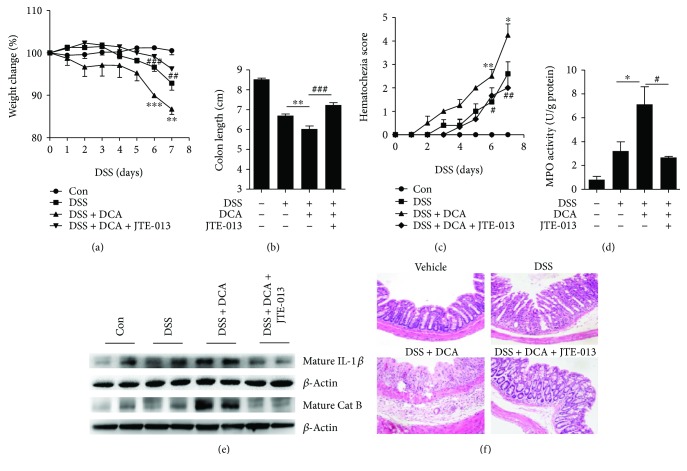
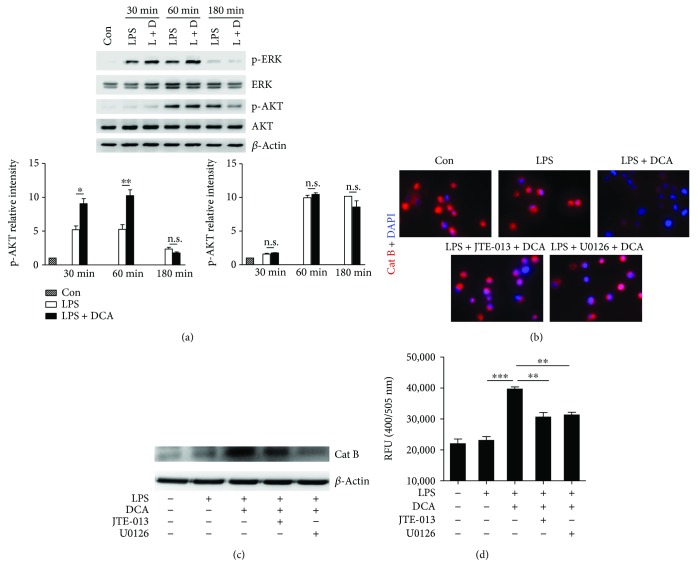
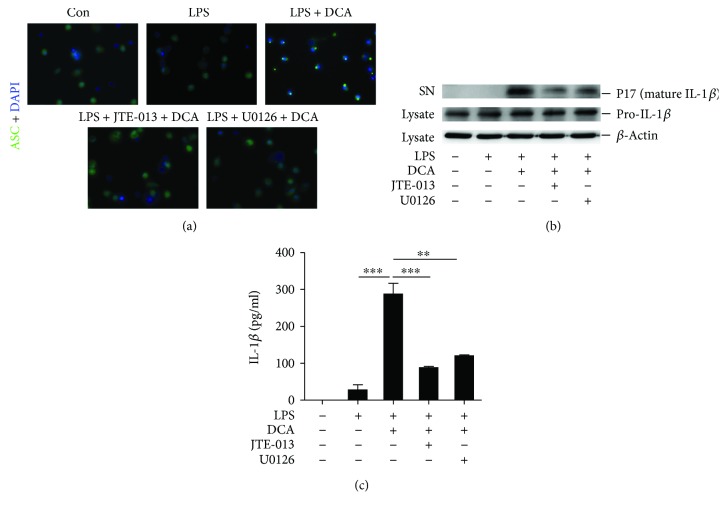
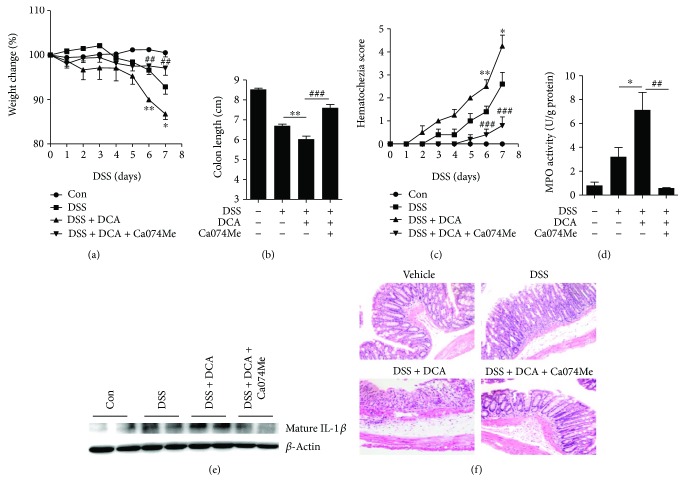
We recently have proved that excessive fecal DCA caused by high-fat diet may serve as an endogenous danger-associated molecular pattern to activate NLRP3 inflammasome and thus contributes to the development of inflammatory bowel disease (IBD). Moreover, the effect of DCA on inflammasome activation is mainly mediated through bile acid receptor sphingosine-1-phosphate receptor 2 (S1PR2); however, the intermediate process remains unclear. Here, we sought to explore the detailed molecular mechanism involved and examine the effect of S1PR2 blockage in a colitis mouse model. In this study, we found that DCA could dose dependently upregulate S1PR2 expression. Meanwhile, DCA-induced NLRP3 inflammasome activation is at least partially achieved through stimulating extracellular regulated protein kinases (ERK) signaling pathway downstream of S1PR2 followed by promoting of lysosomal cathepsin B release. DCA enema significantly aggravated DSS-induced colitis in mice and S1PR2 inhibitor as well as inflammasome inhibition by cathepsin B antagonist substantially reducing the mature IL-1 production and alleviated colonic inflammation superimposed by DCA. Therefore, our findings suggest that S1PR2/ERK1/2/cathepsin B signaling plays a critical role in triggering inflammasome activation by DCA and S1PR2 may represent a new potential therapeutic target for the management of intestinal inflammation in individuals on a high-fat diet.
我们最近证实,高脂肪饮食导致的过量粪脱氧胆酸(DCA)可能作为一种内源性危险相关分子模式,激活 NLRP3 炎性体,从而促进炎症性肠病(IBD)的发展。此外,DCA 对炎性体激活的作用主要通过胆汁酸受体鞘氨醇-1-磷酸受体 2(S1PR2)介导;然而,中间过程尚不清楚。在这里,我们试图探讨涉及的详细分子机制,并在结肠炎小鼠模型中检查 S1PR2 阻断的效果。在这项研究中,我们发现 DCA 可以剂量依赖性地上调 S1PR2 的表达。同时,DCA 诱导的 NLRP3 炎性体激活至少部分是通过 S1PR2 下游的细胞外调节蛋白激酶(ERK)信号通路刺激来实现的,随后促进溶酶体组织蛋白酶 B 的释放。DCA 灌肠显著加重 DSS 诱导的结肠炎小鼠模型的病情,而 S1PR2 抑制剂以及组织蛋白酶 B 拮抗剂抑制炎性体,均可显著减少 DCA 诱导的成熟 IL-1 的产生,并减轻结肠炎炎症。因此,我们的研究结果表明,S1PR2/ERK1/2/组织蛋白酶 B 信号通路在 DCA 触发炎性体激活中起关键作用,S1PR2 可能代表一种针对高脂肪饮食个体肠道炎症管理的新的潜在治疗靶点。