Gillion Valentine, Dahan Karin, Cosyns Jean-Pierre, Hilbert Pascale, Jadoul Michel, Goffin Eric, Godefroid Nathalie, De Meyer Martine, Mourad Michel, Pirson Yves, Kanaan Nada
Division of Nephrology, Cliniques Universitaires Saint-Luc, Université Catholique de Louvain, Brussels, Belgium.
Center of Human Genetics, Institut de Pathologie et de Génétique, Gosselies, Belgium.
Kidney Int Rep. 2018 Feb 2;3(3):652-660. doi: 10.1016/j.ekir.2018.01.008. eCollection 2018 May.
Alport syndrome (AS) is caused by mutations in α3/α4/α5 (IV) collagen genes, the severity of which determine the progression of AS. Posttransplantation outcome is good, although anti-glomerular basement membrane (anti-GBM) glomerulonephritis occurs in 3% to 5% of recipients, clustering in patients with a severe mutation. We assessed whether the severity of the underlying AS mutation affects graft and patients outcome after transplantation, including the occurrence of anti-GBM nephritis.
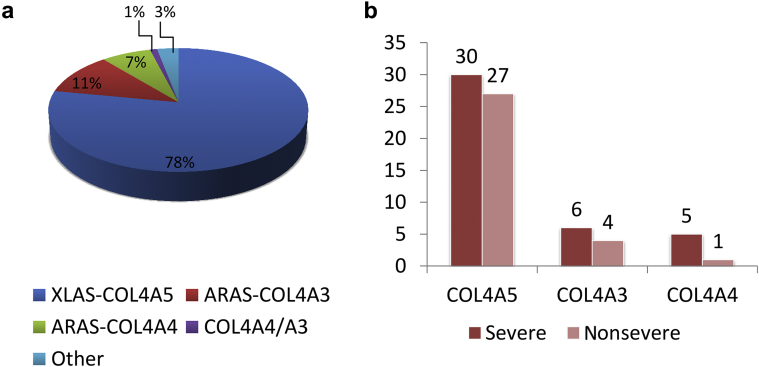
We included 73 AS patients with an identified mutation (COL4A5, 57 patients; COL4A3, 9 patients; COL4A4, 6 patients; heterozygous composite COL4A3 and A4, 1 patient) who underwent transplantation between 1971 and 2014 and who had received a total of 93 kidney grafts.
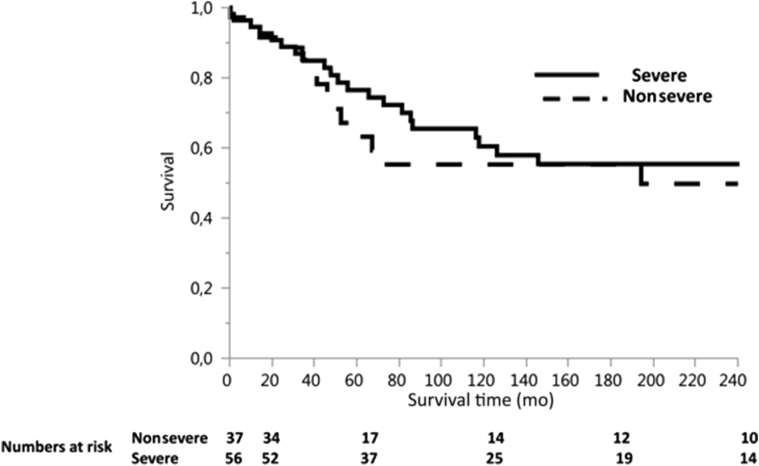
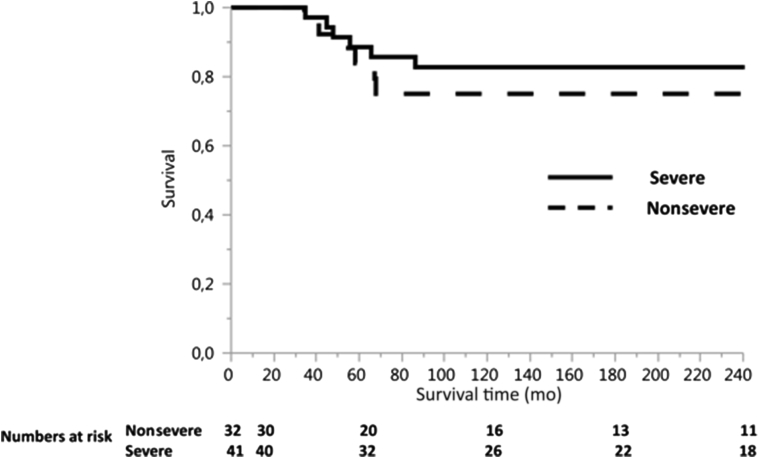
In all, 41 patients had a severe mutation (COL4A5, 30 patients; COL4A3, 6 patients; COL4A4, 5 patients), and 32 had a nonsevere mutation (COL4A5, 27 patients; COL4A3, 4 patients; COL4A4, 1 patient). Patient survival was similar in patients with severe and nonsevere mutations (89% vs. 84% at 5 years, 83% vs. 75% at 10, 15, and 20 years; = 0.46). Graft survival was not affected by the severity of mutation (77% vs. 63% at 5 years, 60% vs. 55% at 10 years, 55% vs. 55% at 15 years, and 55% vs. 50% at 20 years; = 0.65). Clinically significant anti-GBM glomerulonephritis occurred in 1 male patient with severe mutation 6 years after transplantation recurred in a subsequent graft, leading twice to graft loss.
Although severe mutations affect the severity of AS, they do not have an impact on patient and graft survival after transplantation. anti-GBM nephritis after transplantation was less frequent than previously reported, occurring in only 1.4% of AS patients, and in 2% of males with mutation.
Alport综合征(AS)由α3/α4/α5(IV)胶原基因突变引起,其严重程度决定了AS的进展。移植后预后良好,尽管3%至5%的受者会发生抗肾小球基底膜(anti-GBM)肾小球肾炎,且多见于严重突变患者。我们评估了潜在AS突变的严重程度是否会影响移植后移植物和患者的预后,包括anti-GBM肾炎的发生情况。
我们纳入了73例已确定突变的AS患者(COL4A5基因57例;COL4A3基因9例;COL4A4基因6例;COL4A3和A4杂合复合突变1例),这些患者在1971年至2014年间接受了移植,共接受了93次肾移植。
总共有41例患者存在严重突变(COL4A5基因30例;COL4A3基因6例;COL4A4基因5例),32例存在非严重突变(COL4A5基因27例;COL4A3基因4例;COL4A4基因1例)。严重突变和非严重突变患者的生存率相似(5年时分别为89%和84%,10年、15年和20年时分别为83%和75%;P = 0.46)。移植物存活率不受突变严重程度的影响(5年时分别为77%和63%,10年时分别为60%和55%,15年时分别为55%和55%,20年时分别为55%和50%;P = 0.65)。1例存在严重突变的男性患者在移植后6年发生了具有临床意义的anti-GBM肾小球肾炎,在随后的移植中复发,导致两次移植物丢失。
虽然严重突变会影响AS的严重程度,但它们对移植后患者和移植物的存活并无影响。移植后anti-GBM肾炎的发生率低于先前报道,仅在1.4%的AS患者中发生,在存在突变的男性患者中发生率为2%。