Wasiak Sylwia, Tsujikawa Laura M, Halliday Christopher, Stotz Stephanie C, Gilham Dean, Jahagirdar Ravi, Kalantar-Zadeh Kamyar, Robson Richard, Sweeney Michael, Johansson Jan O, Wong Norman C, Kulikowski Ewelina
Resverlogix Corp, Calgary, Alberta, Canada.
University of California, Irvine School of Medicine, Orange, California, USA.
Kidney Int Rep. 2017 Dec 8;3(3):711-721. doi: 10.1016/j.ekir.2017.12.001. eCollection 2018 May.
Apabetalone, a small molecule inhibitor, targets epigenetic readers termed BET proteins that contribute to gene dysregulation in human disorders. Apabetalone has and anti-inflammatory and antiatherosclerotic properties. In phase 2 clinical trials, this drug reduced the incidence of major adverse cardiac events in patients with cardiovascular disease. Chronic kidney disease is associated with a progressive loss of renal function and a high risk of cardiovascular disease. We studied the impact of apabetalone on the plasma proteome in patients with impaired kidney function.
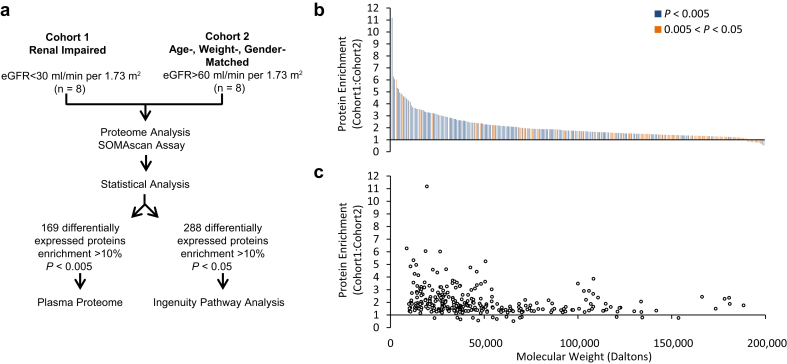
Subjects with stage 4 or 5 chronic kidney disease and matched controls received a single dose of apabetalone. Plasma was collected for pharmacokinetic analysis and for proteomics profiling using the SOMAscan 1.3k platform. Proteomics data were analyzed with Ingenuity Pathway Analysis to identify dysregulated pathways in diseased patients, which were targeted by apabetalone.
At baseline, 169 plasma proteins (adjusted value <0.05) were differentially enriched in renally impaired patients versus control subjects, including cystatin C and β microglobulin, which correlate with renal function. Bioinformatics analysis of the plasma proteome revealed a significant activation of 42 pathways that control immunity and inflammation, oxidative stress, endothelial dysfunction, vascular calcification, and coagulation. At 12 hours postdose, apabetalone countered the activation of pathways associated with renal disease and reduced the abundance of disease markers, including interleukin-6, plasminogen activator inhibitor-1, and osteopontin.
These data demonstrated plasma proteome dysregulation in renally impaired patients and the beneficial impact of apabetalone on pathways linked to chronic kidney disease and its cardiovascular complications.
阿巴他赛,一种小分子抑制剂,作用于称为BET蛋白的表观遗传阅读器,这些蛋白在人类疾病中导致基因失调。阿巴他赛具有抗炎和抗动脉粥样硬化特性。在2期临床试验中,这种药物降低了心血管疾病患者主要不良心脏事件的发生率。慢性肾脏病与肾功能的逐渐丧失和心血管疾病的高风险相关。我们研究了阿巴他赛对肾功能受损患者血浆蛋白质组的影响。
4期或5期慢性肾脏病患者及匹配的对照组接受单剂量阿巴他赛治疗。采集血浆用于药代动力学分析和使用SOMAscan 1.3k平台进行蛋白质组学分析。蛋白质组学数据通过Ingenuity Pathway Analysis进行分析,以识别患病患者中失调的通路,这些通路是阿巴他赛的作用靶点。
在基线时,与对照组相比,肾功能受损患者中169种血浆蛋白(校正P值<0.05)差异富集,包括与肾功能相关的胱抑素C和β微球蛋白。血浆蛋白质组的生物信息学分析显示,42条控制免疫和炎症、氧化应激、内皮功能障碍、血管钙化和凝血的通路显著激活。给药后12小时,阿巴他赛对抗了与肾脏疾病相关的通路激活,并降低了疾病标志物的丰度,包括白细胞介素-6、纤溶酶原激活物抑制剂-1和骨桥蛋白。
这些数据证明了肾功能受损患者血浆蛋白质组失调,以及阿巴他赛对与慢性肾脏病及其心血管并发症相关通路的有益影响。