Synaptic Immunopathology Lab, Department of Systems Medicine, University of Rome Tor Vergata, 00133 Rome, Italy.
Synaptic Immunopathology Lab, IRCCS San Raffaele, Via di Val Cannuta 247, 00166 Rome, Italy.
Neural Plast. 2018 May 14;2018:8430123. doi: 10.1155/2018/8430123. eCollection 2018.
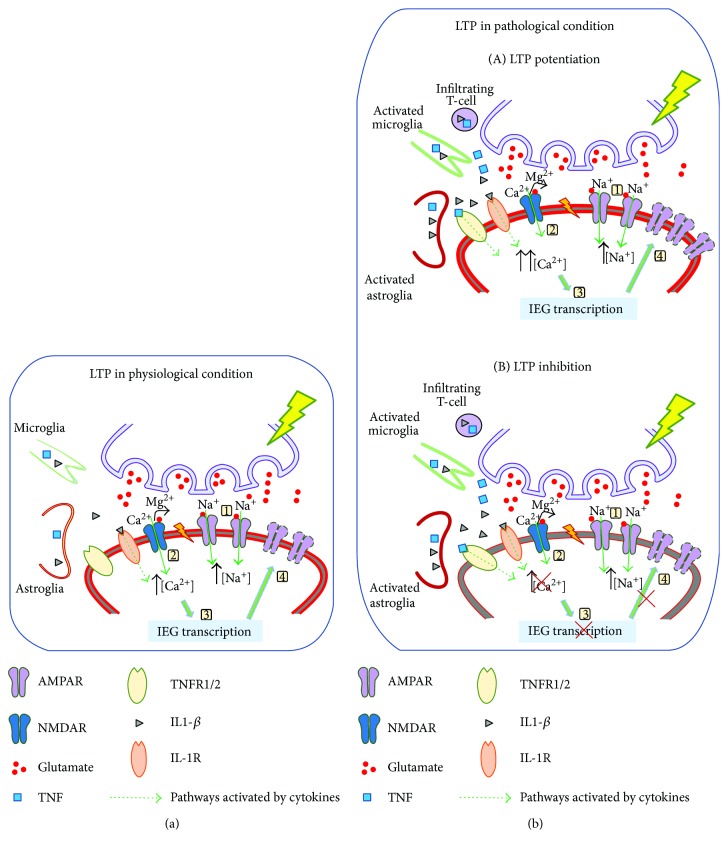
Cytokines are constitutively released in the healthy brain by resident myeloid cells to keep proper synaptic plasticity, either in the form of Hebbian synaptic plasticity or of homeostatic plasticity. However, when cytokines dramatically increase, establishing a status of neuroinflammation, the synaptic action of such molecules remarkably interferes with brain circuits of learning and cognition and contributes to excitotoxicity and neurodegeneration. Among others, interleukin-1 (IL-1) and tumor necrosis factor (TNF) are the best studied proinflammatory cytokines in both physiological and pathological conditions and have been invariably associated with long-term potentiation (LTP) (Hebbian synaptic plasticity) and synaptic scaling (homeostatic plasticity), respectively. Multiple sclerosis (MS) is the prototypical neuroinflammatory disease, in which inflammation triggers excitotoxic mechanisms contributing to neurodegeneration. IL- and TNF are increased in the brain of MS patients and contribute to induce the changes in synaptic plasticity occurring in MS patients and its animal model, the experimental autoimmune encephalomyelitis (EAE). This review will introduce and discuss current evidence of the role of IL-1 and TNF in the regulation of synaptic strength at both physiological and pathological levels, in particular speculating on their involvement in the synaptic plasticity changes observed in the EAE brain.
细胞因子在健康的大脑中由固有髓样细胞持续释放,以保持适当的突触可塑性,无论是在赫布氏突触可塑性还是在动态平衡的可塑性形式中。然而,当细胞因子显著增加,建立神经炎症状态时,这些分子的突触作用会显著干扰学习和认知的大脑回路,并导致兴奋性毒性和神经退行性变。其中,白细胞介素-1 (IL-1) 和肿瘤坏死因子 (TNF) 是生理和病理条件下研究最充分的促炎细胞因子,它们分别与长时程增强 (LTP) (赫布氏突触可塑性) 和突触缩放 (动态平衡的可塑性) 始终相关。多发性硬化症 (MS) 是典型的神经炎症性疾病,其中炎症引发兴奋性毒性机制,导致神经退行性变。在 MS 患者的大脑中,IL- 和 TNF 增加,并有助于诱导 MS 患者及其动物模型实验性自身免疫性脑脊髓炎 (EAE) 中发生的突触可塑性变化。这篇综述将介绍和讨论 IL-1 和 TNF 在调节生理和病理水平突触强度方面的作用的最新证据,特别是推测它们在 EAE 大脑中观察到的突触可塑性变化中的作用。