Kooperman Gabriel J, Pritchard Michael S, O'Brien Travis A, Timmermans Ben W
Department of Geography University of Georgia Athens GA USA.
Department of Earth System Science University of California Irvine CA USA.
J Adv Model Earth Syst. 2018 Apr;10(4):971-988. doi: 10.1002/2017MS001188. Epub 2018 Apr 13.
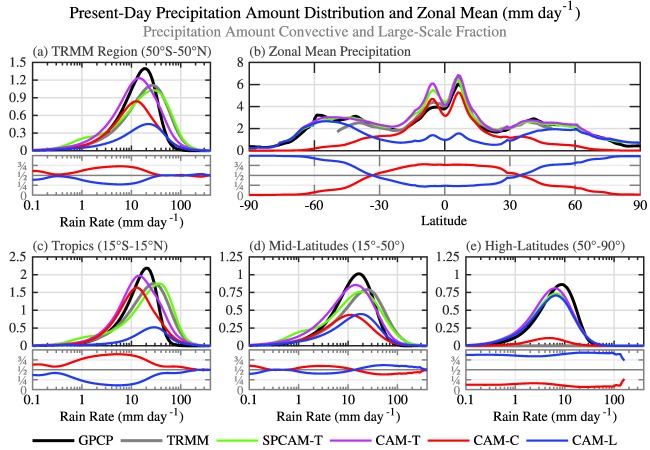
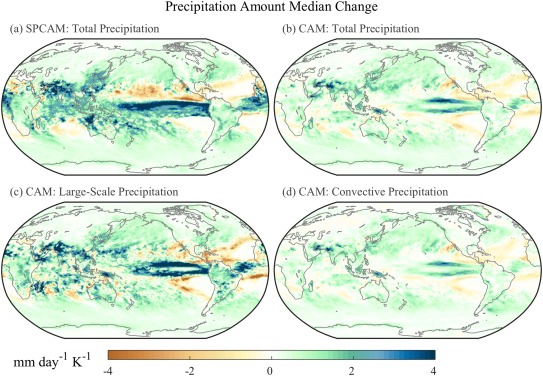
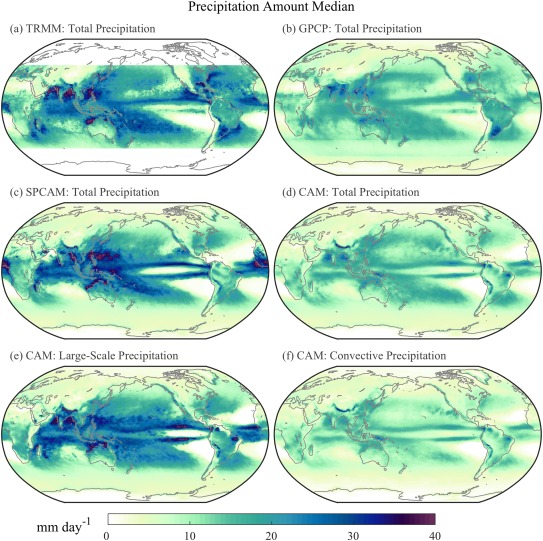
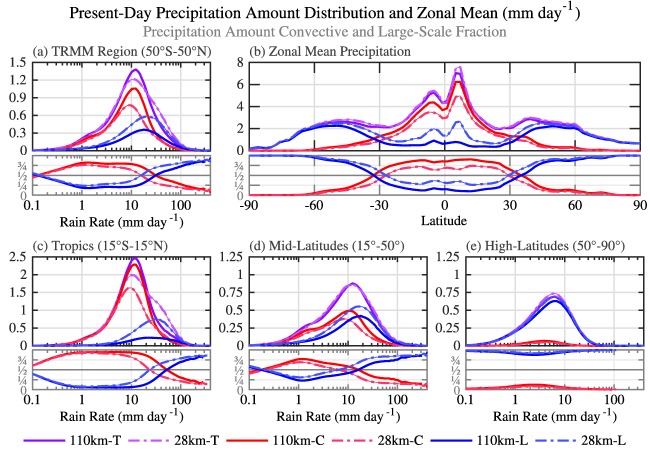
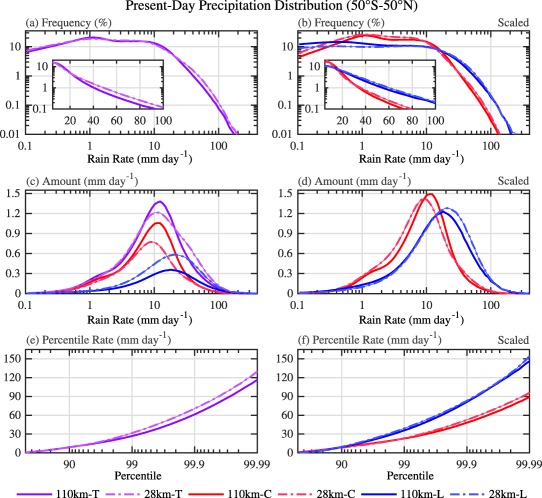
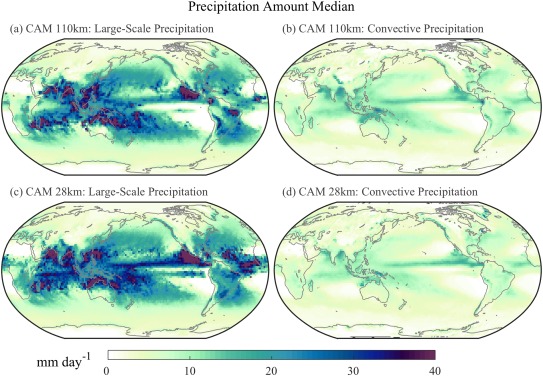
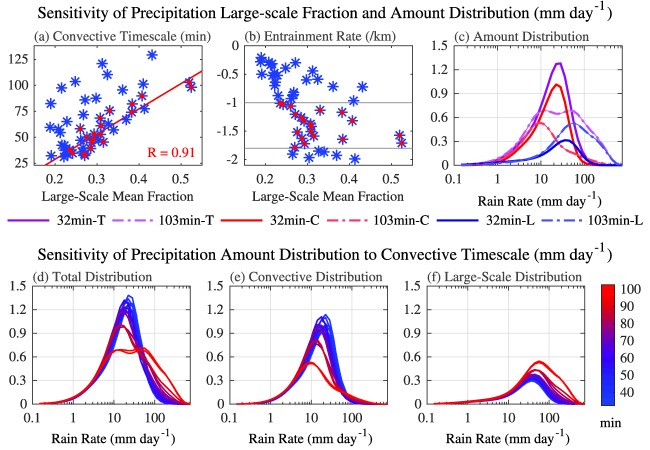
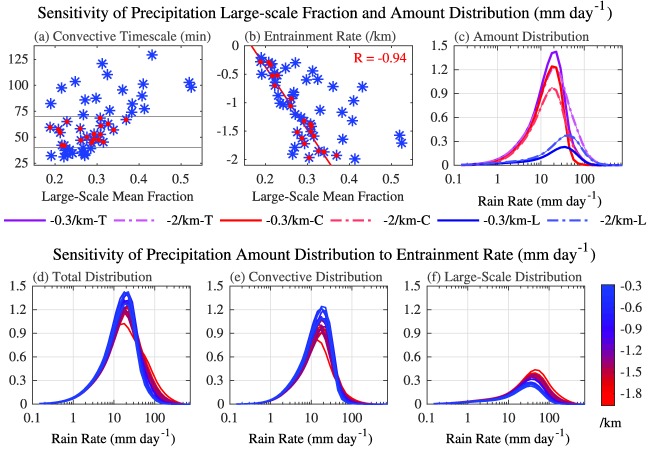
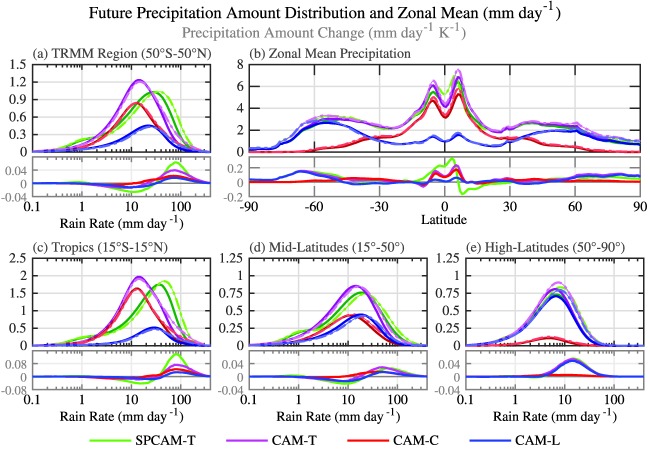
Deficiencies in the parameterizations of convection used in global climate models often lead to a distorted representation of the simulated rainfall intensity distribution (i.e., too much rainfall from weak rain rates). While encouraging improvements in high percentile rainfall intensity have been found as the horizontal resolution of the Community Atmosphere Model is increased to ∼25 km, we demonstrate no corresponding improvement in the moderate rain rates that generate the majority of accumulated rainfall. Using a statistical framework designed to emphasize links between precipitation intensity and accumulated rainfall beyond just the frequency distribution, we show that CAM cannot realistically simulate moderate rain rates, and cannot capture their intensification with climate change, even as resolution is increased. However, by separating the parameterized convective and large-scale resolved contributions to total rainfall, we find that the intensity, geographic pattern, and climate change response of CAM's large-scale rain rates are more consistent with observations (TRMM 3B42), superparameterization, and theoretical expectations, despite issues with parameterized convection. Increasing CAM's horizontal resolution does improve the representation of total rainfall intensity, but not due to changes in the intensity of large-scale rain rates, which are surprisingly insensitive to horizontal resolution. Rather, improvements occur through an increase in the relative contribution of the large-scale component to the total amount of accumulated rainfall. Analysis of sensitivities to convective timescale and entrainment rate confirm the importance of these parameters in the possible development of scale-aware parameterizations, but also reveal unrecognized trade-offs from the entanglement of precipitation frequency and total amount.
全球气候模型中使用的对流参数化缺陷常常导致模拟降雨强度分布的失真(即小雨强产生的降雨量过多)。虽然随着社区大气模型的水平分辨率提高到约25公里,已发现高百分位降雨强度有令人鼓舞的改善,但我们证明,产生大部分累积降雨量的中雨强并无相应改善。使用一个旨在强调降水强度与累积降雨量之间联系(而不仅仅是频率分布)的统计框架,我们表明,即使分辨率提高,社区大气模型也无法真实模拟中雨强,也无法捕捉其随气候变化的增强。然而,通过将参数化对流和大尺度解析对总降雨量的贡献分开,我们发现,尽管存在参数化对流问题,但社区大气模型的大尺度降雨强度、地理模式和气候变化响应与观测结果(热带降雨测量任务3B42)、超级参数化和理论预期更为一致。提高社区大气模型的水平分辨率确实改善了总降雨强度的表示,但不是由于大尺度降雨强度的变化,大尺度降雨强度对水平分辨率出奇地不敏感。相反,改善是通过增加大尺度分量对累积降雨量总量的相对贡献来实现的。对对流时间尺度和卷入率的敏感性分析证实了这些参数在可能发展的尺度感知参数化中的重要性,但也揭示了降水频率和总量纠缠带来的未被认识到的权衡。