Merolle Maria I, Ahmed Makhdum, Nomie Krystle, Wang Michael L
Department of Lymphoma and Myeloma, MD Anderson Cancer Center, Houston, TX, USA.
Oncotarget. 2018 Mar 27;9(38):25332-25341. doi: 10.18632/oncotarget.25011. eCollection 2018 May 18.
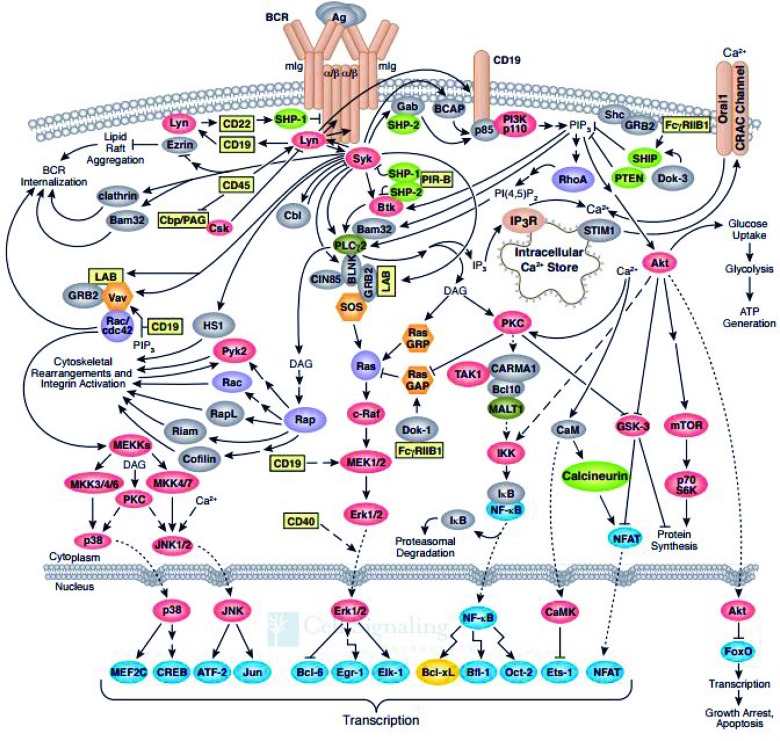
Signal transduction through the constitutively activated B cell receptor (BCR) plays a key role in the pathogenesis of B-cell tumors by promoting survival and proliferation of malignant B cells. The BCR signaling pathway is known to be deregulated in Mantle Cell Lymphoma (MCL) due to mutations or epigenetic events that impact regulatory proteins. One such protein is Bruton's tyrosine kinase (BTK), an integral component of the BCR signaling pathway. The success of ibrutinib, a BTK inhibitor, and other drugs that target components of the BCR pathway is evidence that regulation of the BCR signaling pathway is an effective method of MCL treatment. The complexity of the pathway indicates that it contains other potential therapeutic targets for the treatment of MCL. This is supported by recent and ongoing clinical trials of inhibitors of molecules such as PI3K, BCL-2, and BTK that show promising initial results. Additionally, agents that target different points of the pathway may have synergistic effects when used in combination. This review provides a description of the BCR signaling pathway on the molecular level followed by an explanation of its relationship to MCL. The role of the BCR signaling pathway in the pathogenesis of MCL is explained through an overview of the drugs that target BCR signaling in MCL treatment.
通过组成性激活的B细胞受体(BCR)进行的信号转导,通过促进恶性B细胞的存活和增殖,在B细胞肿瘤的发病机制中发挥关键作用。由于影响调节蛋白的突变或表观遗传事件,已知BCR信号通路在套细胞淋巴瘤(MCL)中失调。其中一种蛋白是布鲁顿酪氨酸激酶(BTK),它是BCR信号通路的一个重要组成部分。BTK抑制剂伊布替尼以及其他靶向BCR通路成分的药物的成功,证明了对BCR信号通路的调控是治疗MCL的有效方法。该通路的复杂性表明它包含其他治疗MCL的潜在靶点。这得到了近期和正在进行的针对PI3K、BCL-2和BTK等分子抑制剂的临床试验的支持,这些试验显示出了有希望的初步结果。此外,靶向该通路不同点的药物联合使用时可能具有协同作用。本综述首先在分子水平上描述了BCR信号通路,然后解释了它与MCL的关系。通过概述在MCL治疗中靶向BCR信号的药物,解释了BCR信号通路在MCL发病机制中的作用。