Department of Internal Medicine and Rheumatology, Medical Faculty in Katowice, Medical University of Silesia, Katowice, Poland.
Biomed Res Int. 2018 May 10;2018:7492904. doi: 10.1155/2018/7492904. eCollection 2018.
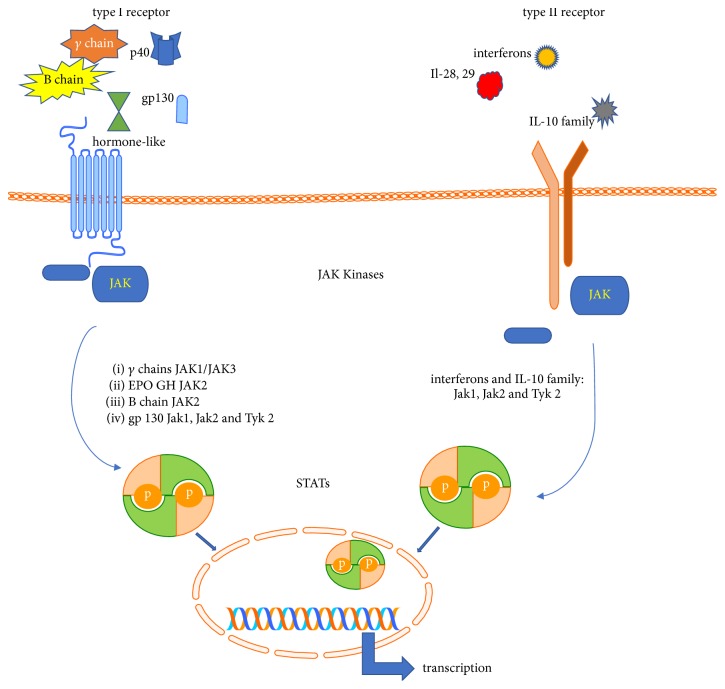
The Janus Kinases (JAKs) are a family of intracellular tyrosine kinases that provide transmission signals from cytokine, interferons, and many hormones receptors to the nucleus resulting in synthesis of many biologically active compounds and changing cell metabolism and function. That was theoretical background to synthetize the JAK inhibitors (Jakinibs). In recent years a substantial battery of evidence has been collected indicating the potential role of Jakinibs to interact with the specific elements of the immune system, therefore changing the inflammatory response. JAK kinase blockade offers a unique opportunity to block most of the key cytokines enabling the deep interaction into immune system functioning. Following discovery first Jakinibs were intensively studied in various forms of autoimmune diseases, including rheumatoid arthritis, and finally two Jakinibs tofacitinib and Baricitinib have been approved for the treatment of rheumatoid arthritis. Some clinical data indicated that under special circumstances Jakinibs may be even superior to biologics in the treatment of RA; however this suggestion should be verified in large clinical and observational studies.
Janus 激酶(JAKs)是一类细胞内酪氨酸激酶,可将细胞因子、干扰素和许多激素受体的信号传递到细胞核,从而导致许多生物活性化合物的合成,并改变细胞代谢和功能。这是合成 JAK 抑制剂(Jakinibs)的理论基础。近年来,大量证据表明 Jakinibs 可能与免疫系统的特定成分相互作用,从而改变炎症反应。JAK 激酶阻断为阻断大多数关键细胞因子提供了独特的机会,从而深入干预免疫系统的功能。在发现第一代 Jakinibs 后,它们被广泛研究用于治疗各种自身免疫性疾病,包括类风湿关节炎,最终两种 JAKinibs tofacitinib 和 Baricitinib 已被批准用于治疗类风湿关节炎。一些临床数据表明,在特殊情况下,Jakinibs 在治疗 RA 方面甚至可能优于生物制剂;然而,这一建议需要在大型临床和观察性研究中得到验证。