Department of Biomedical and Biotechnological Sciences, Section of Physiology, University of Catania, Catania, Italy.
Taub Institute for Research on Alzheimer's Disease and the Aging Brain, Columbia University, New York, NY, USA.
J Alzheimers Dis. 2018;64(s1):S611-S631. doi: 10.3233/JAD-179935.
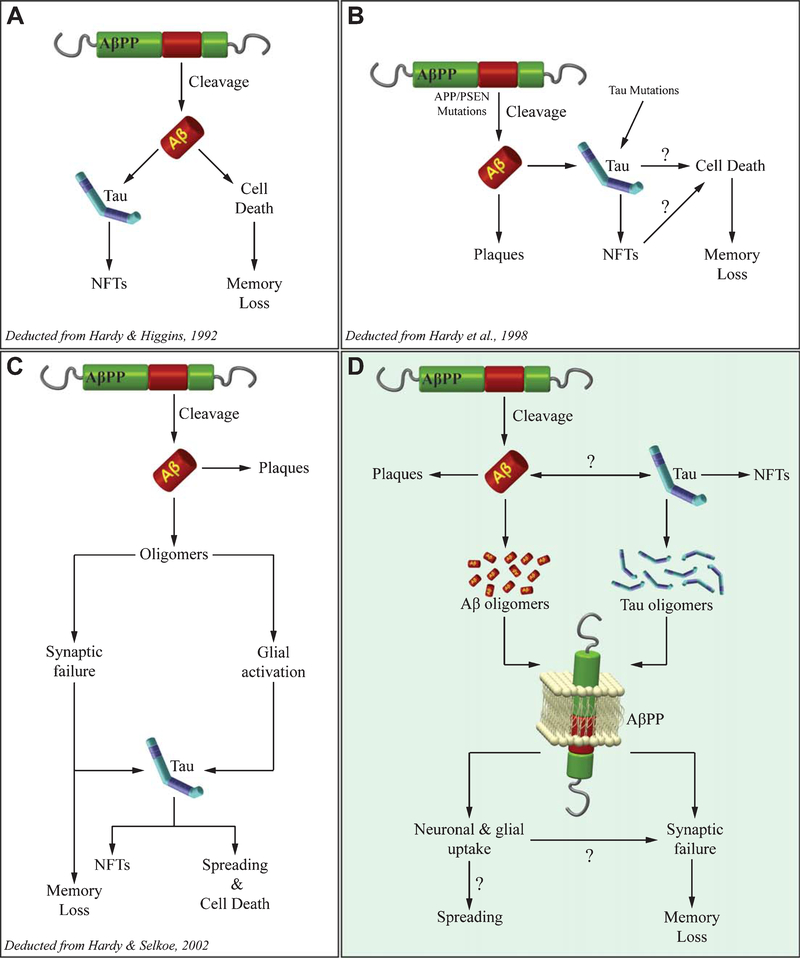
The "Amyloid Cascade Hypothesis" has dominated the Alzheimer's disease (AD) field in the last 25 years. It posits that the increase of amyloid-β (Aβ) is the key event in AD that triggers tau pathology followed by neuronal death and eventually, the disease. However, therapeutic approaches aimed at decreasing Aβ levels have so far failed, and tau-based clinical trials have not yet produced positive findings. This begs the question of whether the hypothesis is correct. Here we have examined literature on the role of Aβ and tau in synaptic dysfunction, memory loss, and seeding and spreading of AD, highlighting important parallelisms between the two proteins in all of these phenomena. We discuss novel findings showing binding of both Aβ and tau oligomers to amyloid-β protein precursor (AβPP), and the requirement for the presence of this protein for both Aβ and tau to enter neurons and induce abnormal synaptic function and memory. Most importantly, we propose a novel view of AD pathogenesis in which extracellular oligomers of Aβ and tau act in parallel and upstream of AβPP. Such a view will call for a reconsideration of therapeutic approaches directed against Aβ and tau, paving the way to an increased interest toward AβPP, both for understanding the pathogenesis of the disease and elaborating new therapeutic strategies.
“淀粉样蛋白级联假说”在过去的 25 年中主导了阿尔茨海默病(AD)领域。该假说认为,淀粉样蛋白-β(Aβ)的增加是 AD 中的关键事件,引发 tau 病理学,随后是神经元死亡,最终导致疾病。然而,迄今为止,旨在降低 Aβ水平的治疗方法都失败了,基于 tau 的临床试验也尚未产生积极结果。这就提出了一个问题,即该假说是否正确。在这里,我们检查了关于 Aβ 和 tau 在突触功能障碍、记忆丧失以及 AD 的播种和传播中的作用的文献,强调了这两种蛋白质在所有这些现象中的重要相似性。我们讨论了新的发现,表明 Aβ 和 tau 寡聚体与淀粉样蛋白前体(AβPP)结合,并且这种蛋白质的存在对于 Aβ 和 tau 进入神经元并诱导异常突触功能和记忆都是必需的。最重要的是,我们提出了一种 AD 发病机制的新观点,即 Aβ 和 tau 的细胞外寡聚体在 AβPP 之前平行且上游起作用。这种观点将需要重新考虑针对 Aβ 和 tau 的治疗方法,为针对 AβPP 的研究开辟道路,这不仅有助于了解疾病的发病机制,还能制定新的治疗策略。