Department of Internal Medicine, Section of Digestive Diseases, Yale University School of Medicine, New Haven, CT, United States of America.
Veterans Affairs Connecticut Healthcare, West Haven, CT, United States of America.
PLoS One. 2018 Jun 5;13(6):e0197362. doi: 10.1371/journal.pone.0197362. eCollection 2018.
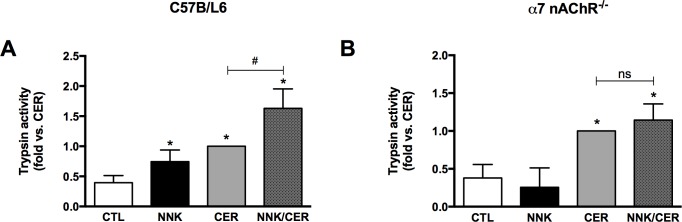
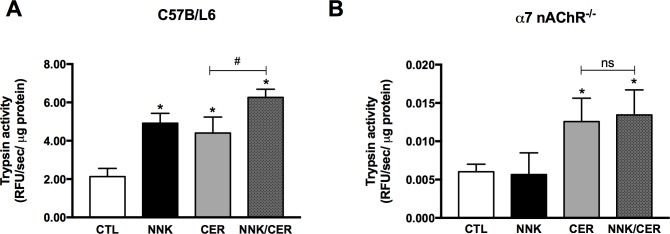
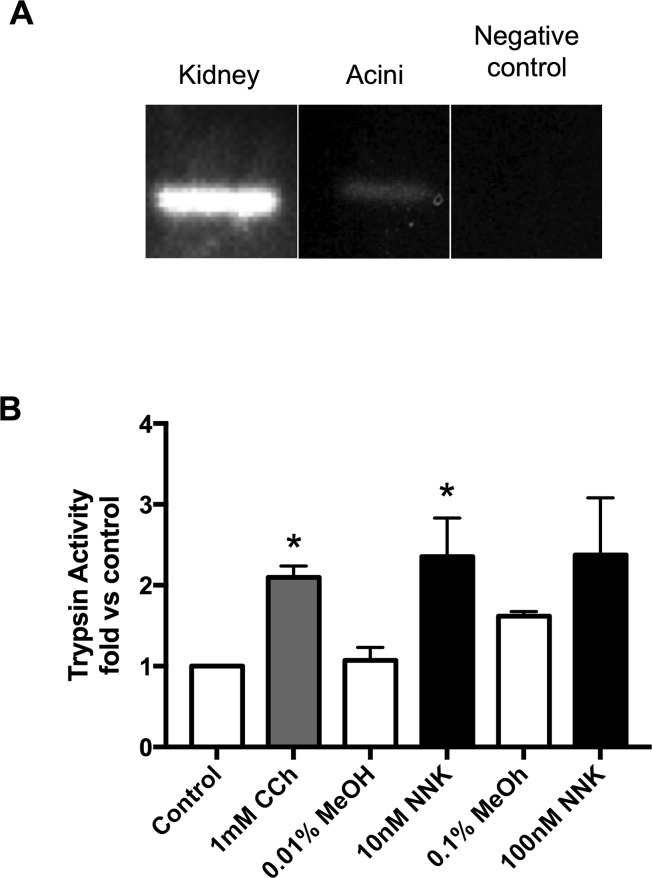
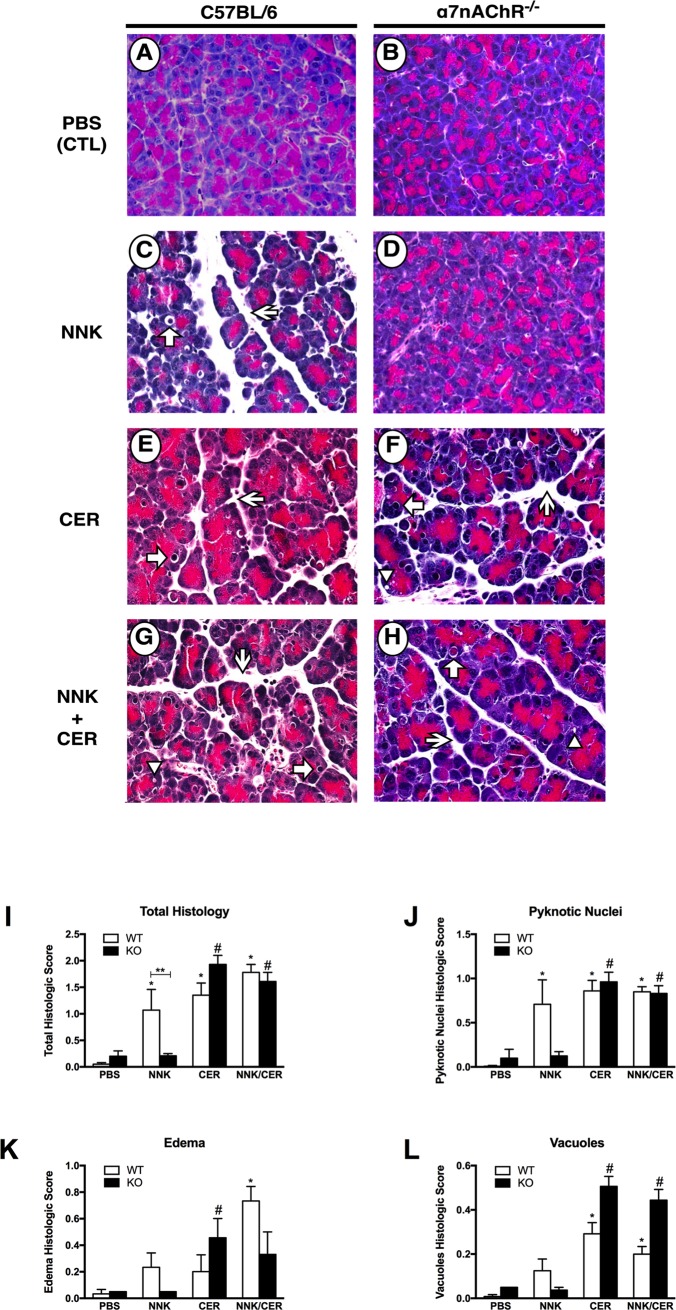
Clinical studies have shown that cigarette smoking is a dose-dependent and independent risk factor for acute pancreatitis. Cigarette smoke contains nicotine which can be converted to the potent receptor ligand and toxin, NNK [4-(methylnitrosamino)-1-(3-pyridyl)-1-butanone]. Previously, we have shown that NNK induces premature activation of pancreatic zymogens in rats, an initiating event in pancreatitis, and this activation is prevented by pharmacologic inhibition of nicotinic acetylcholine receptors (nAChR). In this study, we determined whether NNK mediates pancreatitis through the α7 isoform of nAChR using α7nAChR knockout mice. PCR analysis confirmed expression of non-neuronal α7nAChR in C57BL/6 (WT) mouse and human acinar cells. NNK treatment stimulated trypsinogen activation in acini from WT but not α7nAChR-/- mice. NNK also stimulated trypsinogen activation in human acini. To further confirm these findings, WT and α7nAChR-/- mice were treated with NNK in vivo and markers of pancreatitis were measured. As observed in acini NNK treatment induced trypsinogen activation in WT but not α7nAChR-/- mice. NNK also induced other markers of pancreatitis including pancreatic edema, vacuolization and pyknotic nuclei in WT but not α7nAChR-/- animals. NNK treatment led to increased neutrophil infiltration, a marker of inflammation, in WT mice and to a significantly lesser extent in α7nAChR-/- mice. We also examined downstream targets of α7nAChR activation and found that calcium and PKC activation are involved down stream of NNK stimulation of α7nAChR. In this study we used genetic deletion of the α7nAChR to confirm our previous inhibitor studies that demonstrated NNK stimulates pancreatitis by activating this receptor. Lastly, we demonstrate that NNK can also stimulate zymogen activation in human acinar cells and thus may play a role in human disease.
临床研究表明,吸烟是急性胰腺炎的剂量依赖性和独立危险因素。香烟烟雾中含有尼古丁,可转化为强效受体配体和毒素,NNK [4-(甲基亚硝氨基)-1-(3-吡啶基)-1-丁酮]。此前,我们已经表明,NNK 可诱导大鼠胰腺酶原过早激活,这是胰腺炎的起始事件,而这种激活可通过烟碱型乙酰胆碱受体(nAChR)的药理学抑制来预防。在这项研究中,我们使用α7nAChR 基因敲除小鼠确定 NNK 是否通过α7nAChR 介导胰腺炎。PCR 分析证实了 C57BL/6(WT)小鼠和人腺泡细胞中非神经元α7nAChR 的表达。NNK 处理刺激 WT 但不刺激α7nAChR-/-小鼠腺泡细胞中胰蛋白酶原的激活。NNK 还刺激人腺泡细胞中胰蛋白酶原的激活。为了进一步证实这些发现,用 NNK 体内处理 WT 和α7nAChR-/-小鼠,并测量胰腺炎的标志物。与在腺泡细胞中观察到的一样,NNK 处理诱导 WT 但不诱导α7nAChR-/-小鼠中胰蛋白酶原的激活。NNK 还诱导胰腺炎的其他标志物,包括胰腺水肿、空泡化和 WT 但不α7nAChR-/-动物的固缩核。NNK 处理导致 WT 小鼠中性粒细胞浸润增加,这是炎症的标志物,而在α7nAChR-/-小鼠中则明显减少。我们还检查了α7nAChR 激活的下游靶标,发现钙和 PKC 激活参与 NNK 刺激α7nAChR 后的下游。在这项研究中,我们使用α7nAChR 的基因缺失来确认我们之前的抑制剂研究,该研究表明 NNK 通过激活该受体刺激胰腺炎。最后,我们证明 NNK 还可以刺激人腺泡细胞中酶原的激活,因此可能在人类疾病中发挥作用。