Mackintosh Kate, Power Kevin, Schwannauer Matthias, Chan Stella W Y
1NHS Tayside Psychological Therapies Service, Tayside, Scotland UK.
2Section of Clinical Psychology, School of Health in Social Science, University of Edinburgh, Edinburgh, EH8 9AG UK.
Mindfulness (N Y). 2018;9(3):961-971. doi: 10.1007/s12671-017-0835-6. Epub 2017 Nov 6.
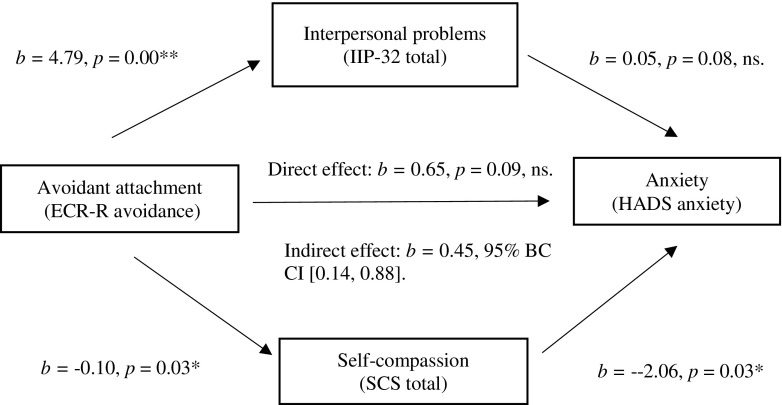
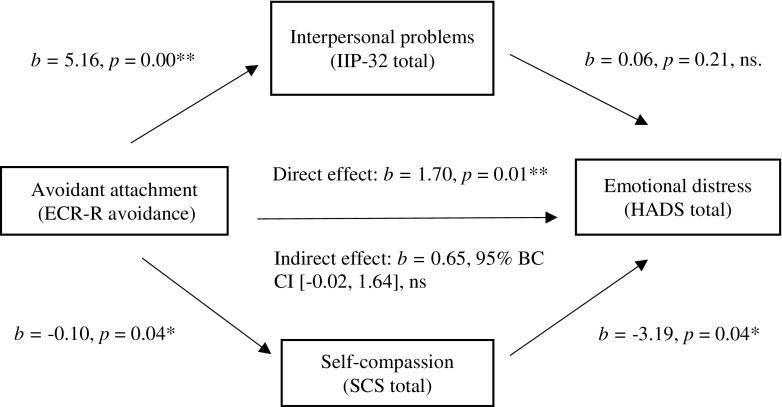
Self-compassion has been consistently linked to psychological well-being. The ability to be self-compassionate may be shaped by early attachment experiences and associated with interpersonal difficulties. However, evidence has yet to be extended to clinical populations. This study examined the role of self-compassion and its relationship with attachment and interpersonal problems in clinical patients with anxiety and depression. Participants ( = 74; 60% female, mean age 40 years) were recruited from a primary care psychological therapies service in Scotland, UK. Participants completed four self-report questionnaires assessing self-compassion, attachment, interpersonal problems and emotional distress (including depression and anxiety). Low self-compassion, attachment-related avoidance (but not attachment-related anxiety) and high interpersonal problems were all associated with higher levels of emotional distress and anxiety. Low self-compassion and high interpersonal problems were predicted by attachment-related avoidance. Self-compassion mediated the relationship between attachment-related avoidance and emotional distress and anxiety. This was a cross-sectional design and therefore a definitive conclusion cannot be drawn regarding causal relationships between these variables. Self-reported questionnaires were subject to response bias. This study has extended the evidence base regarding the role of self-compassion in patients with clinical levels of depression and anxiety. Notably, our findings indicated that self-compassion may be a particularly important construct, both theoretically and clinically, in understanding psychological distress amongst those with higher levels of attachment avoidance. This study supports the development and practice of psychotherapeutic approaches, such as compassion-focused therapy for which there is a growing evidence base.
自我同情一直与心理健康相关联。自我同情的能力可能受到早期依恋经历的塑造,并与人际困难相关。然而,相关证据尚未扩展到临床人群。本研究探讨了自我同情在焦虑和抑郁临床患者中的作用及其与依恋和人际问题的关系。参与者(n = 74;60%为女性,平均年龄40岁)从英国苏格兰的一项初级保健心理治疗服务中招募。参与者完成了四份自我报告问卷,评估自我同情、依恋、人际问题和情绪困扰(包括抑郁和焦虑)。低自我同情、与依恋相关的回避(而非与依恋相关的焦虑)和高人际问题均与更高水平的情绪困扰和焦虑相关。与依恋相关的回避可预测低自我同情和高人际问题。自我同情介导了与依恋相关的回避与情绪困扰和焦虑之间的关系。这是一项横断面设计,因此无法就这些变量之间的因果关系得出明确结论。自我报告问卷存在应答偏差。本研究扩展了关于自我同情在抑郁和焦虑临床水平患者中作用的证据基础。值得注意的是,我们的研究结果表明,自我同情在理论和临床上可能都是一个特别重要的概念,有助于理解那些依恋回避水平较高者的心理困扰。本研究支持了心理治疗方法的发展和实践,比如聚焦同情疗法,对此的证据基础正在不断扩大。