Mastrangelo I A, Hough P V, Wilson V G, Wall J S, Hainfeld J F, Tegtmeyer P
Proc Natl Acad Sci U S A. 1985 Jun;82(11):3626-30. doi: 10.1073/pnas.82.11.3626.
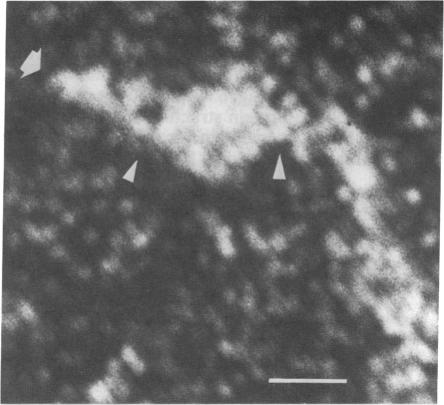
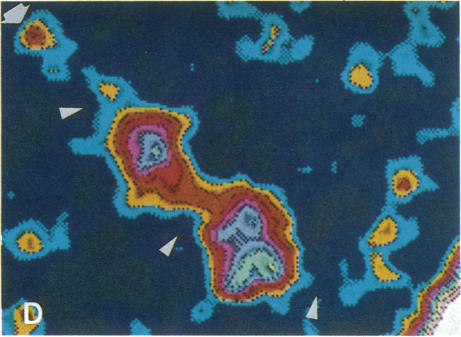
Large tumor (T) antigen and its bound multimeric states are positioned by scanning transmission electron microscopy (STEM) within a few base pairs at control sequences of the simian virus 40 DNA origin of replication region. Proximal and distal edge positions for each multimer group match the end positions of previously mapped fragments protected from DNase cleavage. Since chance correspondence is shown to be extremely unlikely, STEM mass measurements, obtained concurrently with STEM map positions, indicate that the DNase fragments arise from bound monomers, dimers, trimers, and tetramers in binding region II and monomers, dimers, and trimers in binding region I. Simultaneous binding of seven monomer-equivalent masses is observed, three in region I and four in region II, with an ordered and interpretable mass distribution in the plane of the foil. Although this observation does not prove that the six G-A-G-G-C and one T-A-G-G-C sequences, similarly distributed, function as recognition sequences for T-antigen monomer, it provides strong support for such a model. The stable existence in solution of low-and intermediate-mass structures, observed at lower T-antigen concentrations, suggests a role as assembly intermediates.
通过扫描透射电子显微镜(STEM)在猴病毒40 DNA复制起始区域的控制序列中,大肿瘤(T)抗原及其结合的多聚体状态定位在几个碱基对范围内。每个多聚体组的近端和远端边缘位置与先前绘制的免受DNA酶切割的片段的末端位置相匹配。由于已证明偶然对应极不可能,与STEM图谱位置同时获得的STEM质量测量结果表明,DNA酶片段来自结合区域II中的结合单体、二聚体、三聚体和四聚体以及结合区域I中的单体、二聚体和三聚体。观察到七个单体等效质量的同时结合,三个在区域I中,四个在区域II中,在箔平面上具有有序且可解释的质量分布。尽管这一观察结果并未证明六个G-A-G-G-C和一个T-A-G-G-C序列(分布类似)作为T抗原单体的识别序列起作用,但它为这种模型提供了有力支持。在较低T抗原浓度下观察到的低质量和中等质量结构在溶液中的稳定存在,表明其作为组装中间体的作用。