IDLab, Department of Information Technology, Ghent University-IMEC, 9000 Gent, Belgium.
Department of Telecommunications and Information Processing, Ghent University, 9000 Gent, Belgium. samuel.vandevelde@.ugent.be.
Sensors (Basel). 2018 Jun 7;18(6):1875. doi: 10.3390/s18061875.
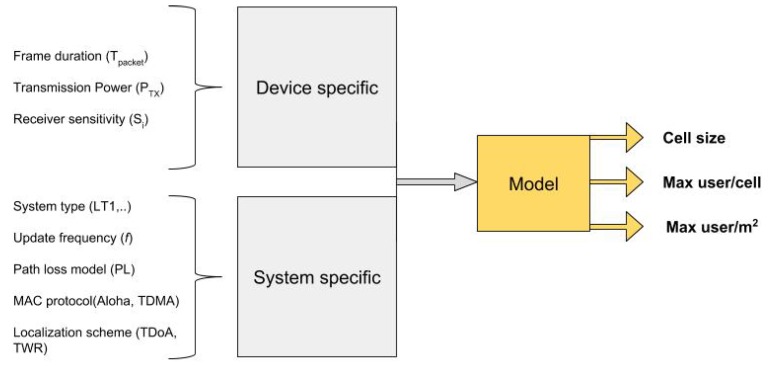
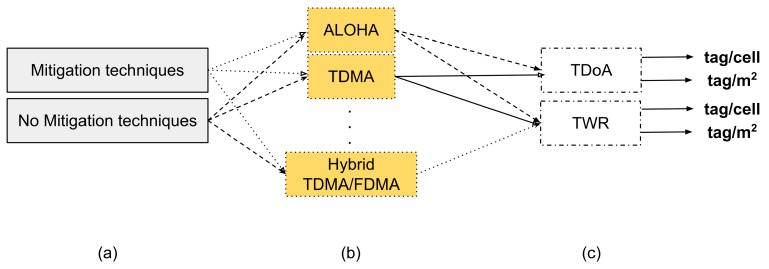
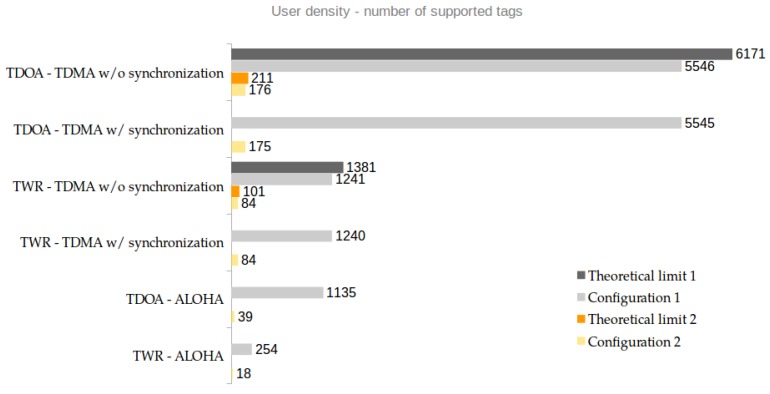
Radio frequency (RF) technologies are often used to track assets in indoor environments. Among others, ultra-wideband (UWB) has constantly gained interest thanks to its capability to obtain typical errors of 30 cm or lower, making it more accurate than other wireless technologies such as WiFi, which normally can predict the location with several meters accuracy. However, mainly due to technical requirements that are part of the standard, conventional medium access strategies such as clear channel assessment, are not straightforward to implement. Since most scientific papers focus on UWB accuracy improvements of a single user, it is not clear to which extend this limitation and other design choices impact the scalability of UWB indoor positioning systems. We investigated the scalability of indoor localization solutions, to prove that UWB can be used when hundreds of tags are active in the same system. This paper provides mathematical models that calculate the theoretical supported user density for multiple localization approaches, namely Time Difference of Arrival (TDoA) and Two-Way Ranging (TWR) with different MAC protocol combinations, i.e., ALOHA and TDMA. Moreover, this paper applies these formulas to a number of realistic UWB configurations to study the impact of different UWB schemes and settings. When applied to the 802.15.4a compliant Decawave DW1000 chip, the scalability dramatically degrades if the system operates with uncoordinated protocols and two-way communication schemes. In the best case scenario, UWB DW1000 chips can actively support up to 6171 tags in a single domain cell (no handover) with well-selected settings and choices, i.e., when adopting the combination of TDoA (one-way link) and TDMA. As a consequence, UWB can be used to simultaneously localize thousands of nodes in a dense network. However, we also show that the number of supported devices varies greatly depending on the MAC and PHY configuration choices.
射频 (RF) 技术常用于跟踪室内环境中的资产。超宽带 (UWB) 技术因其能够获得 30 厘米或更低的典型误差而备受关注,这使得它比其他无线技术(如 WiFi)更精确,后者通常可以以几米的精度预测位置。然而,主要由于标准中的技术要求,传统的介质访问策略(如信道空闲评估)并不容易实现。由于大多数科学论文都侧重于单个用户的 UWB 精度提高,因此不清楚这种限制以及其他设计选择在多大程度上影响 UWB 室内定位系统的可扩展性。我们研究了室内定位解决方案的可扩展性,以证明在同一系统中数百个标签处于活动状态时,UWB 可以使用。本文提供了计算多种定位方法(即到达时间差 (TDoA) 和双向测距 (TWR))的理论支持用户密度的数学模型,这些方法采用不同的 MAC 协议组合,即 ALOHA 和 TDMA。此外,本文还将这些公式应用于许多现实的 UWB 配置中,以研究不同的 UWB 方案和设置的影响。当应用于符合 802.15.4a 的 Decawave DW1000 芯片时,如果系统使用非协调协议和双向通信方案运行,可扩展性会急剧下降。在最佳情况下,通过精心选择设置和选择,UWB DW1000 芯片可以在单个域单元(无需切换)中主动支持多达 6171 个标签,即采用 TDoA(单向链路)和 TDMA 的组合。因此,UWB 可以用于同时在密集网络中定位数千个节点。但是,我们还表明,支持的设备数量取决于 MAC 和 PHY 配置选择,变化很大。