
人类大脑发育过程中的小胶质细胞动力学。
Microglial Dynamics During Human Brain Development.
机构信息
Biological Sciences, Faculty of Natural and Environmental Sciences, Southampton General Hospital, University of Southampton, Southampton, United Kingdom.
出版信息
Front Immunol. 2018 May 24;9:1014. doi: 10.3389/fimmu.2018.01014. eCollection 2018.
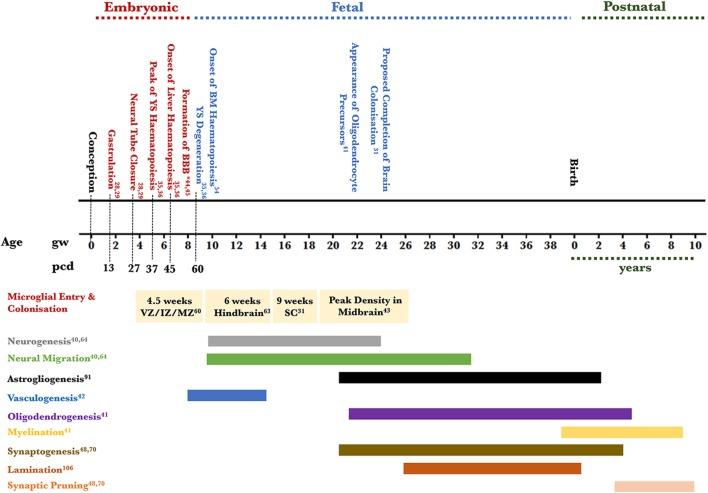
Microglial cells are thought to colonize the human cerebrum between the 4th and 24th gestational weeks. Rodent studies have demonstrated that these cells originate from yolk sac progenitors though it is not clear whether this directly pertains to human development. Our understanding of microglial cell dynamics in the developing human brain comes mostly from postmortem studies demonstrating that the beginning of microglial colonization precedes the appearance of the vasculature, the blood-brain barrier, astrogliogenesis, oligodendrogenesis, neurogenesis, migration, and myelination of the various brain areas. Furthermore, migrating microglial populations cluster by morphology and express differential markers within the developing brain and according to developmental age. With the advent of novel technologies such as RNA-sequencing in fresh human tissue, we are beginning to identify the molecular features of the adult microglial signature. However, this is may not extend to the much more dynamic and rapidly changing antenatal microglial population and this is further complicated by the scarcity of tissue resources. In this brief review, we first describe the various historic schools of thought that had debated the origin of microglial cells while examining the evidence supporting the various theories. We then proceed to examine the evidence we have accumulated on microglial dynamics in the developing human brain, present evidence from rodent studies on the functional role of microglia during development and finally identify limitations for the used approaches in human studies and highlight under investigated questions.
微胶质细胞被认为在妊娠第 4 周到第 24 周之间在人类大脑中定植。啮齿动物研究表明,这些细胞起源于卵黄囊前体,但尚不清楚这是否直接与人类发育有关。我们对发育中人类大脑中微胶质细胞动力学的理解主要来自于尸检研究,这些研究表明,微胶质细胞定植的开始先于血管、血脑屏障、星形胶质细胞发生、少突胶质细胞发生、神经发生、迁移和各种脑区的髓鞘形成。此外,在发育中的大脑中,迁移的微胶质细胞群根据形态聚类,并根据发育年龄表达不同的标志物。随着新技术如 RNA 测序在新鲜人类组织中的应用,我们开始识别成年微胶质特征的分子特征。然而,这可能不适用于更具动态性和快速变化的产前微胶质群体,而组织资源的稀缺性使情况更加复杂。在这篇简要综述中,我们首先描述了各种有争议的关于微胶质细胞起源的历史学派思想,同时检查了支持各种理论的证据。然后,我们继续检查我们在发育中人类大脑中积累的关于微胶质细胞动力学的证据,从啮齿动物研究中呈现微胶质细胞在发育过程中的功能作用的证据,最后确定人类研究中使用方法的局限性,并强调研究不足的问题。
 Zotero 插件