Kuntke Philipp, Rodrigues Mariana, Sleutels Tom, Saakes Michel, Hamelers Hubertus V M, Buisman Cees J N
Wetsus, European Centre of Excellence for Sustainable Water Technology, Oostergoweg 9, 8911 MA Leeuwarden, The Netherlands.
Sub-Department of Environmental Technology, Wageningen University, Bornse Weilanden 9, P.O. Box 17, 6700 AA Wageningen, The Netherlands.
ACS Sustain Chem Eng. 2018 Jun 4;6(6):7638-7644. doi: 10.1021/acssuschemeng.8b00457. Epub 2018 May 8.
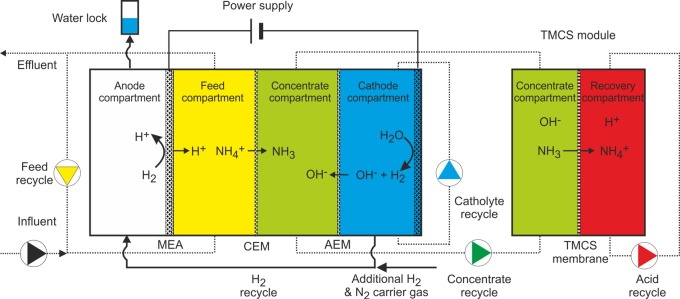
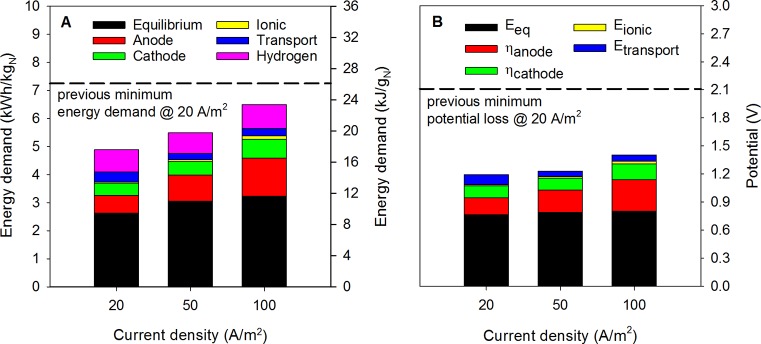
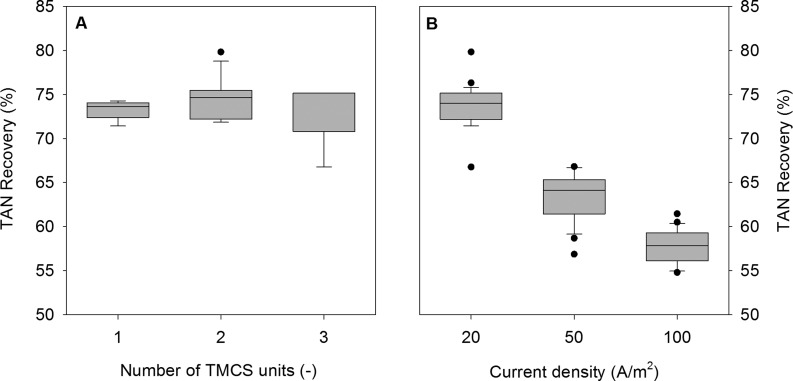
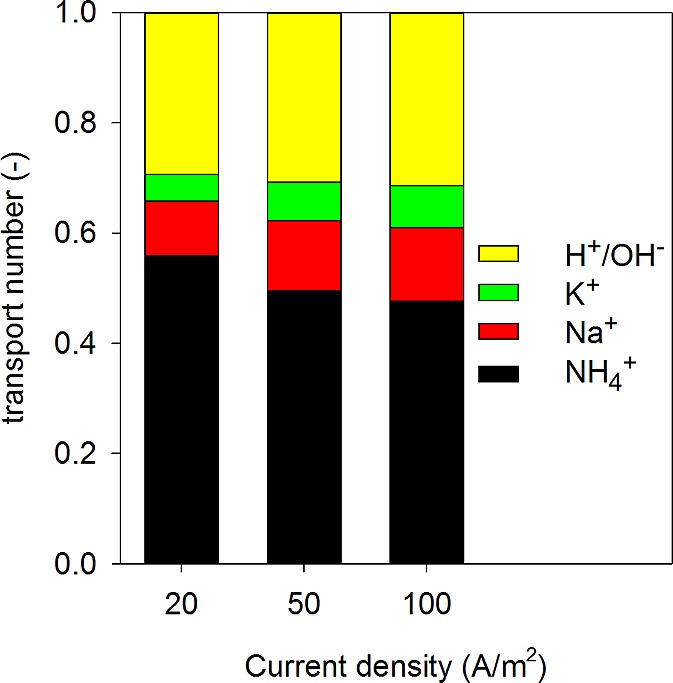
Nutrient and energy recovery is becoming more important for a sustainable future. Recently, we developed a hydrogen gas recycling electrochemical system (HRES) which combines a cation exchange membrane (CEM) and a gas-permeable hydrophobic membrane for ammonia recovery. This allowed for energy-efficient ammonia recovery, since hydrogen gas produced at the cathode was oxidized at the anode. Here, we successfully up-scaled and optimized this HRES for ammonia recovery. The electrode surface area was increased to 0.04 m to treat up to 11.5 L/day (∼46 g/day) of synthetic urine. The system was operated stably for 108 days at current densities of 20, 50, and 100 A/m. Compared to our previous prototype, this new cell design reduced the anode overpotential and ionic losses, while the use of an additional membrane reduced the ion transport losses. Overall, this reduced the required energy input from 56.3 kJ/g (15.6 kW h/kg) at 50 A/m (prototype) to 23.4 kJ/g (6.5 kW h/kg) at 100 A/m (this work). At 100 A/m, an average recovery of 58% and a TAN (total ammonia nitrogen) removal rate of 598 g/(m day) were obtained across the CEM. The TAN recovery was limited by TAN transport from the feed to concentrate compartment.
营养物质和能量回收对于可持续发展的未来正变得越来越重要。最近,我们开发了一种氢气循环电化学系统(HRES),该系统结合了阳离子交换膜(CEM)和透气疏水膜用于氨回收。这实现了节能氨回收,因为在阴极产生的氢气在阳极被氧化。在此,我们成功扩大了该HRES规模并对其进行了优化以用于氨回收。电极表面积增加到0.04平方米,以处理高达11.5升/天(约46克/天)的合成尿液。该系统在20、50和100 A/m²的电流密度下稳定运行了108天。与我们之前的原型相比,这种新的电池设计降低了阳极过电位和离子损失,同时使用额外的膜减少了离子传输损失。总体而言,这将所需的能量输入从50 A/m²(原型)时的56.3 kJ/g(15.6 kW h/kg)降低到100 A/m²(本工作)时的23.4 kJ/g(6.5 kW h/kg)。在100 A/m²时,通过CEM的平均回收率为58%,总氨氮(TAN)去除率为598克/(平方米·天)。TAN回收受到TAN从进料到浓缩室传输的限制。