Wilson Conrad D, Pardo Jason D, Anderson Jason S
Department of Biological Sciences, University of Calgary, Calgary, Alberta T2N 1N4, Canada.
McCaig Institute for Bone and Joint Health, University of Calgary, Calgary, Alberta T2N 1N4, Canada.
R Soc Open Sci. 2018 May 16;5(5):171727. doi: 10.1098/rsos.171727. eCollection 2018 May.
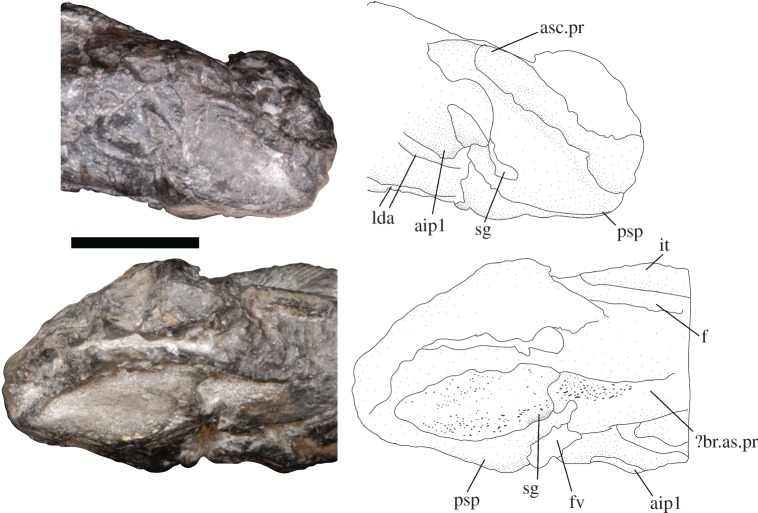
The vertebrate fossil record of the earliest Carboniferous is notoriously poorly sampled, obscuring a critical interval in vertebrate evolution and diversity. Recent studies of diversity across the Devonian-Carboniferous boundary have proposed a vertebrate mass extinction at the end-Devonian, and recent phylogenies suggest that the origin of the actinopterygian crown may have occurred in the earliest Carboniferous, as part of a broader recovery fauna. However, the data necessary to test this are limited. Here, we describe a partial actinopterygian skull, including diagnostic elements of the posterior braincase, from the Tournaisian Horton Bluff Formation of Blue Beach, Nova Scotia. The braincase surprisingly shows a confluence of characters common in Devonian taxa but absent in Mississippian forms, such as an open spiracular groove; lateral dorsal aortae that pass through open broadly separated, parallel grooves in the ventral otoccipital region, posterior to the articulation of the first infrapharyngobranchial and an intertemporal-supratemporal complex. Phylogenetic analysis places it deep within the actinopterygian stem, among Devonian moythomasiids and mimiids, suggesting more phylogenetically inclusive survivorship of stem group actinopterygians across the end-Devonian mass extinction. With a high lineage survivorship in tetrapods and lungfish across the Devonian-Carboniferous boundary and high vertebrate diversity at Tournaisian localities, this hints at a more gradual turnover between Devonian and Carboniferous vertebrate faunas.
石炭纪最早期的脊椎动物化石记录采样极差,使得脊椎动物进化和多样性的一个关键时期变得模糊不清。最近对泥盆纪-石炭纪边界生物多样性的研究提出在泥盆纪末期发生了脊椎动物大灭绝,并且最近的系统发育研究表明辐鳍鱼冠群的起源可能发生在石炭纪最早期,是更广泛的复苏动物群的一部分。然而,验证这一点所需的数据有限。在此,我们描述了一个部分辐鳍鱼颅骨,包括来自新斯科舍省蓝滩图尔奈阶霍顿布拉夫组的脑颅后部诊断性特征。令人惊讶的是,该脑颅显示出泥盆纪类群中常见但密西西比纪类群中不存在的特征的汇合,比如一个开放的鳃裂沟;外侧背主动脉穿过腹侧耳枕区开放的、宽分离的平行沟,位于第一下咽鳃骨关节后方以及颞间-颞上复合体处。系统发育分析将其置于辐鳍鱼干群的深处,在泥盆纪的莫伊托马西鱼科和米米鱼科之间,这表明干群辐鳍鱼在泥盆纪末期大灭绝中具有更具系统发育包容性的生存情况。在泥盆纪-石炭纪边界的四足动物和肺鱼中具有较高的谱系存活率,以及图尔奈阶地区较高的脊椎动物多样性,这暗示着泥盆纪和石炭纪脊椎动物群之间的更替更为渐进。