O'Meara Rachel N, Dirks Wendy, Martinelli Agustín G
The University Museum of Zoology, Downing Street, Cambridge CB2 3EJ, UK.
Department of Anthropology, Durham University, Dawson Building, South Road, Durham DH1 3LE, UK.
R Soc Open Sci. 2018 May 16;5(5):172293. doi: 10.1098/rsos.172293. eCollection 2018 May.
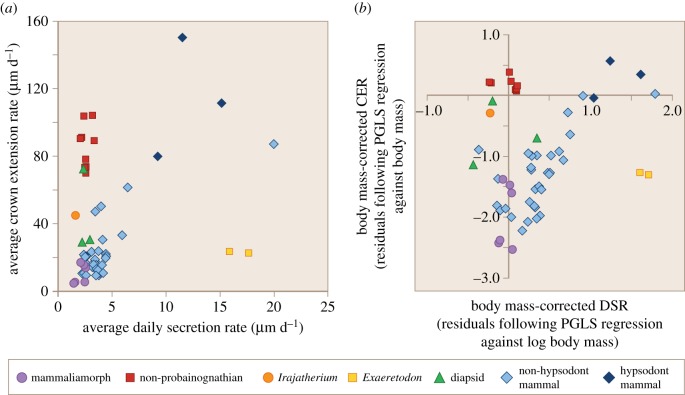
The early evolution of mammals is associated with the linked evolutionary origin of diphyodont tooth replacement, rapid juvenile growth and determinate adult growth. However, specific relationships among these characters during non-mammalian cynodont evolution require further exploration. Here, polarized light microscopy revealed incremental lines, resembling daily laminations of extant mammals, in histological sections of enamel in eight non-mammalian cynodont species. In the more basal non-probainognathian group, enamel extends extremely rapidly from cusp to cervix. By contrast, the enamel of mammaliamorphs is gradually accreted, with slow rates of crown extension, more typical of the majority of non-hypsodont crown mammals. These results are consistent with the reduction in dental replacement rate across the non-mammalian cynodont lineage, with greater rates of crown extension required in most non-probainognathians, and slower crown extension rates permitted in mammaliamorphs, which have reduced patterns of dental replacement in comparison with many non-probainognathians. The evolution of mammal-like growth patterns, with faster juvenile growth and more abruptly terminating adult growth, is linked with this reduction in dental replacement rates and may provide an additional explanation for the observed pattern in enamel growth rates. It is possible that the reduction in enamel extension rates in mammaliamorphs reflects an underlying reduction in skeletal growth rates at the time of postcanine formation, due to a more abruptly terminating pattern of adult growth in these more mammal-like, crownward species.
哺乳动物的早期进化与双套牙替换、幼体快速生长和成年期生长确定的相关进化起源有关。然而,在非哺乳类犬齿兽类进化过程中,这些特征之间的具体关系仍需进一步探索。在此,偏光显微镜在8种非哺乳类犬齿兽类物种的牙釉质组织切片中发现了类似于现存哺乳动物日生长层的生长线。在更原始的非原颌兽类群中,牙釉质从牙尖到颈部延伸极快。相比之下,哺乳形类的牙釉质是逐渐积累的,牙冠延伸速度较慢,这更典型地体现了大多数非高冠哺乳动物的特征。这些结果与整个非哺乳类犬齿兽类谱系中牙齿替换率的降低相一致,大多数非原颌兽类需要更高的牙冠延伸率,而哺乳形类由于与许多非原颌兽类相比牙齿替换模式减少,因而允许较慢的牙冠延伸率。类似哺乳动物的生长模式的进化,即幼体生长更快和成年期生长更突然终止,与牙齿替换率的降低有关,并且可能为观察到的牙釉质生长率模式提供额外的解释。有可能哺乳形类牙釉质延伸率的降低反映了在犬齿后形成时骨骼生长率的潜在降低,这是由于这些更类似哺乳动物的、向牙冠方向发展的物种成年期生长模式更突然终止所致。