University of North Carolina Project, Lilongwe, Malawi.
Kamuzu Central Hospital, Lilongwe, Malawi.
PLoS One. 2018 Jun 12;13(6):e0196561. doi: 10.1371/journal.pone.0196561. eCollection 2018.
Fine needle aspiration cytology (FNAC) has been widely accepted to be a safe, accurate, prompt and inexpensive procedure for diagnosis of both neoplastic and infectious diseases in adult and pediatric populations. Despite its value for diagnosis, FNAC is underutilized in resource limited countries. We reviewed the utilization of FNAC after it was introduced at Kamuzu Central Hospital (KCH).
A retrospective review of all FNAC performed at KCH laboratory during the period of January 2012 to July 2014 was conducted using an electronic database from KCH laboratory. We evaluated factors associated with a diagnostic sample using multivariate logistic regression model.
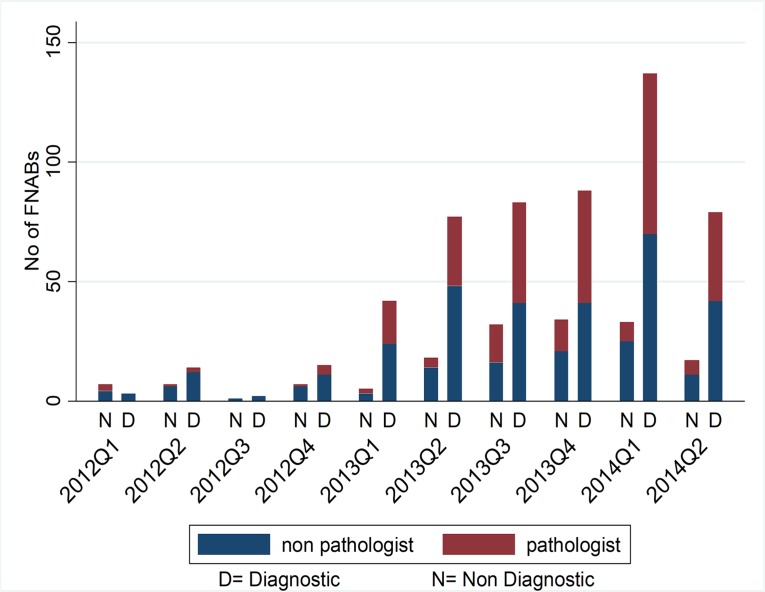
750 FNAC were reviewed from 722 patients: 56.9% were adults >15 years and 54% were female. The number of FNAC increased annually from 56 (2012) to 379 (2013) to 315 (up to July 2014). Of 750 FNAC, 56.4% were performed by non-pathologists. The most common sites were lymph nodes (38.1%), abdomen (25.8%), breast (16.3%), and head & neck (15.7%). Most of the samples (77.6%) were diagnostic. FNAC was more likely to be diagnostic if performed by pathologists versus non-pathologists (OR 1.78, 95% CI 1.20-2.64), in 2013 compared to 2012 (OR 1.95, 95% CI 1.05-3.56), or performed on a deep lesion versus a subcutaneous lesion (OR 1.71, 95% CI 1.15-2.5), or if samples were taken from the head and neck (OR 2.4, 95% CI: 1.39-4.39), and abdomen (OR 2.66, 95%CI1.59-4.42) compared to those from the lymph nodes. The odds of a diagnostic test did not differ significantly according to gender, HIV status, or age groups.
Most FNACs successfully diagnosed the presence or absence of disease, with substantial improvements over time. However, training for non-pathologists may facilitate more diagnostic results.
细针穿刺细胞学检查(FNAC)已被广泛接受,可用于诊断成人和儿科人群的肿瘤和感染性疾病,是一种安全、准确、迅速且廉价的方法。尽管 FNAC 对诊断有价值,但在资源有限的国家中并未得到充分利用。我们回顾了卡姆祖中心医院(KCH)引入 FNAC 后的应用情况。
我们使用 KCH 实验室的电子数据库对 2012 年 1 月至 2014 年 7 月期间在 KCH 实验室进行的所有 FNAC 进行了回顾性分析。我们使用多变量逻辑回归模型评估了与诊断样本相关的因素。
共回顾了 722 例患者的 750 例 FNAC,其中 56.9%为>15 岁的成年人,54%为女性。FNAC 的数量逐年增加,从 2012 年的 56 例增加到 2013 年的 379 例,截至 2014 年 7 月增加到 315 例。750 例 FNAC 中,56.4%由非病理学家进行。最常见的部位是淋巴结(38.1%)、腹部(25.8%)、乳房(16.3%)和头颈部(15.7%)。大多数样本(77.6%)具有诊断价值。与非病理学家相比,由病理学家进行 FNAC(OR 1.78,95%CI 1.20-2.64)、与 2012 年相比在 2013 年进行 FNAC(OR 1.95,95%CI 1.05-3.56)、对深部病变进行 FNAC(OR 1.71,95%CI 1.15-2.5)、对头颈部进行 FNAC(OR 2.4,95%CI:1.39-4.39)和腹部病变(OR 2.66,95%CI1.59-4.42)的诊断率更高。性别、HIV 状态和年龄组对诊断试验的几率没有显著影响。
大多数 FNAC 成功诊断了疾病的存在或不存在,随着时间的推移取得了显著的进展。然而,对非病理学家的培训可能会促进更多的诊断结果。