Department of Biomedical Sciences, Cooper Medical School of Rowan University, Camden, NJ, USA; Department of Anesthesiology, Vanderbilt University School of Medicine, Nashville TN, USA.
Department of Anesthesiology, Vanderbilt University School of Medicine, Nashville TN, USA.
Pharmacol Res. 2019 Feb;140:56-66. doi: 10.1016/j.phrs.2018.06.008. Epub 2018 Jun 9.
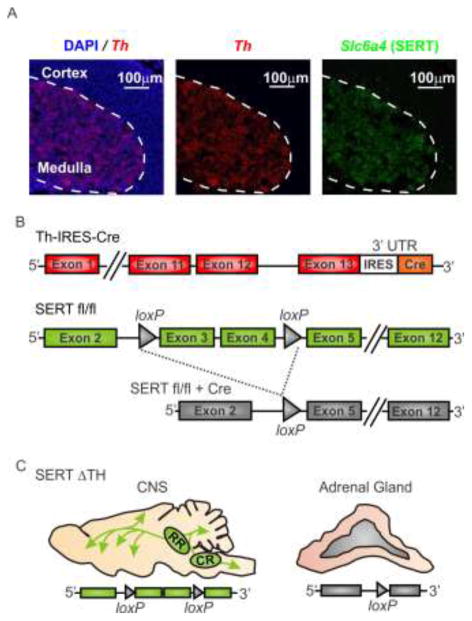
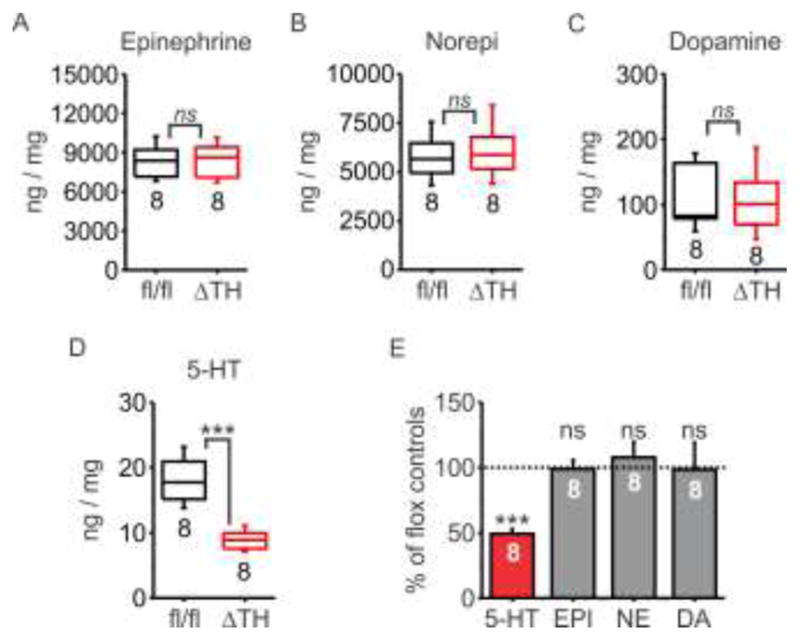
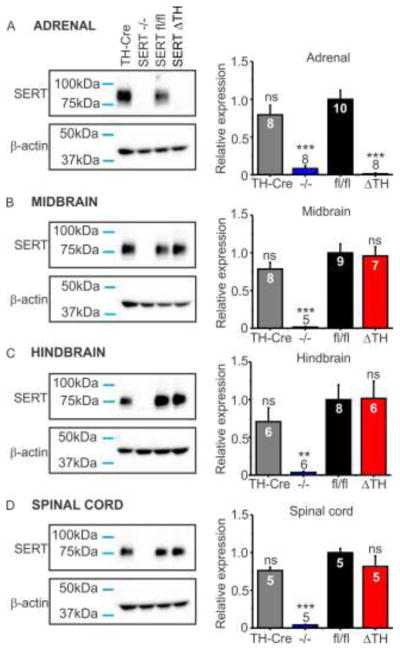
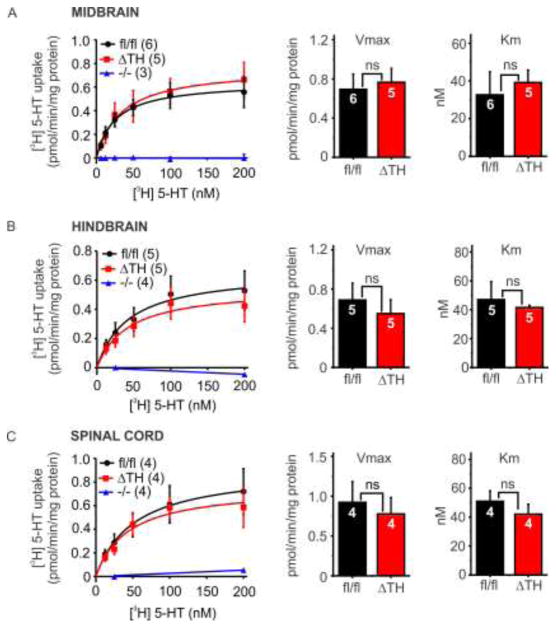
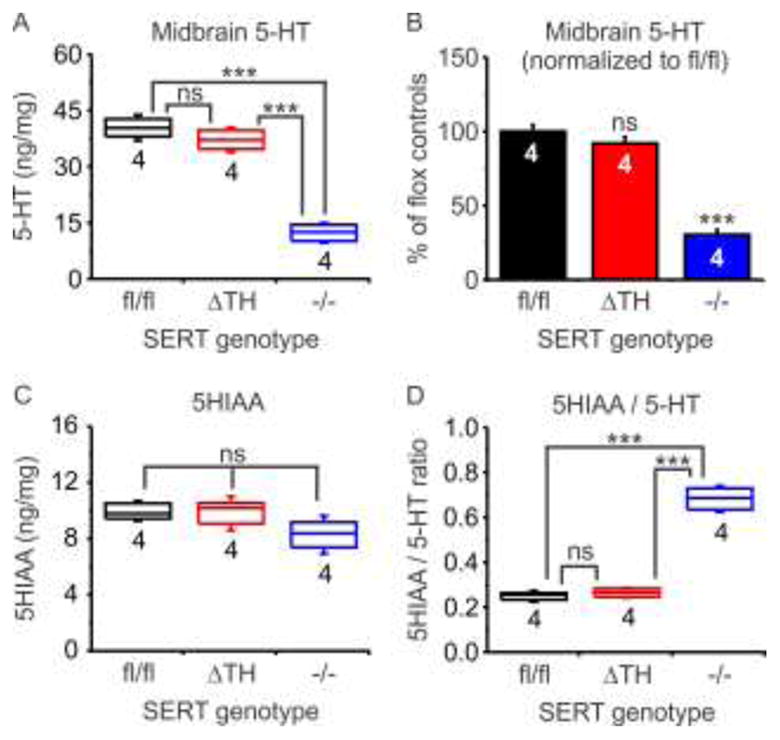
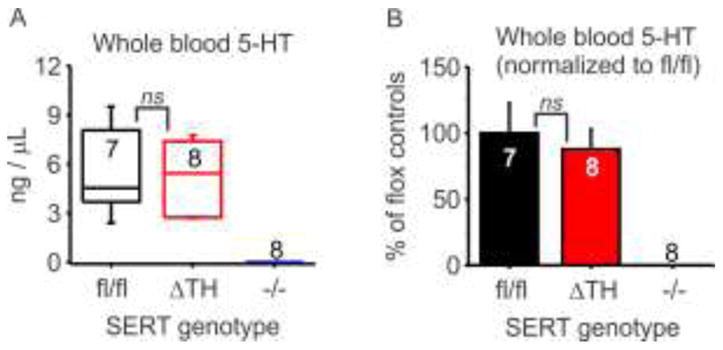
Adrenal chromaffin cells comprise the neuroendocrine arm of the sympathetic nervous system and secrete catecholamines to coordinate the appropriate stress response. Deletion of the serotonin (5-HT) transporter (SERT) gene in mice (SERT mice) or pharmacological block of SERT function in rodents and humans augments this sympathoadrenal stress response (epinephrine secretion). The prevailing assumption is that loss of CNS SERT alters central drive to the peripheral sympathetic nervous system. Adrenal chromaffin cells also prominently express SERT where it might coordinate accumulation of 5-HT for reuse in the autocrine control of stress-evoked catecholamine secretion. To help test this hypothesis, we have generated a novel mouse model with selective excision of SERT in the peripheral sympathetic nervous system (SERT), generated by crossing floxed SERT mice with tyrosine hydroxylase Cre driver mice. SERT expression, assessed by western blot, was abolished in the adrenal gland but not perturbed in the CNS of SERT mice. SERT-mediated [H] 5-HT uptake was unaltered in midbrain, hindbrain, and spinal cord synaptosomes, confirming transporter function was intact in the CNS. Endogenous midbrain and whole blood 5-HT homeostasis was unperturbed in SERT mice, contrasting with the depleted 5-HT content in SERT mice. Selective SERT excision reduced adrenal gland 5-HT content by ≈ 50% in SERT mice but had no effect on adrenal catecholamine content. This novel model confirms that SERT expressed in adrenal chromaffin cells is essential for maintaining wild-type levels of 5-HT and provides a powerful tool to help dissect the role of SERT in the sympathetic stress response.
肾上腺嗜铬细胞构成交感神经系统的神经内分泌分支,分泌儿茶酚胺以协调适当的应激反应。在小鼠中删除血清素(5-HT)转运体(SERT)基因(SERT 小鼠)或在啮齿动物和人类中药理学阻断 SERT 功能会增强这种交感肾上腺应激反应(肾上腺素分泌)。普遍的假设是,中枢神经系统 SERT 的缺失改变了对周围交感神经系统的中枢驱动。肾上腺嗜铬细胞也明显表达 SERT,它可能协调 5-HT 的积累,用于自主控制应激诱导的儿茶酚胺分泌的再利用。为了帮助检验这一假设,我们通过将 SERT 基因敲除小鼠与酪氨酸羟化酶 Cre 驱动小鼠杂交,产生了一种新型的外周交感神经系统(SERT)选择性敲除的小鼠模型。通过 Western blot 评估,SERT 在肾上腺中的表达被消除,但在 SERT 小鼠的中枢神经系统中未受到干扰。SERT 介导的[H]5-HT 摄取在中脑、后脑和脊髓突触体中未改变,证实了中枢神经系统中的转运体功能完整。SERT 小鼠的内源性中脑和全血 5-HT 稳态未受干扰,与 SERT 小鼠中耗尽的 5-HT 含量形成对比。选择性 SERT 切除可使 SERT 小鼠的肾上腺 5-HT 含量减少约 50%,但对肾上腺儿茶酚胺含量没有影响。这种新型模型证实,肾上腺嗜铬细胞中表达的 SERT 对于维持 5-HT 的野生型水平是必不可少的,并为帮助剖析 SERT 在交感应激反应中的作用提供了有力工具。