Liu Xiangrong, Wen Shaohong, Zhao Shunying, Yan Feng, Zhao Shangfeng, Wu Di, Ji Xunming
1China-America Joint Institute of Neuroscience, Xuanwu Hospital, Capital Medical University, Beijing, China.
2 Beijing Key Laboratory of Translational Medicine for Cerebrovascular Diseases, Beijing, China.
Aging Dis. 2018 Jun 1;9(3):401-411. doi: 10.14336/AD.2017.0703. eCollection 2018 Jun.
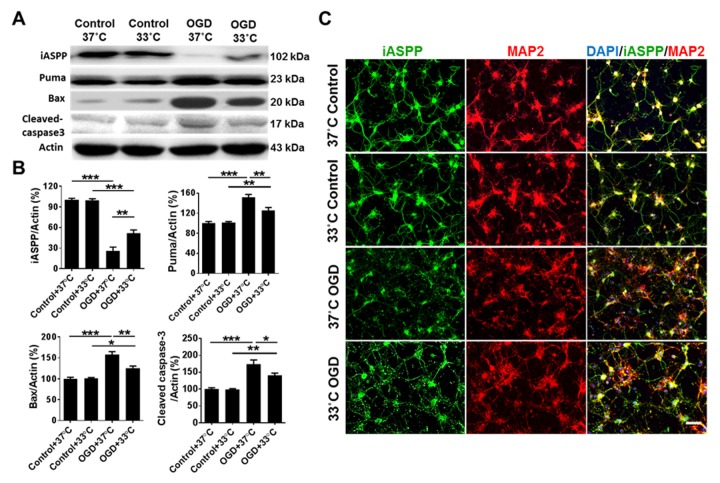
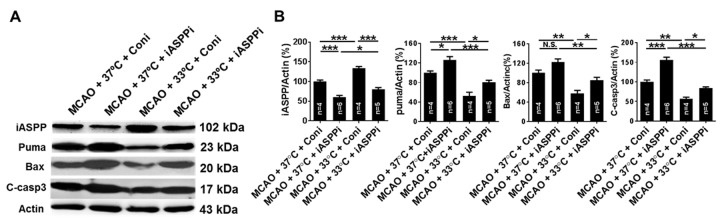
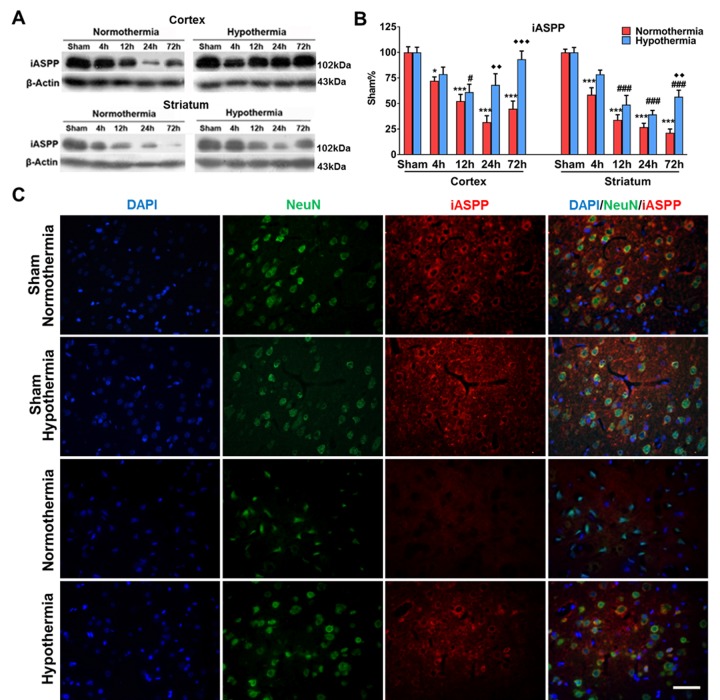
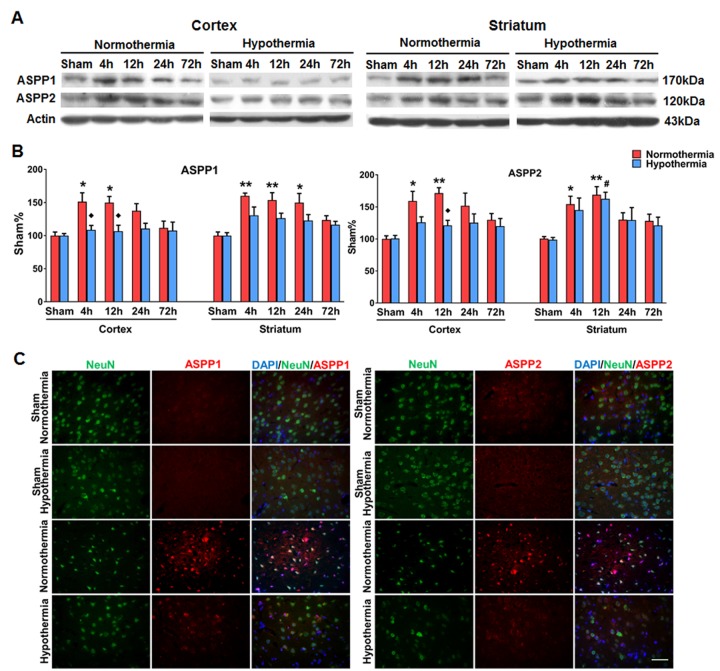
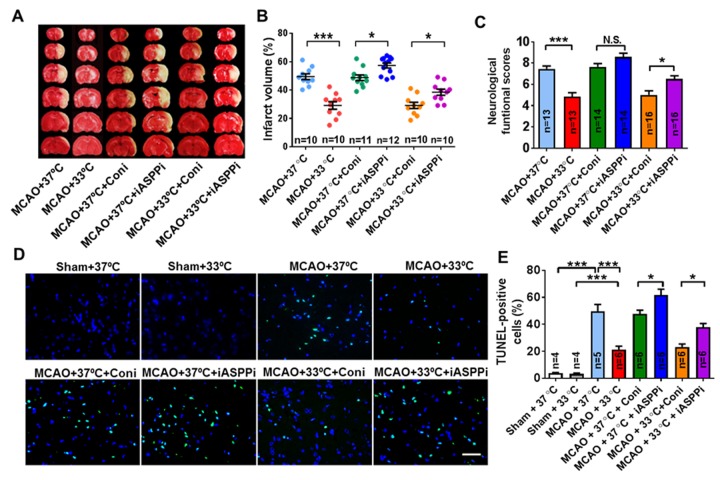
Mild therapeutic hypothermia, a robust neuroprotectant, reduces neuronal apoptosis, but the precise mechanism is not well understood. Our previous study showed that a novel inhibitor of an apoptosis-stimulating protein of p53 (iASPP) might be involved in neuronal death after stroke. The aim of this study was to confirm the role of iASPP after stroke treated with mild therapeutic hypothermia. To address this, we mimicked ischemia/reperfusion injury in vitro by using oxygen-glucose deprivation/reperfusion (OGD/R) in primary rat neurons. In our in vivo approach, we induced middle cerebral artery occlusion (MCAO) for 60 min in C57/B6 mice. From the beginning of ischemia, focal mild hypothermia was applied for two hours. To evaluate the role of iASPP, small interfering RNA (siRNA) was injected intracerebroventricularly. Our results showed that mild therapeutic hypothermia increased the expression of iASPP and decreased the expression of its targets, Puma and Bax, and an apoptosis marker, cleaved caspase-3, in primary neurons under OGD/R. Increased iASPP expression and decreased ASPP1/2 expression were observed under hypothermia treatment in MCAO mice. iASPP siRNA (iASPPi) or hypothermia plus iASPPi application increased infarct volume, apoptosis and aggravated the neurological deficits in MCAO mice. Furthermore, iASPPi downregulated iASPP expression, and upregulated the expression of proapoptotic effectors, Puma, Bax and cleaved caspase-3, in mice after stroke treated with mild therapeutic hypothermia. In conclusion, mild therapeutic hypothermia protects against ischemia/reperfusion brain injury in mice by upregulating iASPP and thus attenuating apoptosis. iASPP may be a potential target in the therapy of stroke.
轻度治疗性低温是一种强大的神经保护剂,可减少神经元凋亡,但其确切机制尚不完全清楚。我们之前的研究表明,一种新型的p53凋亡刺激蛋白抑制剂(iASPP)可能参与了中风后的神经元死亡。本研究的目的是证实轻度治疗性低温治疗中风后iASPP的作用。为了解决这个问题,我们在原代大鼠神经元中通过氧糖剥夺/再灌注(OGD/R)模拟体外缺血/再灌注损伤。在我们的体内实验中,我们在C57/B6小鼠中诱导大脑中动脉闭塞(MCAO)60分钟。从缺血开始,进行局部轻度低温治疗两小时。为了评估iASPP的作用,将小干扰RNA(siRNA)脑室内注射。我们的结果表明,在OGD/R条件下,轻度治疗性低温可增加原代神经元中iASPP的表达,降低其靶点Puma和Bax以及凋亡标志物裂解的半胱天冬酶-3的表达。在MCAO小鼠的低温治疗下,观察到iASPP表达增加和ASPP1/2表达降低。iASPP siRNA(iASPPi)或低温加iASPPi应用增加了MCAO小鼠的梗死体积、凋亡并加重了神经功能缺损。此外,在轻度治疗性低温治疗的中风小鼠中,iASPPi下调了iASPP的表达,并上调了促凋亡效应分子Puma、Bax和裂解的半胱天冬酶-3的表达。总之,轻度治疗性低温通过上调iASPP从而减轻凋亡来保护小鼠免受缺血/再灌注脑损伤。iASPP可能是中风治疗的一个潜在靶点。