Department of Medicine, The University of Melbourne, Austin Health, Heidelberg, Victoria, Australia.
Department of Cardiology, Austin Health, Heidelberg, Victoria, Australia.
PLoS One. 2018 Jun 13;13(6):e0198144. doi: 10.1371/journal.pone.0198144. eCollection 2018.
Angiotensin converting enzyme 2 (ACE2) is an endogenous regulator of the renin angiotensin system. Increased circulating ACE2 predicts adverse outcomes in patients with heart failure (HF), but it is unknown if elevated plasma ACE2 activity predicts major adverse cardiovascular events (MACE) in patients with obstructive coronary artery disease (CAD).
We prospectively recruited patients with obstructive CAD (defined as ≥50% stenosis of the left main coronary artery and/or ≥70% stenosis in ≥ 1 other major epicardial vessel on invasive coronary angiography) and measured plasma ACE2 activity. Patients were followed up to determine if circulating ACE2 activity levels predicted the primary endpoint of MACE (cardiovascular mortality, HF or myocardial infarction).
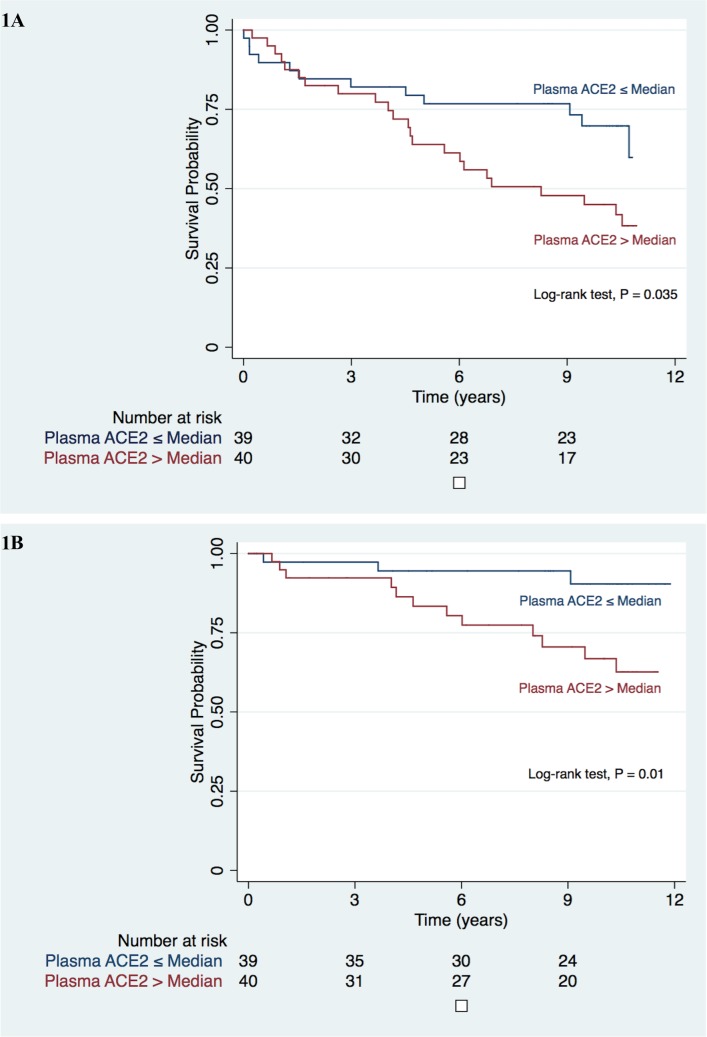
We recruited 79 patients with obstructive coronary artery disease. The median (IQR) plasma ACE2 activity was 29.3 pmol/ml/min [21.2-41.2]. Over a median follow up of 10.5 years [9.6-10.8years], MACE occurred in 46% of patients (36 events). On Kaplan-Meier analysis, above-median plasma ACE2 activity was associated with MACE (log-rank test, p = 0.035) and HF hospitalisation (p = 0.01). After Cox multivariable adjustment, log ACE2 activity remained an independent predictor of MACE (hazard ratio (HR) 2.4, 95% confidence interval (CI) 1.24-4.72, p = 0.009) and HF hospitalisation (HR: 4.03, 95% CI: 1.42-11.5, p = 0.009).
Plasma ACE2 activity independently increased the hazard of adverse long-term cardiovascular outcomes in patients with obstructive CAD.
血管紧张素转换酶 2(ACE2)是肾素-血管紧张素系统的内源性调节剂。循环中 ACE2 水平升高预示心力衰竭(HF)患者预后不良,但尚不清楚阻塞性冠状动脉疾病(CAD)患者中升高的血浆 ACE2 活性是否可预测主要不良心血管事件(MACE)。
我们前瞻性招募了阻塞性 CAD 患者(定义为经侵入性冠状动脉造影检查左主干冠状动脉≥50%狭窄和/或≥1 个其他主要心外膜血管≥70%狭窄)并测量了血浆 ACE2 活性。随访患者以确定循环 ACE2 活性水平是否预测 MACE(心血管死亡率、HF 或心肌梗死)的主要终点。
我们招募了 79 名阻塞性冠状动脉疾病患者。血浆 ACE2 活性中位数(IQR)为 29.3 pmol/ml/min [21.2-41.2]。中位随访 10.5 年[9.6-10.8 年]后,46%的患者发生 MACE(36 例事件)。在 Kaplan-Meier 分析中,高于中位数的血浆 ACE2 活性与 MACE(对数秩检验,p = 0.035)和 HF 住院(p = 0.01)相关。在 Cox 多变量调整后,log ACE2 活性仍然是 MACE(危险比(HR)2.4,95%置信区间(CI)1.24-4.72,p = 0.009)和 HF 住院(HR:4.03,95%CI:1.42-11.5,p = 0.009)的独立预测因素。
在阻塞性 CAD 患者中,血浆 ACE2 活性独立增加了不良长期心血管结局的发生风险。