Surveillance and Health Services Research, American Cancer Society, Atlanta, GA, United States of America.
Rollins School of Public Health, Emory University, Atlanta, GA, United States of America.
PLoS One. 2018 Jun 13;13(6):e0198771. doi: 10.1371/journal.pone.0198771. eCollection 2018.
Breast cancer in young women tends to be more aggressive, but timely treatment may not be always available, particularly to those without health insurance. We aim to examine whether the dependent coverage expansion under the Affordable Care Act (ACA-DCE) implemented in 2010 was associated with changes in time to treatment among women diagnosed with early stage breast cancer.
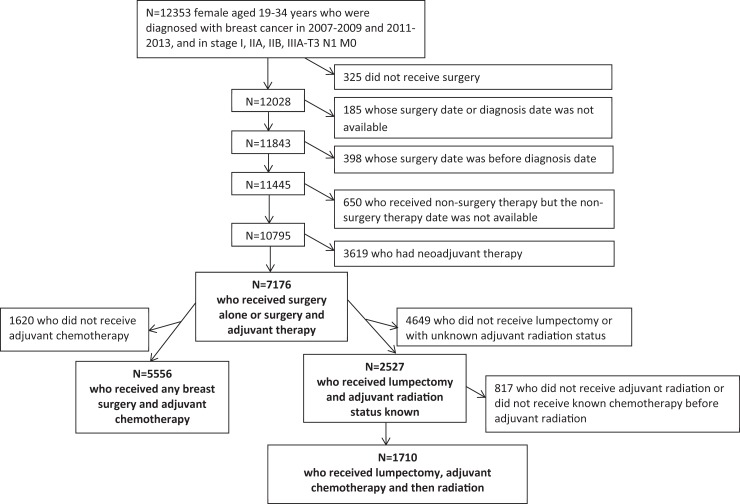
A total of 7,176 patients diagnosed with early stage breast cancer in 2007-2009 (pre-ACA) and 2011-2013 (post-ACA) were identified from the National Cancer Database. A quasi-experimental design difference-in-differences (DD) approach was used, with patients aged 19-25 (targeted by the policy) considered as the intervention group, and patients aged 26-34 years (not affected by the policy) as the control group. Changes in the following treatment outcomes were examined: time from diagnosis to surgery, time from surgery to adjuvant chemotherapy, and time from adjuvant chemotherapy to radiation.
Compared with the control group of patients aged 26-34, young patients aged 19-25 experienced a statistically nonsignificant decrease of 2.7 percentage points (95% CI [-1.2, 6.5]) in the uninsured rate. This did not translate into more reduction in delays to surgery (DD = 2.7 days, 95% CI [-3.2, 8.3]), chemotherapy (DD = -1.0 days, 95% CI [-7.2, 5.2]) or radiation (DD = 5.3 days, 95% CI [-15.6, 26.3]) in the younger cohort than the older cohort.
No significant changes in time to treatment were found among young women diagnosed with early stage breast cancer after the implementation of the ACA-DCE. Future studies examining impacts of health care policy reform on breast cancer care are warranted to include patients from low-income families and to consider effects from Medicaid expansion.
年轻女性的乳腺癌往往更具侵袭性,但及时治疗并非总是可行的,特别是对于那些没有医疗保险的人。我们旨在研究 2010 年实施的平价医疗法案(ACA-DCE)下的附属保险范围扩大是否与早期乳腺癌患者的治疗时间变化有关。
从国家癌症数据库中确定了 2007-2009 年(ACA 前)和 2011-2013 年(ACA 后)诊断为早期乳腺癌的 7176 名患者。采用准实验设计的差异-差异(DD)方法,将年龄在 19-25 岁的患者(受政策影响)视为干预组,年龄在 26-34 岁的患者(不受政策影响)视为对照组。检查以下治疗结果的变化:从诊断到手术的时间、从手术到辅助化疗的时间以及从辅助化疗到放疗的时间。
与年龄在 26-34 岁的对照组患者相比,年龄在 19-25 岁的年轻患者的未参保率统计学上无显著下降(95%CI[-1.2,6.5])。这并没有转化为手术(DD=2.7 天,95%CI[-3.2,8.3])、化疗(DD=-1.0 天,95%CI[-7.2,5.2])或放疗(DD=5.3 天,95%CI[-15.6,26.3])延迟的减少在年轻组中比在老年组中更为明显。
在实施 ACA-DCE 后,早期乳腺癌诊断的年轻女性的治疗时间没有明显变化。未来研究有必要检查医疗保健政策改革对乳腺癌护理的影响,包括来自低收入家庭的患者,并考虑医疗补助扩大的影响。