Cancer Research Division, Cancer Council NSW, Sydney, New South Wales, Australia.
Sydney School of Public Health, University of Sydney, Sydney, New South Wales, Australia.
PLoS One. 2018 Jun 13;13(6):e0198679. doi: 10.1371/journal.pone.0198679. eCollection 2018.
An elevated risk of suicide after a diagnosis of prostate cancer has been reported previously in the USA and Sweden. We aimed to identify whether prostate cancer survivors resident in New South Wales Australia are at higher risk of suicide and if so, who is most at risk.
Data were obtained from the New South Wales (NSW) Cancer Registry for all men diagnosed with prostate cancer in NSW during 1997 to 2007. These were linked by the Centre for Health Record Linkage (CHeReL) to Australian Bureau of Statistics Mortality Data to the end of 2007 to determine vital status and cause of death. We compared the number of suicides observed for prostate cancer survivors with the expected number of suicides based on age- and calendar year- specific rates for the NSW male population using standardised mortality ratios (SMRs). Suicide rate ratios (RR) by disease and patients' characteristics were estimated using multivariable negative binomial regression to determine the most at risk groups.
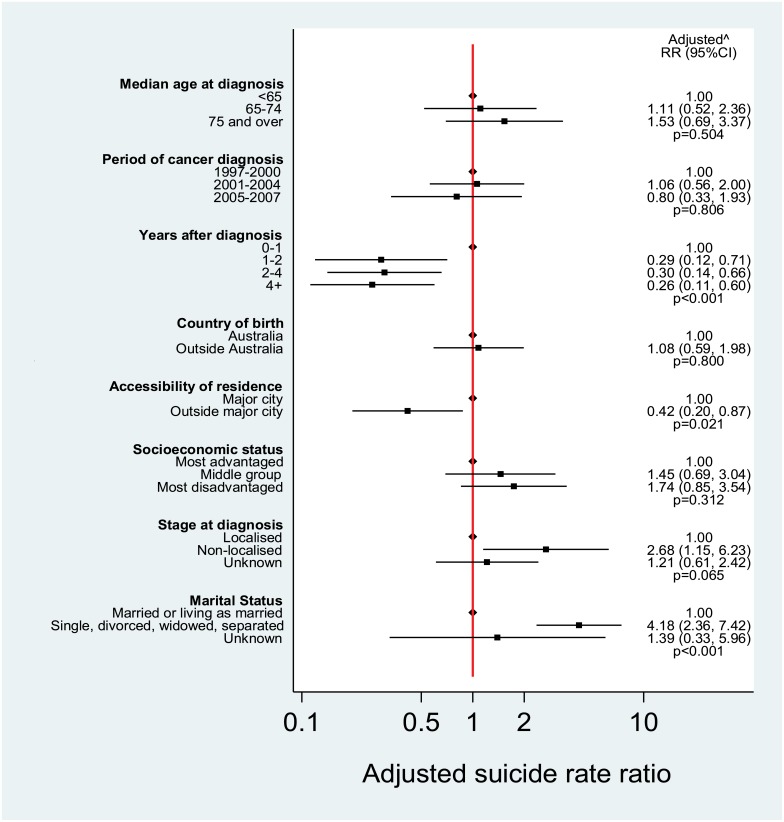
During the study period 51,924 NSW men were diagnosed with prostate cancer. Forty nine of these men were subsequently recorded as committing suicide up to 10 years after diagnosis with an SMR of 1.70 (95% CI:1.26-2.25). Twenty six (53%) of these suicides occurred within 12 months after diagnosis. Risk diminished over time since diagnosis (RR in 1-2 years after diagnosis = 0.29, 95% CI: 0.12-0.71, 2-4 years RR = 0.30, 95% CI: 0.14-0.16 and 4+ years RR = 0.26, 95% CI: 0.11-0.60 compared with <1 year since diagnosis). Men with non-localised disease had a higher risk of suicide compared to men with localised disease (RR = 2.68, 95% CI: 1.15-6.23). Men living outside major cities had lower risk of suicide compared to those resident in major cities (rate ratio = 0.42, 95% CI: 0.20-0.87). Single, divorced, widowed or separated men were more likely to commit suicide than married men (RR = 4.18, 95% CI: 2.36-7.42).
Risk of suicide is higher for NSW men diagnosed with prostate cancer than the general age matched male population. Vulnerable or lonely men and those with pre-existing depression or suicidal ideation who are diagnosed with prostate cancer should be offered additional psychological support.
此前在美国和瑞典的研究报告显示,前列腺癌确诊后自杀风险会升高。我们旨在确定澳大利亚新南威尔士州的前列腺癌幸存者是否存在更高的自杀风险,如果存在,哪些人群的风险最高。
本研究数据来自新南威尔士州(NSW)癌症登记处,纳入了 1997 年至 2007 年期间在 NSW 确诊的所有前列腺癌男性患者。通过健康记录链接中心(CHeReL),将这些数据与澳大利亚统计局的死亡率数据进行链接,以确定 2007 年底的生存状态和死因。我们将观察到的前列腺癌幸存者的自杀人数与基于 NSW 男性人群年龄和日历特定死亡率的预期自杀人数进行比较,使用标准化死亡率比(SMR)进行比较。使用多变量负二项回归估计疾病和患者特征的自杀率比(RR),以确定风险最高的人群。
在研究期间,共有 51924 名 NSW 男性被诊断为前列腺癌。其中 49 人在诊断后 10 年内被记录为自杀,SMR 为 1.70(95%CI:1.26-2.25)。其中 26 例(53%)自杀发生在诊断后 12 个月内。诊断后时间的风险逐渐降低(诊断后 1-2 年 RR = 0.29,95%CI:0.12-0.71,2-4 年 RR = 0.30,95%CI:0.14-0.16,4+年 RR = 0.26,95%CI:0.11-0.60 与<1 年自诊断相比)。与局限性疾病患者相比,非局限性疾病患者的自杀风险更高(RR = 2.68,95%CI:1.15-6.23)。与居住在主要城市的男性相比,居住在非主要城市的男性自杀风险较低(比率比= 0.42,95%CI:0.20-0.87)。单身、离婚、丧偶或分居的男性比已婚男性更有可能自杀(RR = 4.18,95%CI:2.36-7.42)。
与年龄匹配的一般男性人群相比,新南威尔士州男性前列腺癌患者的自杀风险更高。诊断患有前列腺癌的易受伤害或孤独的男性以及患有先前存在的抑郁症或自杀意念的男性应获得额外的心理支持。