Reis Flávia Mylla de Sousa, Branco Renata Rodrigues de Oliveira Castelo, Conceição Amanda Mota, Trajano Letícia Paula Benvindo, Vieira José Felipe Pinheiro do Nascimento, Ferreira Pablo Ricardo Barbosa, Araújo Éverton José Ferreira de
Universidade Federal do Piauí, Teresina, PI, Brazil.
Laboratório Central de Saúde Pública Dr. Costa Alvarenga, Teresina, PI, Brazil.
Einstein (Sao Paulo). 2018 Jun 7;16(2):eAO4150. doi: 10.1590/S1679-45082018AO4150.
To evaluate the incidence of variant hemoglobins in different health regions.
A descriptive, observational, and cross-sectional study with a quantitative approach based on secondary data in the internal records of the neonatal screening service - Laboratório Central de Saúde Pública do Estado do Piauí (PI, Brazil). The variables related to sex, ethnicity and positive diagnosis for variant hemoglobins were analyzed, with further population distribution of hemoglobinopathies among the macroregions of the state.
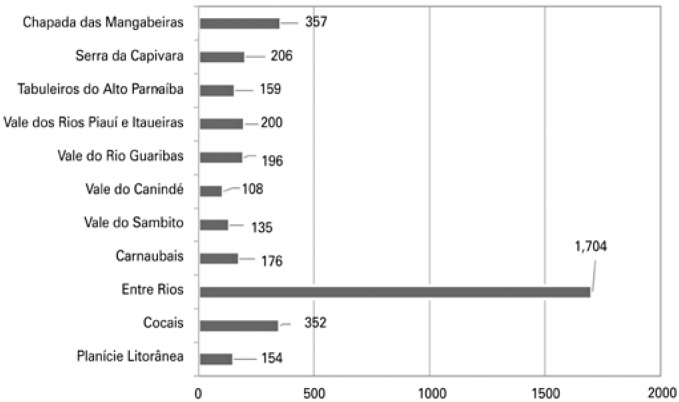
A total of 69,180 samples of newborns were analyzed, and 3,747 were diagnosed as hemoglobinopathies, from February 1st, 2014 and December 31st, 2015. Sickle cell trait was the most frequent (4.1%), followed by hemoglobinopathy C in 0.9%; homozygous hemoglobin S cases 0.1% stood out and there were no cases of hemoglobinopathy D in the state. It is also worth noting that the highest frequencies of hemoglobin alterations in Piauí were in males (49.8%) and of parda skin color (38.5%). The region of Piauí presenting the highest incidence of heteroygous variant hemoglobins was Tabuleiros do Alto Parnaíba and Vale do Sambito, due to importance of the region's population Entre Rios.
Neonatal screening programs are important for screening, orientations regarding health actions and monitoring of families with hemoglobinopathies, in order to reduce morbidity and mortality rates.
评估不同健康区域中变异血红蛋白的发生率。
采用描述性、观察性和横断面研究方法,基于皮奥伊州公共卫生中央实验室(巴西皮奥伊州)新生儿筛查服务内部记录中的二手数据进行定量研究。分析了与性别、种族以及变异血红蛋白阳性诊断相关的变量,并进一步分析了该州各大区域血红蛋白病的人群分布情况。
在2014年2月1日至2015年12月31日期间,共分析了69180份新生儿样本,其中3747例被诊断为血红蛋白病。镰状细胞性状最为常见(4.1%),其次是血红蛋白病C,占0.9%;纯合血红蛋白S病例占0.1%,该州无血红蛋白病D病例。还值得注意的是,皮奥伊州血红蛋白改变发生率最高的是男性(49.8%)和棕色皮肤人群(38.5%)。由于恩特雷里奥斯地区人口的重要性,皮奥伊州异源变异血红蛋白发生率最高的地区是上帕拉伊巴河平原和桑比托河谷地区。
新生儿筛查项目对于筛查、提供健康行动指导以及监测血红蛋白病家庭非常重要,以降低发病率和死亡率。